Free The Primary and Secondary Immune Response OCR A Level Biology revision notes – covering specification point 4.1.1(g).
Want to go deeper?
The Primary and Secondary Immune Response
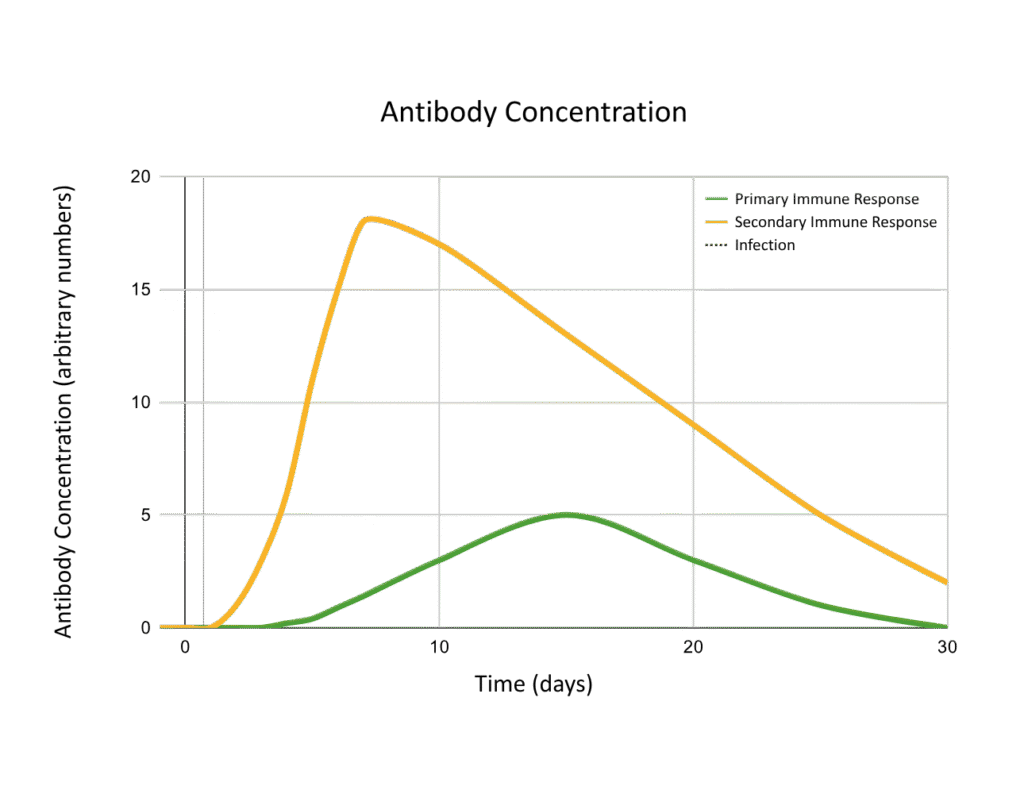
The first exposure to a pathogen is called the primary response, and subsequent exposures are known as a secondary response:
- Primary response: Characterised by a delay in, slower rate of, and lower overall total concentration of antibody production.
- Secondary response: Characterised by a rapid, high rate of, and higher overall total concentration of antibody production.
Exposure to a pathogen, or its antigens, could be from infection or vaccination.
Memory cells are produced by T killer cells and plasma cells, allowing new T killer and plasma cells to be produced faster upon reexposure.
The graph below visualises the difference between the primary and secondary response: