
Free The Light-Dependent Reactions OCR A Level Biology revision notes – covering specification points 5.2.1 (ci) and 5.2.1 (d).
Want to go deeper?
The light-dependent reactions convert light energy into chemical energy in the form of ATP and reduced NADP in a process known as photophosphorylation.
There are two types of photophosphorylation: non-cyclic and cyclic.
Both pathways depend on the structural arrangement of photosystems, electron carriers and ATP synthase in the thylakoid membrane.
Photosystems
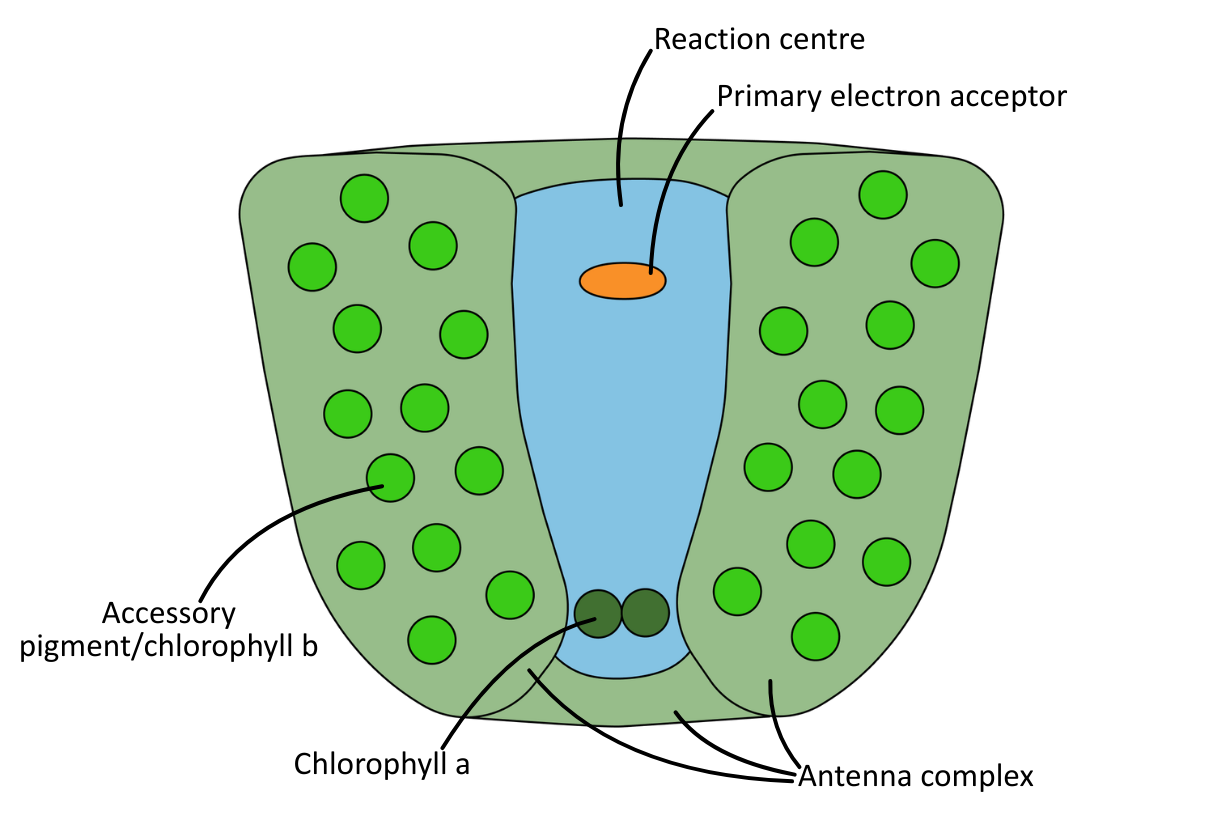
Photosystems consist of an antenna complex and a reaction centre:
- The antenna complex contains many chlorophyll b and accessory pigments that absorb light energy and transfer it towards the reaction centre.
- The reaction centre contains a pair of chlorophyll a molecules and a primary electron acceptor that uses harvested light energy to excite an electron to a higher energy level for use in non-cyclic photophosphorylation.
The diagram below shows the generic structure of a photosystem:
There are two types of photosystems, distinguished by the type of chlorophyll a in their reaction centre:
- Photosystem II (PSII) has a chlorophyll a molecule absorbing light around 680nm.
- Photosystem I (PSI) has a chlorophyll a molecule absorbing light around 700nm.
It is useful to know that PSII is located at the start of the ETC (instead of in second place), simply because it was discovered after PSI.
The Electron Transport Chain
The electron transport chain (ETC) is a series of electron carriers embedded in the thylakoid membrane, located between PSII and PSI.
The carriers accept and donate electrons, which releases energy that is used to actively transport H+ (protons) into the thylakoid lumen from the stroma, generating an electrochemical gradient.
The diagram below shows the structure of the electron transport chain:
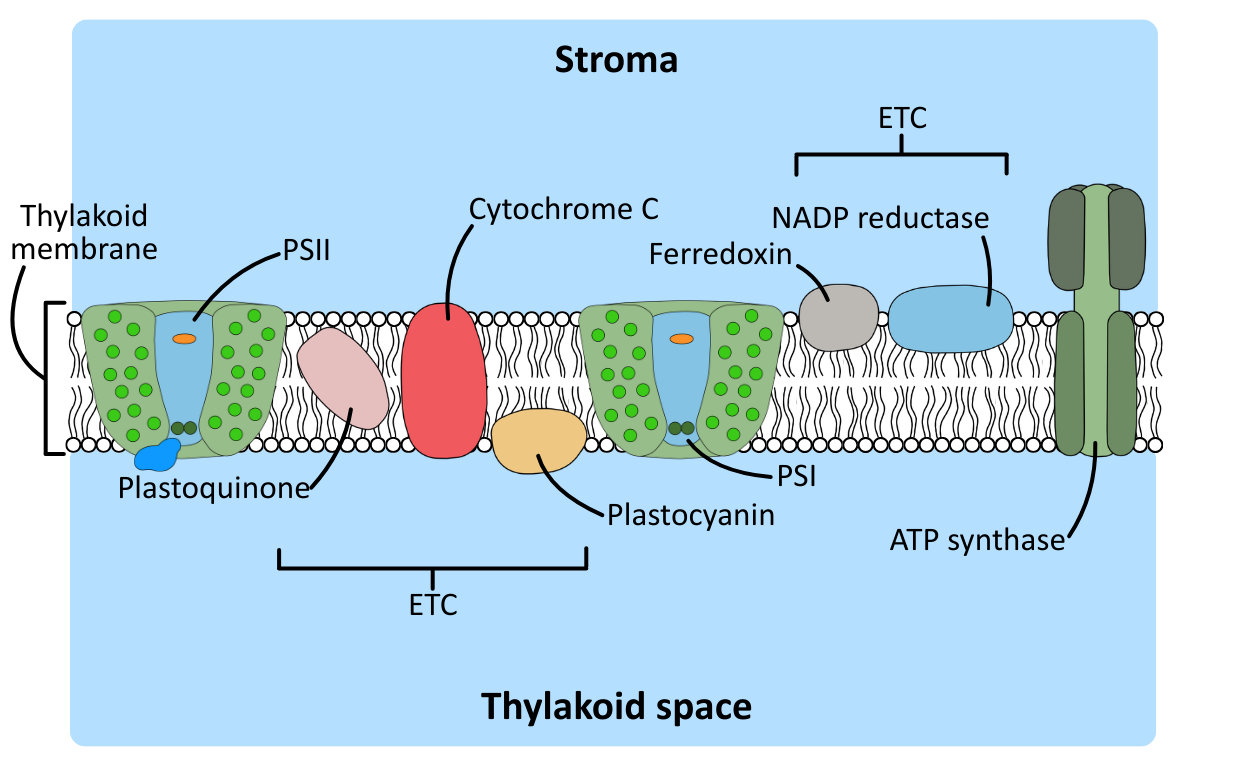
The electrochemical gradient between the thylakoid lumen and the stroma causes H+ to diffuse down their electrochemical gradient* through ATP synthase (a channel protein associated with an enzyme), which makes ATP. This process is known as chemiosmosis.
Non-cyclic Photophosphorylation
Non-cyclic photophosphorylation relies on the transfer of electrons from water to NADP.
As the electrons move along the ETC, they release energy harvested from photons for use in setting up a H+ concentration gradient for making ATP in chemiosmosis.
The process can be summarised as:
- Light energy absorbed by the antenna complex in PSII is used to excite an electron to a higher energy state.
- The electron is transferred along the electron carriers in the ETC, releasing energy for active transport, before arriving at PSI.
- H+ are pumped into the thylakoid space, creating a concentration gradient between the thylakoid space and the stroma.
- Light is absorbed by PSI and re-excites electrons to a higher energy state in P700, being is transferred to ferredoxin, and then NADP reductase, which uses 2 e– and 2 H+ to make reduced NADP.
- H+ diffuse out of the thylakoid space via ATP synthase, which uses Pi to phosphorylate ADP into ATP.
- Photolysis splits water into oxygen, 2H+, and an e– that replaces the one lost from PSII.
Cyclic Photophosphorylation
Cyclic photophosphorylation releases some additional energy for the active transport of H+ to produce ATP in chemiosmosis, but does not ‘lose’ electrons to NADP.
The process can be summarised as:
- Light energy is absorbed by accessory pigments in PSI and transferred to P700 in the reaction centre.
- An electron in P700 is excited to a higher energy state and transferred to the electron transport chain.
- Energy released from electron transfer is used for the active transport of H⁺ into the thylakoid space, creating an electrochemical gradient.
- The electrons return to PSI to replace those lost from P700.