The complete Year 13 OCR A Level Biology textbook in one place ⚡
Year 13 Textbook includes all the topics across Modules 5 and 6 – specification-aligned and ready to use from day one.
What’s included
141
Textbook topics
Exam-style
Answers
Labelled
Diagrams
Summary
Tables
Inside the textbook
Full Year 13 textbook – comprehensive coverage from nerves, hormones and homeostasis to photosynthesis, respiration, genetics and ecosystems. Clear explanations, summary tables and visuals with spec reminders throughout.
Why choose Year 13 Textbook?
- Complete Year 13 textbook coverage in one purchase
- Specification-aligned and updated when the spec changes
- Clear explanations, summary tables and visuals
- One-off payment, no subscription
Format
Web-based resources. Mobile/desktop friendly. Full access for 2 years, updates included.
Topics covered
Module 5: Communication, Homeostasis and Energy (75 topics)
- The Need for Communication Systems
- Introduction to Communication Systems
- Homeostasis and Feedback Systems
- Thermoregulation: Ectothermy and Endothermy
- The Importance of Excretion
- Functions of the Liver
- Liver Anatomy and Histology
- Interpreting Photomicrographs of the Liver
- Kidney Anatomy and Histology
- Kidney Nephrons: Filtering the Blood
- Osmoregulation: The Collecting Duct and ADH
- Interpreting Photomicrographs of the Kidney
- Kidney Failure
- Urine Analysis
- Introduction to the Nervous System
- Principles of Neuronal Communication
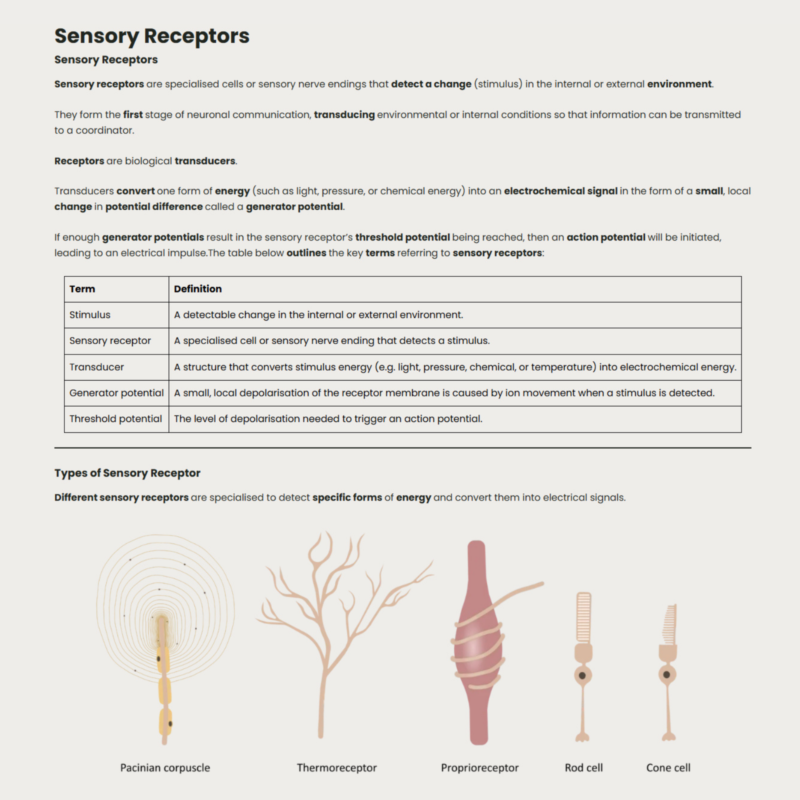
- Sensory Receptors
- Neurones
- Nerve Impulses
- Myelinated and Unmyelinated Neurones
- Introduction to Synapses
- Synaptic Action
- Introduction to the Endocrine System
- Principles of Hormonal Communication
- Hormones: Types and Mechanisms
- Adrenal Glands
- Pancreas Anatomy and Histology
- Control of Blood Glucose
- Diabetes Mellitus
- Treating Diabetes
- Introduction to Plant Responses
- Types of Plant Responses
- Plant Responses to Herbivory
- Principles of Plant Coordination
- The Roles of Plant Hormones
- Hormonal Control of Shoot and Root Elongation
- Hormonal Control of Stem Elongation
- Hormonal Control of Seed Germination
- Hormonal Control of Apical Dominance
- Hormonal Control of Leaf Loss
- Hormonal Control of Stress Responses
- Commercial Uses of Plant Hormones
- Communication Systems in Animals
- The Mammalian Nervous System
- The Central Nervous System
- The Peripheral Nervous System
- Reflexes
- Controlling Heart Rate
- The Fight or Flight Response
- Mammalian Muscle Structure
- Neuronal Control of Striated Muscle
- Myofibrils and the Sliding Filament Theory
- How Muscles Contract
- Importance of ATP in Muscle Contraction
- Photosynthesis and Chloroplasts
- Photosystems and the Electron Transport Chain
- The Light-Dependent Reactions
- The Light-Independent Reactions
- Uses of Triose Phosphate
- Photosynthetic Pigments in Plants
- Factors Affecting the Rate of Photosynthesis
- Thin-Layer Chromatography of Plant Pigments
- Introduction to Respiration
- Mitochondria Structures and Functions
- Glycolysis
- The Link Reaction
- The Krebs Cycle
- The Importance of Coenzymes in Cellular Respiration
- Oxidative Phosphorylation and Chemiosmosis
- Anaerobic Respiration
- Respiratory Substrates
- Respiratory Quotient
- The Interrelationship between Photosynthesis and Respiration
- Factors Affecting the Rate of Respiration
- Investigating the Rate of Respiration
Module 6: Genetics, Evolution and Ecosystems (66 topics)
- Cellular Control
- The Lac Operon
- Controlling the Cell Cycle
- Control of Body Plans
- Gene Mutations
- Introduction to Phenotypic Variation
- Generating Genetic Variation
- Interactions between Genes and the Environment
- Continuous and Discontinuous Variation
- Introduction to Genetic Inheritance
- Principles of Mendelian Inheritance
- Genetic Diagrams and Punnett Squares
- Monohybrid and Dihybrid Crosses
- Multiple Alleles
- Codominance
- Autosomal Linkage
- Sex Linkage
- Epistasis
- Modified Phenotypic Ratios
- Chi-squared Test
- Evolution and Natural Selection
- Speciation
- Geographical and Reproductive Isolation
- Hardy-Weinberg
- Artificial Selection
- Disadvantages of Artificial Selection
- DNA Sequencing
- The Polymerase Chain Reaction
- Electrophoresis
- DNA Profiling
- Uses of DNA Profiling
- Bioinformatics and Computational Biology
- Genetic Modification
- Gene Therapy
- Ethical Issues in Genetic Manipulation
- Introduction to Clones
- Natural Cloning in Plants
- Artificial Cloning of Plants
- Natural and Artificial Cloning in Animals
- Introduction to Biotechnology
- Culturing Microorganisms
- Standard Growth Curve
- Calculating Microorganism Population Growth
- Batch and Continuous Fermentation
- Factors Affecting the Growth of Microorganisms
- Introduction to Immobilised Enzymes
- Immobilising Enzymes
- Ecosystems
- Biomass Transfers
- Food Chains and Food Webs
- Manipulating Biomass Transfers
- Recycling in Ecosystems
- The Carbon Cycle
- The Nitrogen Cycle
- Succession
- Introduction to Sampling Methods
- Measuring Abundance
- Measuring Distribution
- Populations and Limiting Factors
- Population Growth and Carrying Capacity
- Interactions between Populations
- Predator-Prey Relationships
- Conservation and Preservation
- Managing Ecosystems and Resources
- Sustainable Management of Ecosystems for Timber
- Sustainable Management of Ecosystems for Fish
Need Year 12 too?
Year 12 & 13 Textbook gives you both years in one purchase – every topic across Modules 2 to 6.