Free Thermoregulation: Ectothermy and Endothermy revision notes for OCR A Level Biology – covering specification point 5.1.1 (d).
Thermoregulation
Thermoregulation is the maintenance of a stable internal body temperature, despite changes in the external environment, around an optimal set point.
Organisms have evolved different ways to regulate their internal body temperature, each with advantages and disadvantages, making them well adapted to their ecological niche. Broadly, they are classified as either ectotherms or endotherms, depending on their main source of heat.
- Ectothermy: Regulation of body temperature using external heat sources.
- Endothermy: Regulation of body temperature using internal metabolic heat.
Ectotherms are organisms that use ectothermy, such as reptiles, amphibians and fish; their body temperature changes with the environment’s temperature.
Endotherms are organisms that use endothermy, such as mammals and birds; their body temperature remains stable.
Ectotherms
Ectotherms depend largely on behavioural mechanisms to control their body temperature.
The table below outlines some examples of ectotherms and their adaptations:
| Organism | Adaptation | Effect |
|---|---|---|
| Crocodile |
|
|
| Lizard | Uses burrows. | Burrow cooler in the day, warmer at night. |
| Locust |
|
|
Endotherms
Endotherms can maintain their body temperature above that of the environment due to more heat being released by metabolic reactions (exergonic) than being taken in (endergonic).
Endotherms use both physiological and behavioural mechanisms to maintain their body temperature around a set point.
Behavioural responses in endotherms are similar to those seen in ectotherms.
Physiological responses require communication systems to monitor stimuli and coordinate effectors. Consequently, their mechanism of action is that of a negative feedback process.
The hypothalamus measures inputs on temperature changes in the internal and external temperature from the receptors, and coordinates the response by signalling effectors.
The effectors which are signalled by the hypothalamus vary depending on the condition:
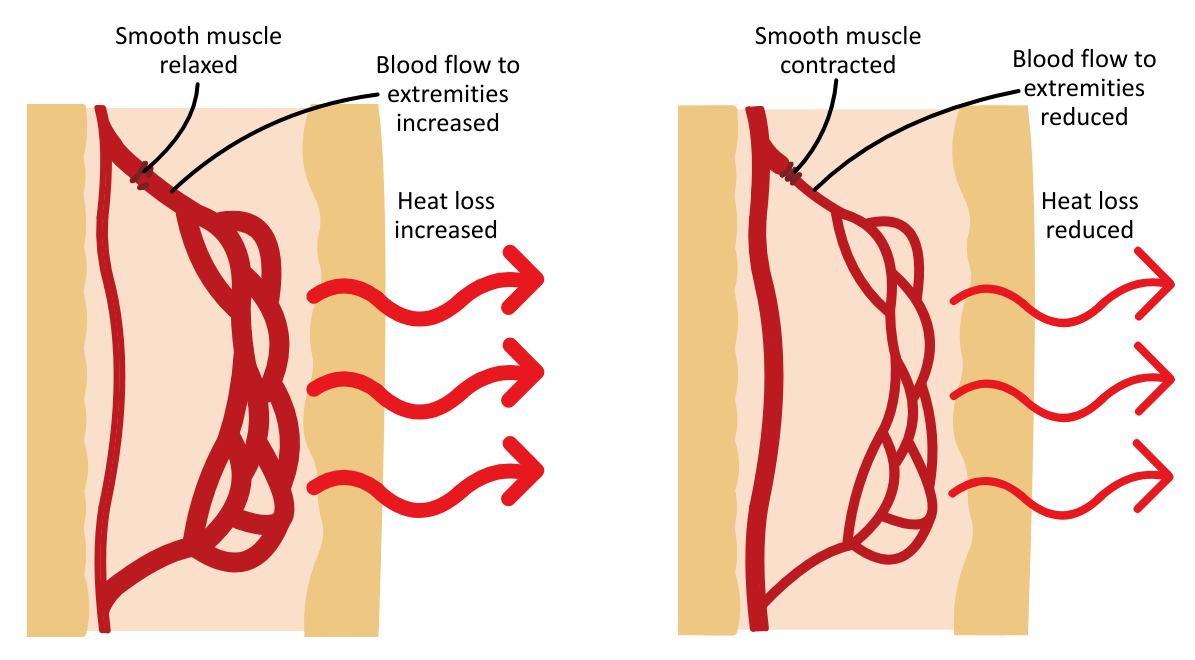
- If too hot: Arterioles dilate, sweat glands activate, hair erector muscles relax, and skeletal muscles relax.
- If too cold: Arterioles constrict, sweat glands are inactive, hair erector muscles contract, skeletal muscles contract (shivering), respiration rate of liver increases, and the adrenal medulla and thyroid gland secrete metabolism-raising hormones.
The diagram below illustrates the dilation and constriction of arterioles to control the release or retention of heat during vasodilation and vasoconstriction: