Free The Light-Independent Reactions OCR A Level Biology revision notes – covering specification points 5.2.1 (e) and 5.2.1 (f).
Want to go deeper?
The light-independent reactions (also known as the Calvin Cycle) occur in the stroma of the chloroplast.
The Calvin cycle is a cyclical series of enzyme-controlled reactions that use ATP and reduced NADP from the light-dependent reactions to fix carbon dioxide.
The fixation of carbon dioxide produces triose phosphate (TP), a 3-carbon molecule, which can be used to produce larger and more complex organic molecules (e.g. glucose, amino acids, lipids).
2 TP (3C) molecules are required to make 1 glucose (a 6C molecule), combining after the Calvin cycle.
The production of 2 TP molecules, needed to produce 1 glucose molecule, requires the Calvin cycle to turn 6 times.
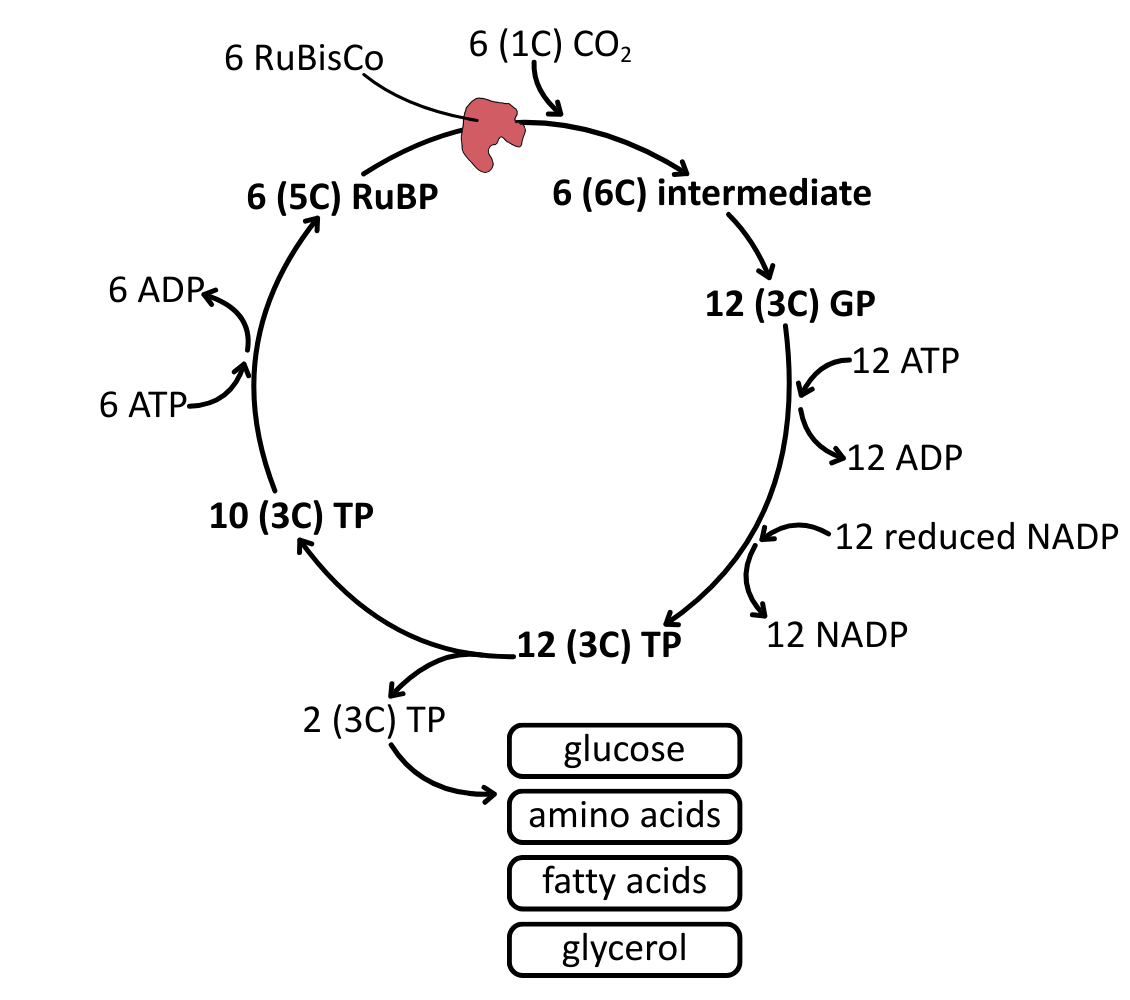
The process of 6 CO2 being used to produce 2 TP for a whole glucose molecule (6 turns of the Calvin cycle) can be summarised as:
- RuBisCO catalyses the reaction of 6 RuBP and 6 CO₂ in the stroma to form 6 unstable intermediate 6 carbon compounds.
- The 6 intermediate 6C compounds break down to form 2 3C GP molecules each (12 GPs in total).
- 12 GPs are reduced using 1 ATP, and 1 reduced NADP each, producing 12 TPs (using 12 ATP and 12 reduced NADP in total).
- 10 TP molecules are used to regenerate 6 RuBPs using 6 ATPs.
- 2 TPs leave the Calvin cycle to be used in the formation of glucose, amino acids, fatty acids or glycerol.
The diagram below outlines the roles of the substances used in 6 turns of the Calvin cycle: