
Free Succession OCR A Level Biology revision notes – covering specification point 6.3.1(d).
Succession is defined as the gradual change in a community of organisms over time.
Succession (typically) follows similar patterns of change over time, although the species involved and the climax community vary between habitats.
The process of succession can be simplified into the following stages:
- Pioneer species colonise a bare or disturbed surface.
- Soil begins to form from the weathering of rocks by pioneer species and the decomposition of their dead biomass after they die.
- The soil becomes deeper and retains more water and nutrients, making the habitat less hostile.
- Plants colonise the habitat, outcompeting the pioneer species for resources such as light, water and mineral ions.
- Successive generations of organisms develop the soil as decomposers break down dead biomass and release nutrients.
- The community gradually becomes larger with more biomass, biodiversity, and larger food webs, as earlier species are outcompeted by newer species.
- A stable climax community is reached, in which the community is in dynamic equilibrium with its environment.
The diagram below shows the typical stages of succession, from a bare or disturbed surface to a climax woodland:
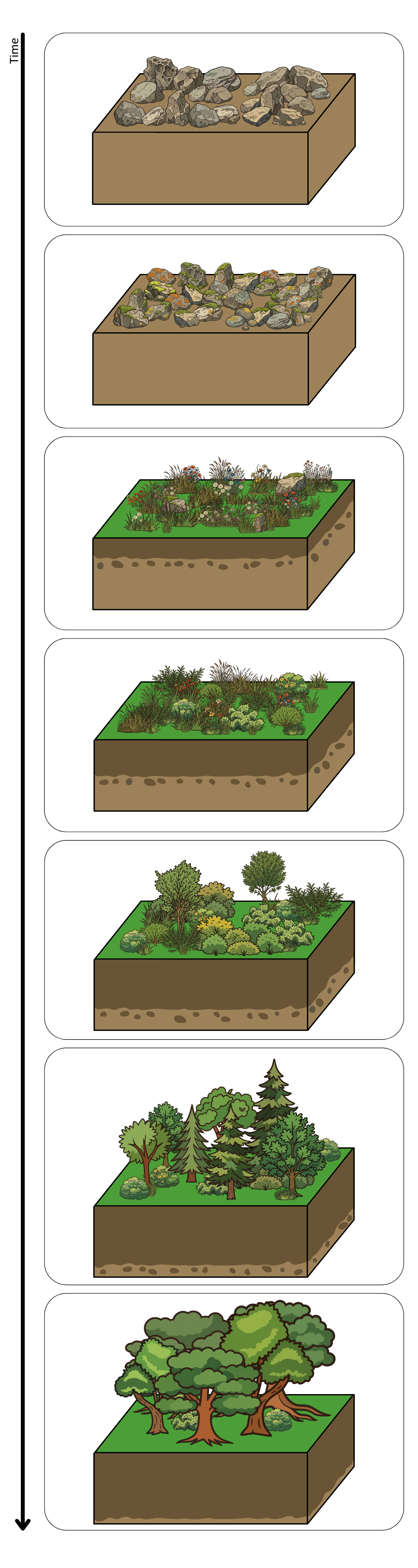
It is important to note that the animal community also undergoes succession, as the changing plant community creates new niches, eliminates old ones, and can support a food web with greater biomass.
Primary and Secondary Succession
Succession is categorised as either primary or secondary:
- Primary succession occurs when a newly exposed surface, lacking soil, is colonised.
- Secondary succession is when land that has already been colonised is disturbed (e.g. a fire or a flood), but the soil remains.
You are only expected to know about primary succession.
Primary Succession
Primary succession occurs where there is no soil, which makes the environmental conditions very harsh, such as little water, nutrients, and extremes of temperature.
Deflected Succession
Succession is sometimes stopped before it reaches the climax community stage.
Deflected succession is when the process of succession is interrupted at a particular stage by a disturbance which maintains an intermediate community.
Deflected succession can occur as a result of abiotic or biotic factors:
- Abiotic factors, such as drought, fire, and flooding, prevent species involved in the later stages of succession from colonising the habitat, allowing the intermediate community to dominate.
- Biotic factors, such as herbivore grazing and trampling, only allow certain species to persist, maintaining the community at an intermediate stage of succession.