
Free Populations and Limiting Factors OCR A Level Biology revision notes – covering specification point 6.3.2(a).
Population size is the number of individuals of a species present in a habitat.
The size of a population is determined by the environment’s carrying capacity and the species’ rate of population growth:
- Carrying capacity is the maximum number of individuals that a habitat can support.
- Population growth is the rate at which the number of individuals changes over time.
Population growth and an environment’s carrying capacity are determined by limiting factors in the environment.
Limiting Factors
Limiting factors lower the rate of reproduction (and growth rate) and raise the mortality rate (which lowers the carrying capacity).
Limiting factors affect the rate of population growth by:
- Decreasing reproduction: If there are limited resources, then organisms will be less likely to mate and produce live offspring.
- Increasing mortality: If there are limited resources, then organisms will be less likely to compete successfully and survive.
- Decreasing immigration: If a habitat has limited resources, then organisms will be less likely to travel to, and remain, in an area.
- Increasing emigration: If a habitat has limited resources, then organisms will be more likely to disperse to other habitats.
The table below outlines some examples of abiotic factors that can limit population size:
| Abiotic factor | Effect on Population |
|---|---|
| Light intensity | Low light intensity reduces photosynthesis, limiting the biomass produced by producers and the food available to consumers. |
| Oxygen availability | Low oxygen availability restricts aerobic respiration. |
| Soil composition and mineral ions | A shortage of mineral ions limits the biomass producers can make. |
| Water availability | Lack of water reduces metabolic function. |
The table below outlines some examples of biotic factors that can limit population size:
| Biotic factor | Effect on population |
|---|---|
| Accumulation of waste | Toxic waste products accumulate faster than decomposers break them down, causing harm and disrupting metabolic function. |
| Disease | Pathogens increase the death rate. |
| Food availability | The biomass at the trophic level below limits the number of consumers. |
| Predation | Predators raise the death rate of the prey population. |
The graph below shows the carrying capacity of a woodland ecosystem during the summer and winter:
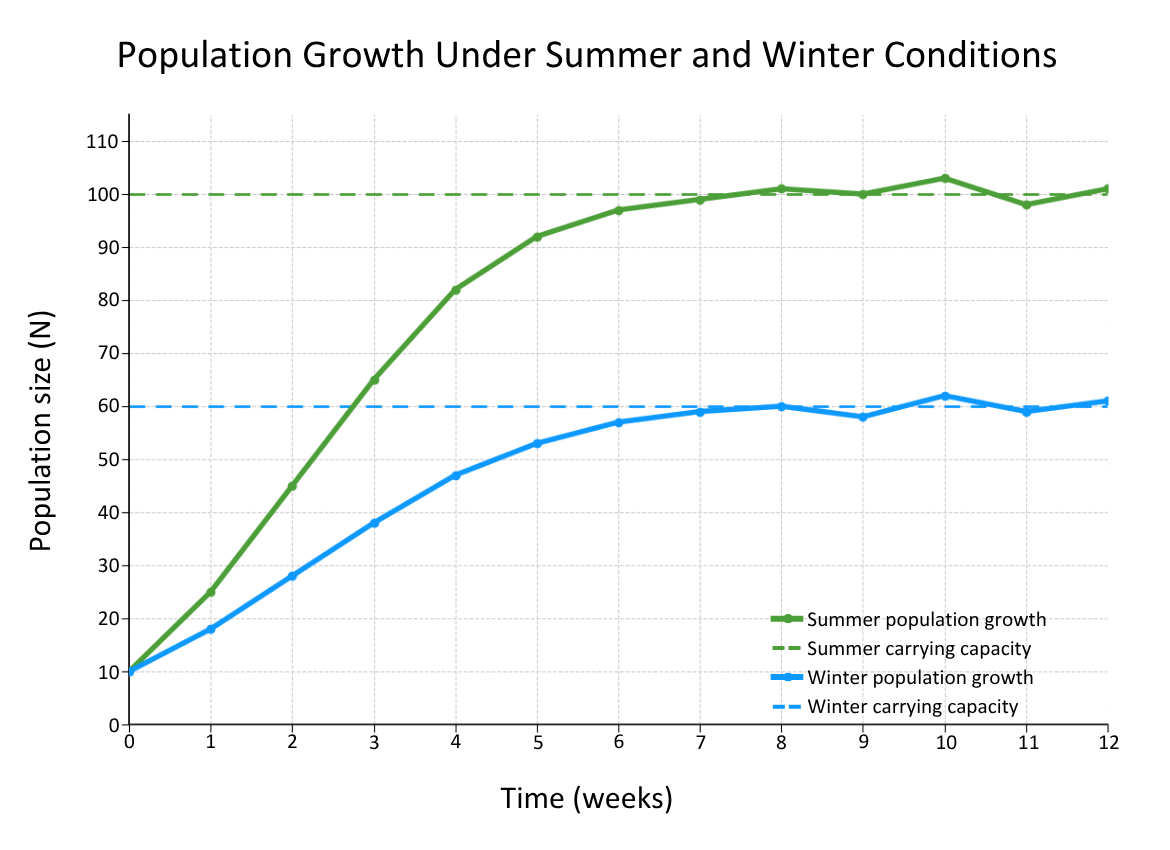
The graph above shows how the lower temperatures and light intensity during winter lower the carrying capacity of the environment.