Free Plant Transport of Water revision notes for OCR A Level Biology – covering specification points 3.1.3(c.i) and 3.1.3(d).
lant Transport of Water
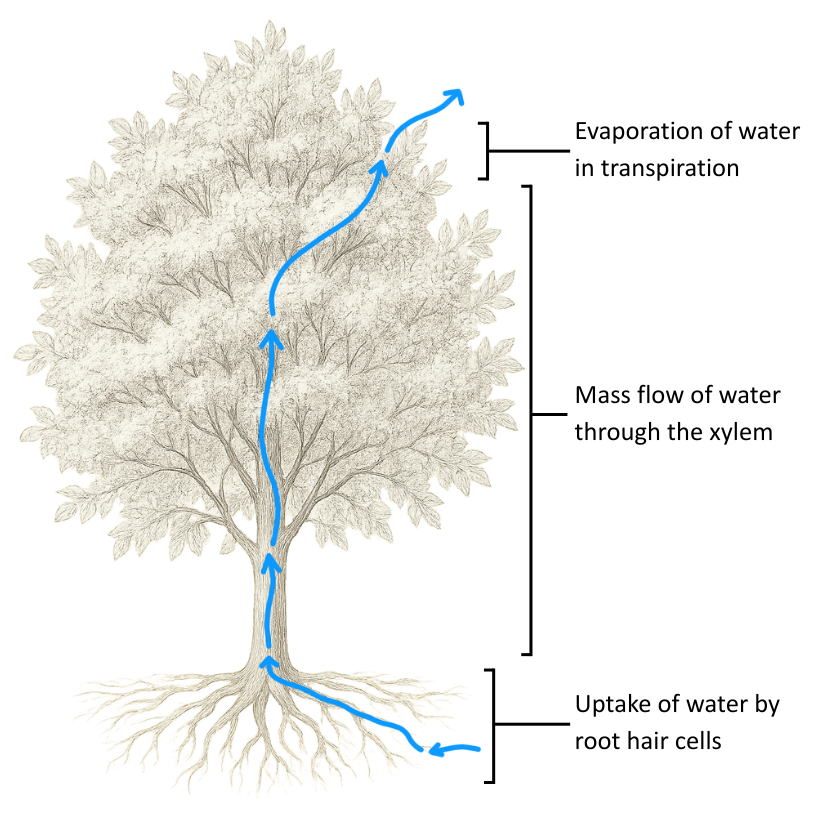
The transpiration stream is a continuous column of water that moves upwards through the plant from the roots to the leaves:
The Transpiration Stream
The table below provides an overview of the transpiration stream:
| Location | Process | Driving Force |
|---|---|---|
| Soil → root hairs | Osmosis | Water potential gradient |
| Root cortex → xylem |
Apoplast (diffusion) Symplast (osmosis) Vacuolar (osmosis) |
Water potential gradient Hydrostatic pressure |
| Xylem | Cohesion–tension mechanism | Transpiration pull from the leaf |
| Leaf → atmosphere | Evaporation and diffusion via stomata | Water potential gradient and stomatal opening |
Processes
The table below provides an overview of the key processes involved in the transpiration stream:
| Process | Description |
|---|---|
| Evaporation | Water evaporates from the cellulose cell walls of mesophyll cells into leaf air spaces. |
| Diffusion | Water vapour diffuses out through open stomata, down a water vapour potential gradient. |
| Cohesion–Tension | A decrease in pressure caused by the loss of water molecules creates tension between hydrogen-bonded water molecules that pull more water into the mesophyll from, and up, the xylem (transpiration pull). |
| Adhesion | Hydrogen bonding between the water column and the xylem walls helps water move upwards against gravity. |
| Root pressure | The active transport of mineral ions into the medulla and xylem draws in water by osmosis, increasing water pressure that pushes the water column up the xylem. |
Transpiration
Transpiration is the evaporation of water from the stomata.
- Water moves by osmosis into the spongy mesophyll from the xylem (through cellulose cell walls) or via the apoplast pathway.
- Some may be used for photosynthesis or maintaining cell turgidity.
- Unused water evaporates into the air spaces.
- Water vapour builds up in the air spaces, creating a high water vapour potential.
- Water vapour diffuses towards the stomata, where there is a lower water vapour potential.
- Water vapour moves out of the air spaces via the stomata, lowering the water vapour potential just inside the leaf.
Factors Affecting Transpiration Rate
The following environmental factors affect the rate of transpiration:
| Factor | Factor change that increases transpiration | Mechanism |
|---|---|---|
| Light intensity | Increase | Opens stomata, increasing diffusion. |
| Temperature | Increase | Faster evaporation and diffusion. |
| Humidity | Decrease | Increases the water vapour potential gradient. |
| Air movement | Increase | Increases the water vapour potential gradient. |
| Leaf surface area | Increase | More surface area for more stomata. |
The Importance of Transpiration
Some key examples of why transpiration is important are that it:
- Maintains water movement through the xylem (it enables the transpiration stream).
- Transports mineral ions to growing tissues.
- Enables leaf turgor for mechanical support.
- Cools the plant via the latent heat of evaporation.
Mass Flow
Mass flow is the upward movement of water and dissolved mineral ions through the xylem.
Whilst the water column is pulled upwards by transpiration pull, which is assisted by adhesion, upwards pressure from the root also contributes to this movement.
Root Pressure
Water enters the root through root hair cells, which have a low water potential due to dissolved mineral ions, so water enters down a water potential gradient from the soil by osmosis.
Water travels through the cortex to the endodermis via three possible pathways:
- Apoplast: Through the cell wall.
- Symplast: Through cytoplasm via plasmodesmata.
- Vacuolar: Through vacuoles.
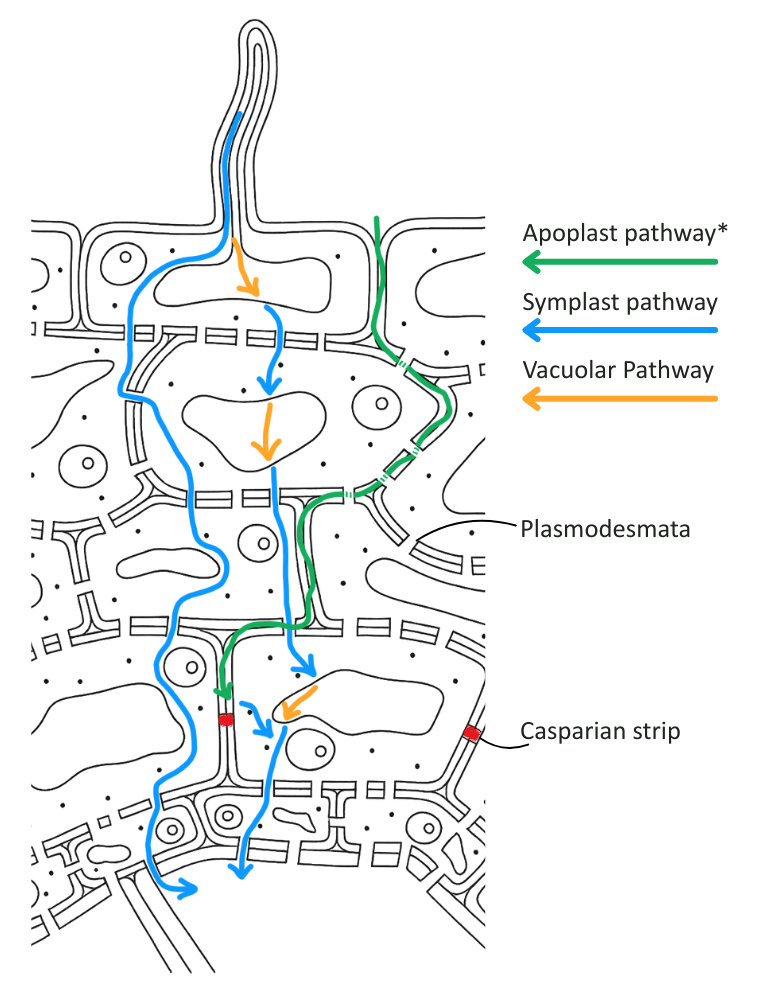
At the endodermis, the Casparian strip blocks the apoplast route, so water is forced into the symplast pathway. This ensures that it enters the xylem.
Mineral ions are actively transported into the medulla and xylem, lowering the water potential there. Water moves down its water potential gradient by osmosis into the xylem, increasing the root pressure, which pushes water up into the xylem.
This pressure helps move water up the plant.