
Free Organisation in Plants OCR A Level Biology revision notes – covering specification points 2.1.6(h), 2.1.6(i) and 2.1.6(l).
Want to go deeper?
Differentiated and Specialised Plant Cells
In plants, cells become specialised to perform specific roles more effectively.
These differentiated cells work together to form tissues, organs, and organ systems.
Specialised Cells
Meristem cells (plant stem cells) differentiate into specialised cells.
They are found in the tips of plant shoots, roots and in a ring in the cambium; this allows the plant to grow longer and wider.
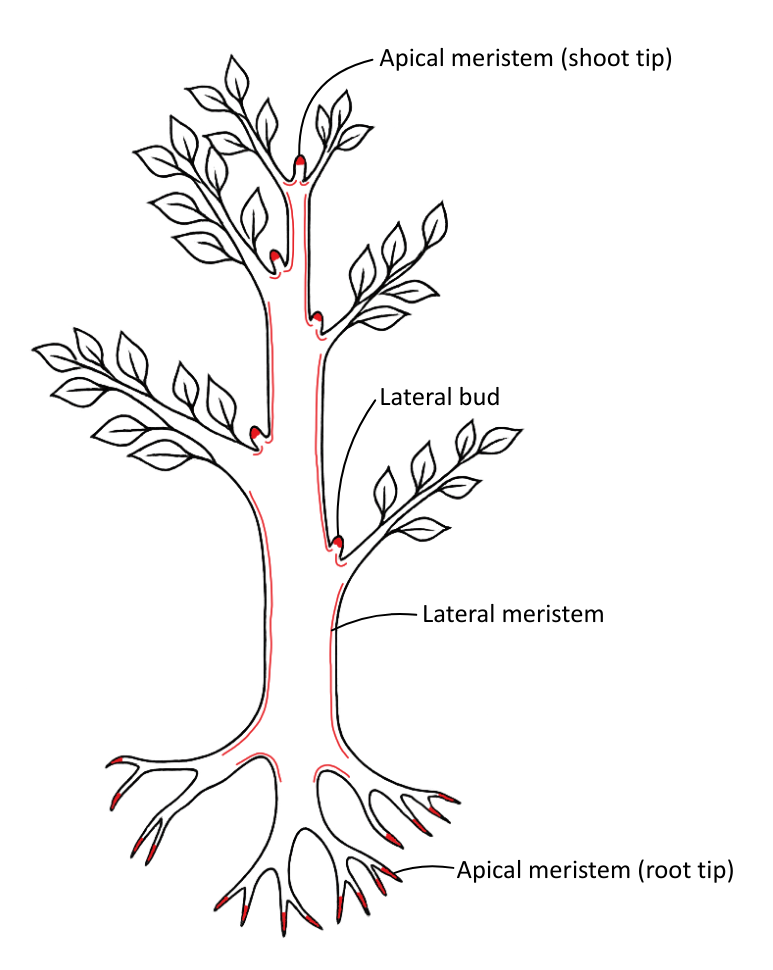
Specialised cells are metabolically and structurally adapted for their role, with unneeded genes switched off.
The table below provides an overview of the examples you need to know for OCR A level Biology:
| Cell Type | Function | Adaptations |
|---|---|---|
| Palisade Cells | Photosynthesis |
– Many chloroplasts – Large vacuole pushes chloroplasts to the edge for light maximisation – Cylinder shape allows for close packing in palisade mesophyll with space for CO2 diffusion |
| Root Hair Cells | Water and mineral ion absorption |
– Long projections increase the surface area – Mitochondria make ATP for active transport – Many carrier proteins for active transport – No chloroplasts (as there is no light) |
| Guard Cells | Control stomatal opening for gas exchange |
– Chloroplasts make ATP for the active transport of K+ (cannot do photosynthesis) – Can inflate and deflate vacuole – Uneven cellulose cell wall thickness causes the pore to open/close |
Plant Tissues
The table below outlines the most common plant tissues encountered in A level OCR biology:
| Tissue | Structure | Function |
|---|---|---|
| Xylem | Dead vessels with lignin | Transport of water and minerals |
| Phloem | Living sieve tubes with companion cells | Transport of sugars via mass flow |
| Meristematic | Small, undifferentiated stem cells | Divide to form other tissue types, enabling growth |
Xylem and phloem are examples of two different specialised cells which both arise from the same meristematic tissue in the cambium, forming vascular bundles.
The table below gives an overview of how they compare:
| Feature | Xylem | Phloem |
|---|---|---|
| Cell Type | Dead hollow tubes | Living sieve tubes (supported by companion cells) |
| Transported Substance | Water and mineral ions | Sucrose (and other solutes) |
| Differentiation Changes | Cell death, lignification | Sieve plates form, organelles are lost in sieve tubes |
| Mechanism | Capillary action: cohesion & adhesion | Mass flow: sucrose loading/unloading changes water potential/pressure |
Plant Organs
Plant tissues come together to form organs in plants.
Here are some of the most common plant organs encountered in OCR A level Biology:
| Organ | Function |
|---|---|
| Leaf |
– Photosynthesis – Gas exchange |
| Root |
– Water/mineral ion uptake – Anchorage – Starch storage |
| Stem |
– Supports leaves – Transport – Stores photosynthesis products (starch and/or sugars) |