Free Introduction to the Endocrine System revision notes for OCR A Level Biology – covering specification points 5.1.1 (a) and 5.1.4 (a).
The endocrine system is a long-lasting (compared to the neuronal system) communication network that coordinates the activity of organs and tissues using chemical messengers (hormones).
These chemical messengers are released from endocrine glands.
There are two main types of glands:
- Endocrine glands are ductless, releasing hormones into the bloodstream.
- Exocrine glands release non-hormonal secretions onto bodily surfaces or into lumens through ducts.
The diagram below shows the typical structure of endocrine and exocrine glands:
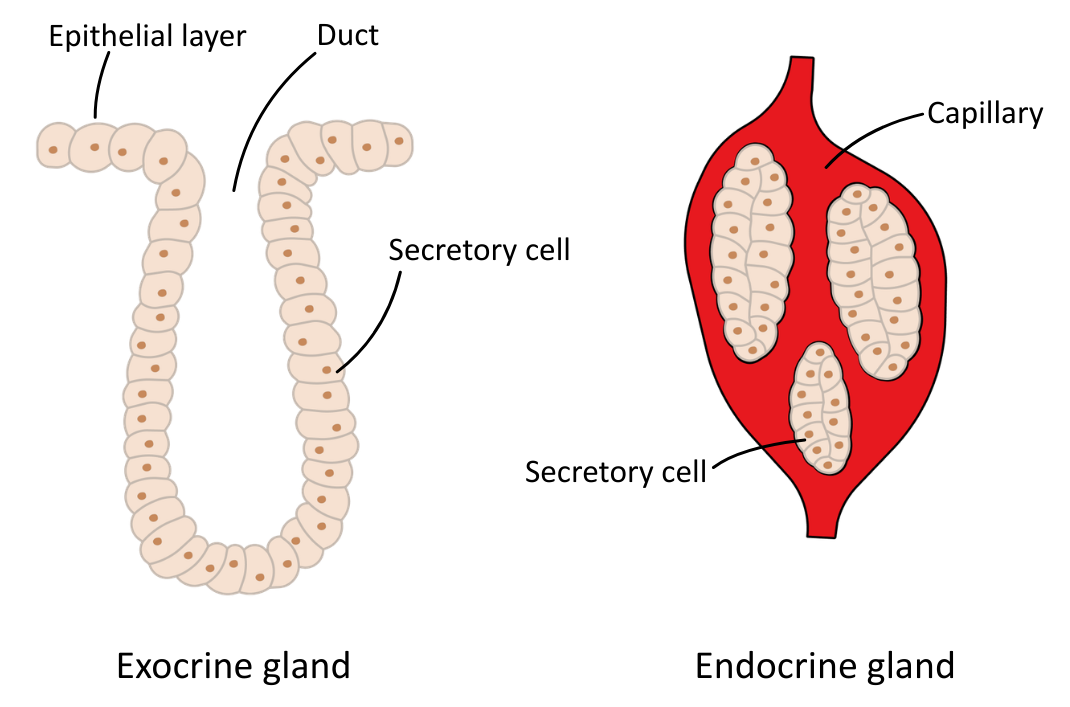
It is important to note that exocrine glands are not a part of hormonal communication.
The table below outlines some of the different endocrine glands and the role(s) of their secreted hormones:
| Endocrine Gland | Main Hormone(s) | Endocrine Gland Role(s) |
|---|---|---|
| Adrenal cortex (on kidneys) |
|
|
| Adrenal medulla (on kidneys) |
|
Triggers fight-or-flight responses:
|
| Pancreas (islets of Langerhans) |
|
|
Hormones are transported to target cells in the bloodstream.
A target cell (or tissue) is one that has a complementary receptor (usually on its cell surface membrane) for a specific hormone to bind to.
The diagram below shows how hormones act on specific target cells:
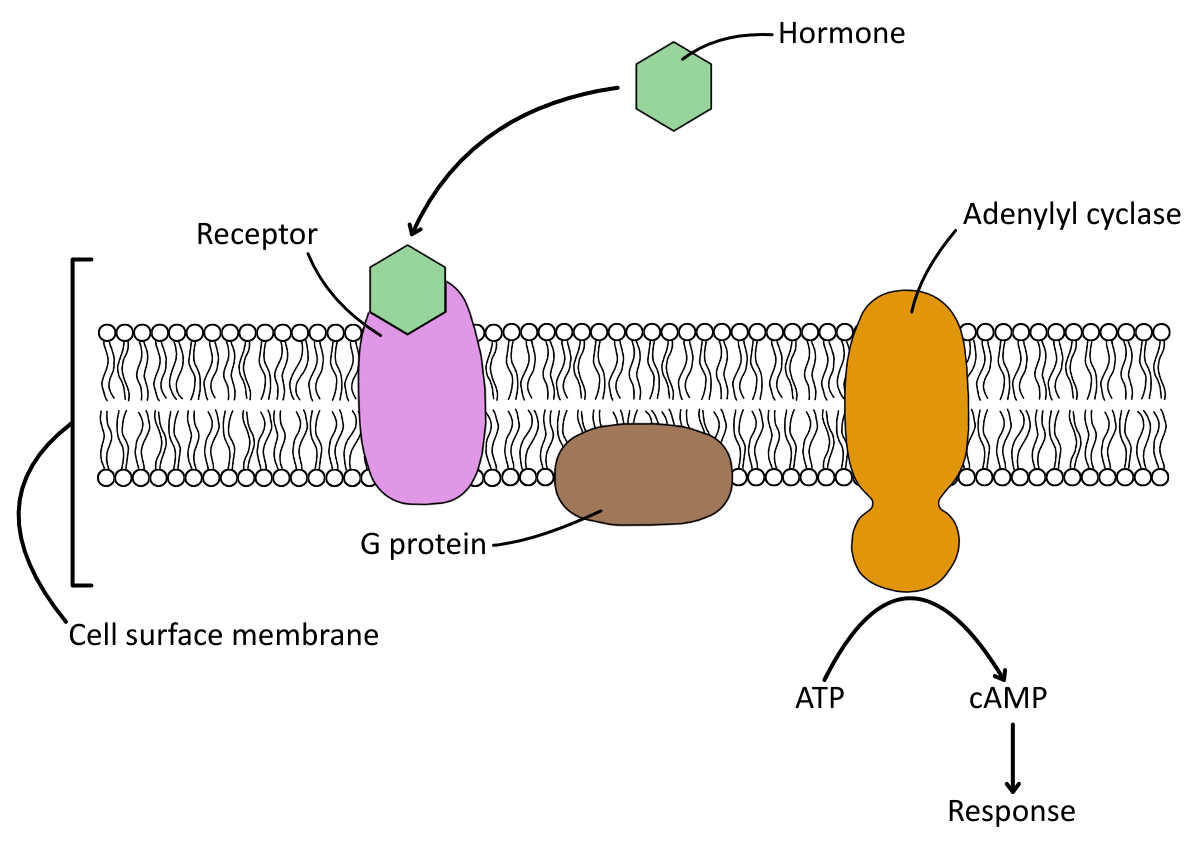
The three types of hormones are amino-acid derivatives, peptides/proteins, and steroids:
- Amino-acid derivatives are hydrophilic and water-soluble, typically binding to receptors on the cell surface membrane.
- Peptide/Protein hormones are hydrophilic and water-soluble, binding to receptors on the cell surface membrane.
- Steroid hormones are not water-soluble, but can cross the lipid bilayer of plasma membranes to bind to receptors inside the cell’s cytoplasm or nucleus.
Hormones: First Messengers and Second Messengers
All types of endocrine hormones travel to their target cells via the bloodstream to transmit information. What distinguishes them is whether they bind to external or internal receptors.
Steroidal hormones are able to pass through the lipid bilayer and bind directly to receptors inside the cytoplasm or nucleus.
Non-steroidal hormones (amino acids and peptide/protein hormones) are unable to do this, and instead bind to external receptors on the cell surface membrane.
First messengers are hormones, because they carry information directly to the target cells.
Second messengers are substances produced or activated in response to hormones binding to external receptors.
Adrenaline and cAMP are the named examples of a first and second messenger (respectively) in OCR A Level Biology.
The full overview of adrenaline’s mechanism of action is outlined below:
Adrenaline → binds to receptor → G protein activated → adenylyl cyclase activated → ATP converted to cAMP → cAMP activates PKA →
Enzymes phosphorylated by PKA → Enzymes carry out metabolic responses