
Free Introduction to Genetic Inheritance OCR A Level Biology revision notes – covering specification point 6.1.2(ai).
Principles of Genetic Inheritance
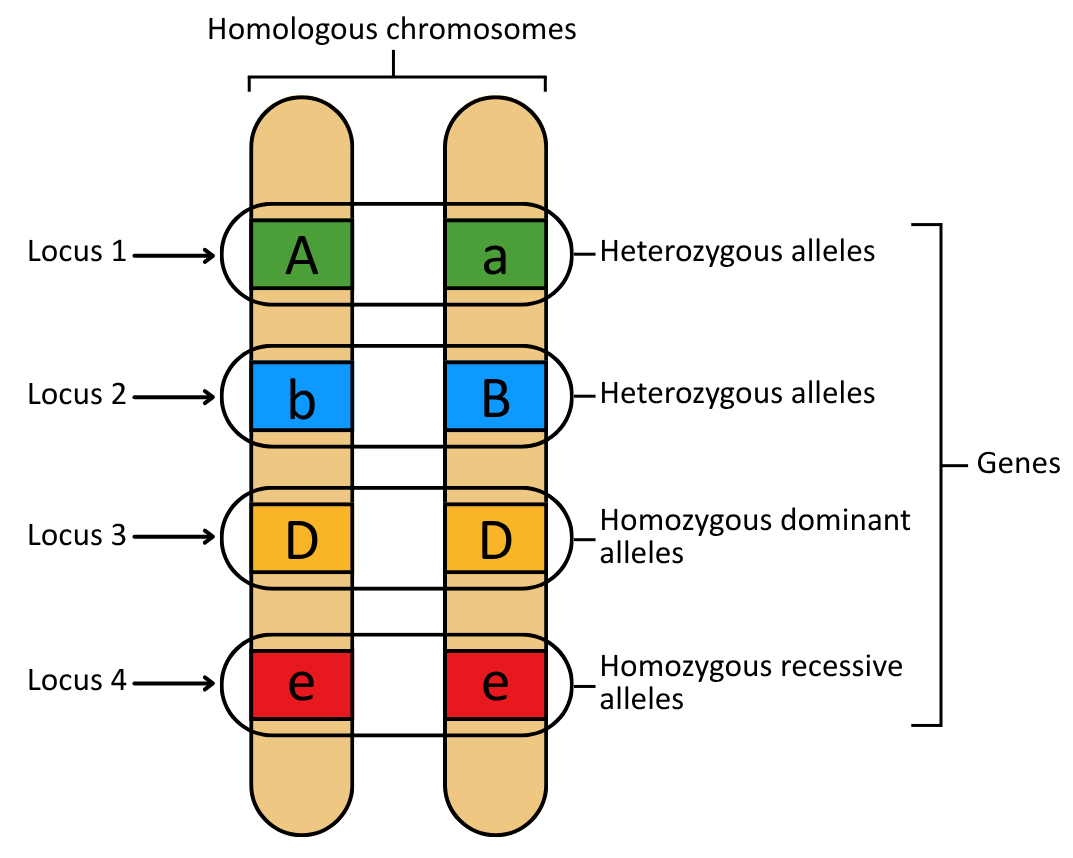
The inheritance of a genetic trait is dependent on the section of DNA that codes for it (the gene, or genes), the variants involved (alleles), and its position on the chromosome (the locus):
- Genes are the sections of DNA that code for proteins or RNA.
- Alleles are slightly different versions of a gene with slightly different base sequences, which code for different versions of the gene’s product.
- Loci* are the gene’s positions on the chromosomes.
*‘Loci’ is plural, ‘locus’ is singular.
The diagram below shows the relationship between genes, alleles and their loci:
Alleles: Genotypes and Phenotypes
Diploid organisms have two copies of each gene, but the two copies may not be identical.
Different versions of a gene are known as alleles.
The combination of alleles at each locus determines the characteristics of an organism.
An individual organism’s combination of alleles is called its genotype.
A genotype can be either homozygous or heterozygous:
- Homozygous genotypes have the same alleles at a particular gene locus on a pair of homologous chromosomes.
- Heterozygous genotypes have different alleles at a particular gene locus on a pair of homologous chromosomes.
The characteristics which a genotype gives rise to are known as the phenotype.
Phenotype is determined by the interaction between the two alleles* in an organism’s genome.
*As well as any other genes that may also interact with each other.
Alleles are typically categorised by their relationship with other alleles, in terms of being either dominant or recessive:
- A dominant allele is expressed over another allele.
- A recessive allele is only expressed when the individual is homozygous for it (e.g. aa).