Free Hormonal Control of Stem Elongation revision notes for OCR A Level Biology – covering specification points 5.1.5 (b), 5.1.5 (d) and 5.1.5 (e).
Elongation and growth responses depend on changes in cellulose cell wall extensibility (stretchiness) and the rate of cell division in specific tissues.
Gibberellins (GAs) are synthesised in young leaves and root tips, and transported in both the xylem and phloem to elongating tissues.
Gibberellins stimulate growth by increasing the rate of:
- cell elongation (through wall-loosening proteins)
- cell division (via activation of cell-cycle genes)
It is important to note that GA₁ (Gibberellin A1) is the main gibberellin controlling stem elongation in pea plants, and GA₃ (gibberellic acid*) is a fungal gibberellin originally identified from infected rice seedlings (which causes “foolish seedling disease”).
It is useful to know that GA₃ is known specifically as gibberellic acid because it was discovered before the other types of gibberellins were discovered.
Higher concentrations of gibberellins correlate with increased plant stem elongation, but they do not demonstrate the same inhibitory effect that auxin does when reaching relatively high concentrations.
The graph below illustrates the correlation between pea plant stem height and GA1 concentration in two different pea plant varieties (le le and Le Le):
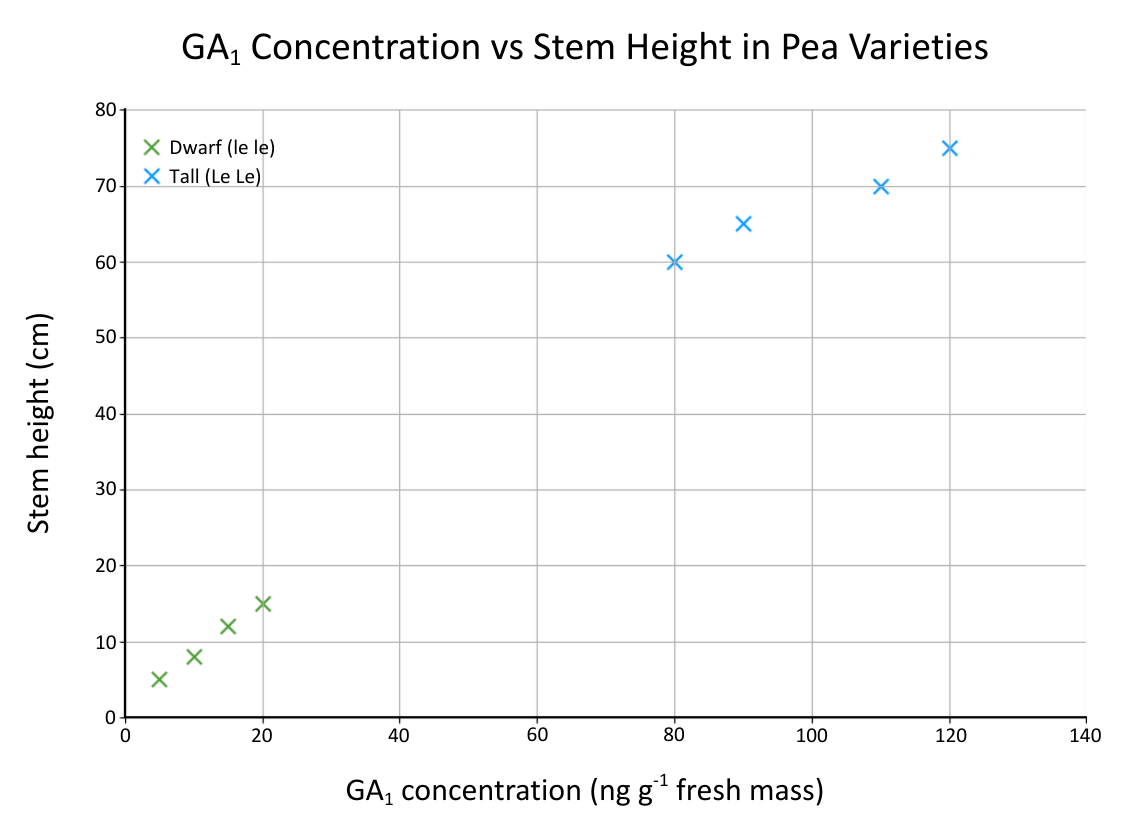
The dwarf pea plant (le le) is unable to produce normal levels of GA1, and so elongation is reduced, and overall growth is stunted. le le represents its genotype, which transcribes a faulty enzyme in the metabolic pathway for synthesising GA1. Le Le is the genotype for the tall pea plant variety, which produces a functional enzyme capable of synthesising GA1.
Experimental Evidence that GA₁ Causes Stem Elongation
In OCR A Level Biology you need to be able to use your general understanding of the mechanisms of gibberellin to interpret experimental investigations. You are not required to learn or recall any specific experiments (although the Le/le mutation is the most commonly taught one).
The table below outlines some examples of experiments or natural observations, relating to the effect of gibberellin on stem elongation and what we can infer from them:
| Experiment/ Observation | Mechanism | Observation | Inference |
|---|---|---|---|
| Foolish seedling disease | Pathogenic fungus produces GA₃. |
|
GA strongly promotes stem elongation. |
| Grafting a tall ‘Le’ plant tip onto a dwarf ‘le’ plant stem. | Gibberellin diffused down from the tip. | Dwarf plants grow tall after grafting. | GA₁ is made in the shoot. |
| GA concentration–response curves | Different concentrations of GA applied to observe the effects. |
|
GA’s effect is concentration dependent. |