
Free Epistasis OCR A Level Biology revision notes – covering specification points 6.1.2(bi) and 6.1.2(bii).
The interaction between two genes, where the phenotypic expression of one is modified or masked, is known as epistasis.
There are two types of epistasis, distinguished by whether the genotype at the epistatic locus, which modifies or masks the hypostatic locus, is recessive or dominant:
- Recessive epistasis is when a homozygous recessive genotype at the epistatic gene locus prevents the expression of the hypostatic gene; at least one dominant allele at the epistatic gene locus is required for the hypostatic gene locus to be expressed.
- Dominant epistasis is when a dominant allele at the epistatic gene locus prevents the expression of the hypostatic gene; a homozygous recessive genotype at the epistatic gene locus is required for the hypostatic gene to be expressed.
How epistasis modifies the expected phenotype ratios of a cross between heterozygotes depends on if it is recessive or dominant:
- Recessive epistasis produces a 9:3:4 ratio.
- Dominant epistasis often produces a 13:3 or 12:3:1 ratio.
The exact phenotypic ratio from any epistatic interaction will depend on the underlying mechanisms and the phenotypes involved.
The mechanism by which the epistatic gene can mask or modify the expression of the hypostatic gene is sometimes described as antagonistic or complementary:
- Antagonistic gene interaction is where the epistatic gene actively prevents the hypostatic gene’s phenotype from being expressed.
- Complementary gene interaction occurs when both genes’ protein products are required for the phenotype to be expressed, so the absence of one gene’s product masks the phenotype of the other.
Worked Example: Complementary Recessive Epistasis
Flower colour in sweet peas is produced in a multi-step reaction catalysed by two enzymes, each expressed at separate gene loci.
The first gene locus codes for an enzyme which converts a colourless precursor molecule into a colourless intermediate product; the recessive allele codes for a non-functional enzyme.
The second gene locus codes for an enzyme which converts the colourless intermediate product into a coloured pigment.
The genes involved are located on two different chromosomes:
- A/a is the first gene locus, where aa prevents pigment production.
- B/b is the second gene locus, where B produces purple, and b produces white.
A pure-breeding white-flowered variety (AAbb) is crossed with a pure-breeding white-flowered variety (aaBB), and the F1 generation is interbred to produce the F2 generation:
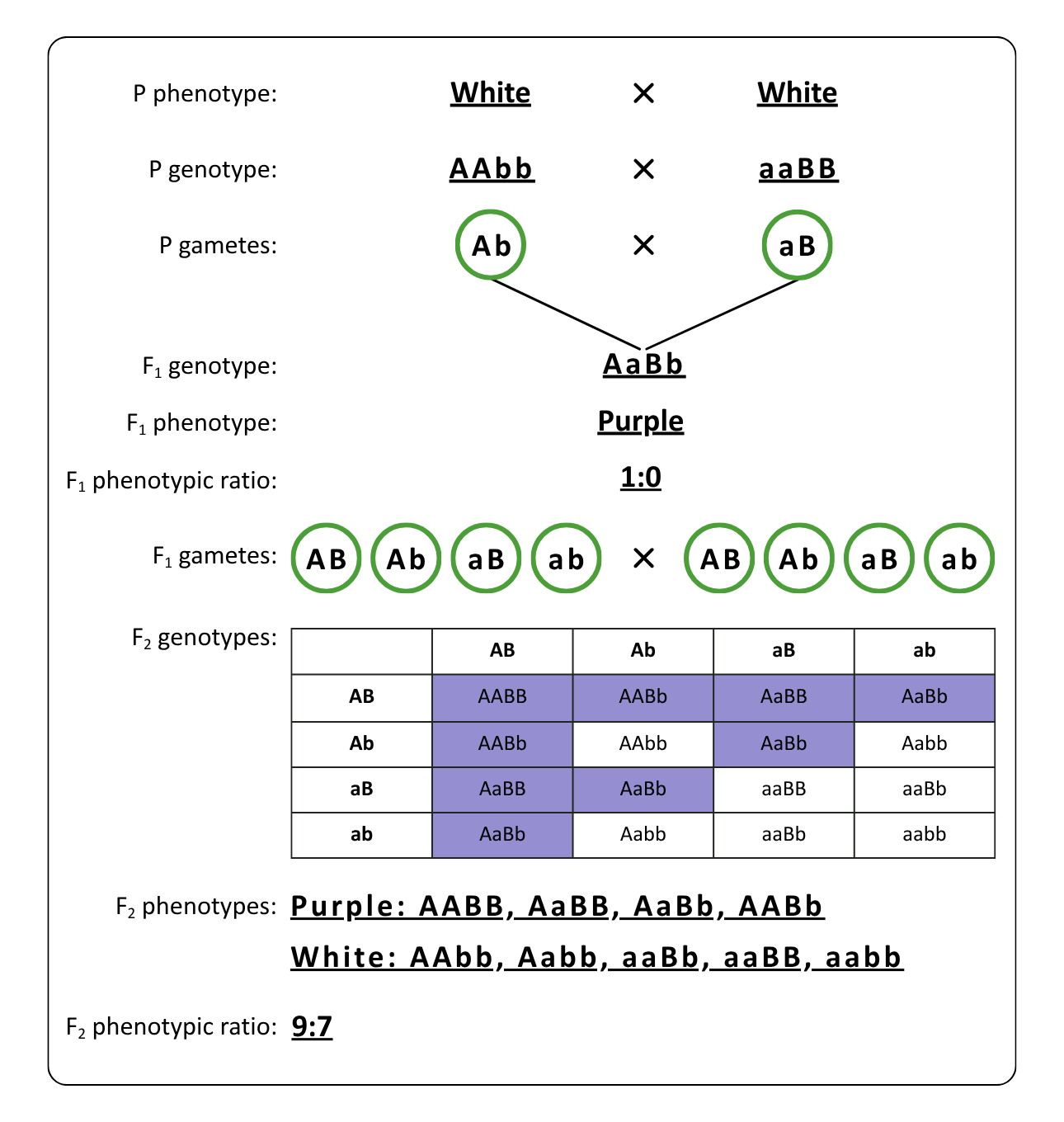
The homozygous genotype (aa) at the epistatic gene locus masks the B gene, so any plant that is aa at the epistatic locus is white, regardless of the genotype at the second locus. This modifies the expected phenotypic ratio of 9:3:3:1 to 9:7.
The dominant allele (W) at the epistatic gene locus masks the Y gene, so any squash plant that inherits at least one W allele is white, regardless of the genotype at the second locus. This modifies the expected phenotypic ratio of 9:3:3:1 to 12:3:1.