
Free Diabetes Mellitus revision notes for OCR A Level Biology – covering specification points 5.1.4 (e) and 5.1.4 (f).
Diabetes Mellitus
Diabetes mellitus is a disorder in which blood glucose concentration cannot be controlled effectively, regularly moving outside the optimal range of 4 – 6 mmol dm-3.
Blood glucose concentrations which are continuously above 7 mmol dm-3 are indicative of diabetes mellitus.
The graph below shows the changes in blood glucose levels of an unaffected person and a diabetic person:
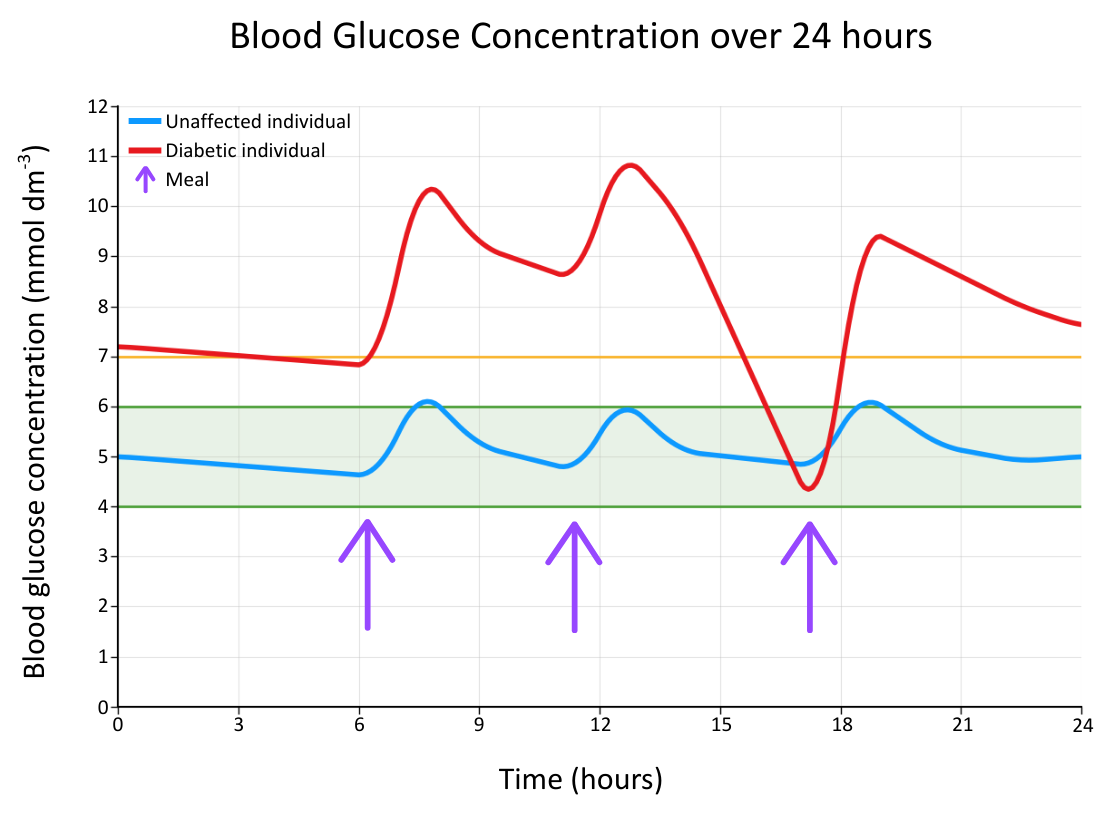
The green band represents an optimal concentration of blood glucose. The orange line represents the diagnostic threshold for diabetes mellitus.
Diabetes
There are two main types of diabetes, type 1 and type 2.
What distinguishes type 1 and type 2 diabetes is why the action of insulin fails:
- Type 1: Caused by the autoimmune destruction of pancreatic β cells. Sufferers respond to insulin, but are deficient in it.
- Type 2: Caused by target tissues being resistant to the effects of insulin. Sufferers are less responsive to insulin, but do produce it.
Treating Diabetes
Diabetes requires careful management throughout life to prevent damage to organs and tissues from accumulating.
Treating Type 1 Diabetes
The blood glucose concentration of type 1 diabetes must be monitored frequently, requiring a balance of carbohydrate intake and physical activity.
The table below compares the advantages and disadvantages of some of the treatments for type 1 diabetes:
| Treatment | Advantages | Disadvantages |
|---|---|---|
| Insulin injections |
|
|
| Insulin pump |
|
|
| Stem cell therapy |
|
|
Treating Type 2 Diabetes
Type 2 diabetes is usually managed with lifestyle interventions first, before introducing medical options.
The blood glucose concentration of type 2 diabetes must be monitored frequently, ensuring a balance of carbohydrate intake and physical activity.
The table below outlines the advantages and disadvantages of some of the lifestyle interventions taken to manage type 2 diabetes:
| Intervention | Advantages | Disadvantages |
|---|---|---|
| Regular physical activity |
|
|
| Balanced carbohydrate diet |
|
|
Medicines are used when lifestyle changes are insufficient.
The table below outlines the advantages and disadvantages of the main medical treatment for type 2 diabetes:
| Treatment | Primary Effect | Advantages | Disadvantages |
|---|---|---|---|
| Insulin injections | ↑ tissue uptake and storage of glucose |
|
|
Insulin
Historically, insulin was extracted from the pancreas of pigs or cattle, as their insulin is similar to human insulin.
Today, insulin is produced more safely and efficiently using genetically modified (GM) bacteria, such as Escherichia coli, to produce human insulin in bulk.
The table below compares insulin sourced from animal and GM bacteria:
| Source | Description | Effectiveness |
|---|---|---|
| Animal | Extracted from animal pancreas. | Similar to human insulin, but may cause allergic or immune reactions. |
| GM Bacteria | Produced by genetically modified bacteria (e.g. E. coli) using recombinant DNA technology*. |
|
*Recombinant DNA technology is when a gene from one organism is transferred into the genome of another.
Want to dive deeper?
-

Textbook: Diabetes Mellitus
£1.99 -

Textbook: Treating Diabetes
£2.99 -

Textbook: Control of Blood Glucose
£3.99 -

Bundle: Year 12 Textbook
£44.99