
Free Cloning in Plants OCR A Level Biology revision notes – covering specification points 6.2.1(ai), 6.2.1(aii), 6.2.1(bi) and 6.2.1(bii).
Natural Cloning in Plants
Natural cloning occurs more frequently in plants than in animals because they retain more tissues with undifferentiated cells throughout their lives.
Undifferentiated plant tissues are called meristems.
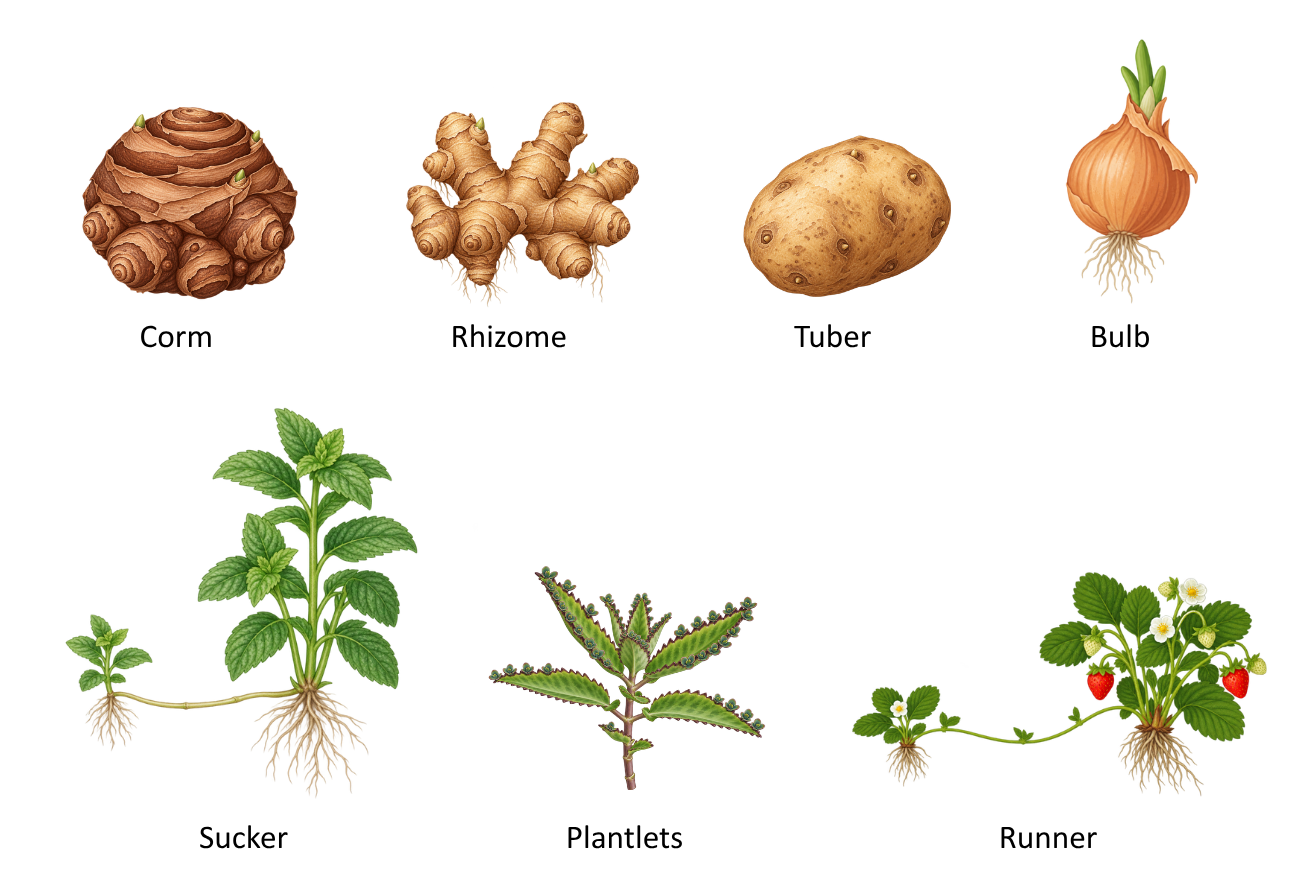
Vegetative propagation* is the development of a new plant from meristematic tissue, producing offspring that are genetically identical to the parent.
*Vegetative refers to the non-reproductive parts of a plant (e.g. roots, stem, leaves).
The diagram below shows examples of vegetative propagation structures:
Artificial cloning in plants is used to produce large numbers of genetically identical plants.
Techniques used to artificially clone plants include cuttings, tissue culturing and micropropagation.
Cuttings
Taking plant cuttings is the simplest technique to artificially clone a plant because it exploits the plant’s own vegetative propagation abilities and does not require a sterile environment.
A simple method for cloning a plant by taking stem cuttings is outlined below:
- Select a healthy shoot from the parent plant and remove any flowers and excess leaves.
- Cut the stem at an angle between two leaf joints (just below a node).
- Apply rooting powder, which contains auxin, to the cut end to stimulate root growth.
- Plant the cutting in moist compost.
Tissue Culturing and Micropropagation
Tissue culturing is a range of techniques used for stimulating small pieces of plant tissue (explants) or whole plant tissues to grow into calluses, which can then be stimulated to grow into plantlets.
A simplified method for tissue culturing is outlined below:
- Cut the meristematic tissue from the parent plant to form explants.
- Sterilise the explants using bleach or alcohol.
- Place the explants on a sterile agar gel containing nutrients, auxin and cytokinin, so that they develop into a callus (a mass of undifferentiated cells).
- Divide the callus into small clumps of undifferentiated cells.
- Transfer the clumps to a 4:1 cytokinin to auxin solution to promote stem formation.
- Transfer the clumps to a 100:1 auxin to cytokinin ratio to promote root formation.
- Transfer the plantlets to compost and grow in a greenhouse or propagator under optimal conditions.
Micropropagation involves the use of tissue culturing techniques to culture large numbers of genetically identical plants*.
*Typically for commercial purposes.
Arguments For and Against Artificial Cloning in Plants
The table below outlines the advantages of artificial cloning in plants:
| Advantage | Explanation |
|---|---|
| Rapid production | Large numbers of plants can be produced quickly and independently of seasonal reproduction, especially using methods such as tissue culture and micropropagation. |
| Overcomes limitations of sexual reproduction | Allows propagation of seedless, sterile, or slow-reproducing plants and bypasses unreliable germination and vulnerable seedling stages. |
| Desirable traits retained | Plants are genetically identical, ensuring that commercially valuable traits such as yield, disease resistance and appearance are retained. |
| Uniformity | Produces genetically identical crops with predictable size, quality and yield, making cultivation and harvesting easier on a commercial scale. |
The table below outlines the disadvantages of artificial cloning in plants:
| Disadvantage | Explanation |
|---|---|
| Labour intensive | Requires skilled labour, particularly for techniques such as tissue culture that involve sterile technique and careful handling of explants. |
| Expensive | High initial costs due to the need for specialised equipment, sterile facilities, and trained personnel. |
| No genetic variation | Populations have very low genetic diversity, with variation arising only from mutation, reducing adaptability. |
| Disease and infection risk | Genetically identical populations are more vulnerable to the same pathogens and environmental changes because of their low genetic diversity. |