
Free Cellular Control of Gene Expression OCR A Level Biology revision notes – covering specification point 6.1.1(b).
Cellular control refers to the regulatory mechanisms by which cells regulate their metabolic activities, development, structure and function.
Regulatory mechanisms involved in cellular control work by controlling gene expression.
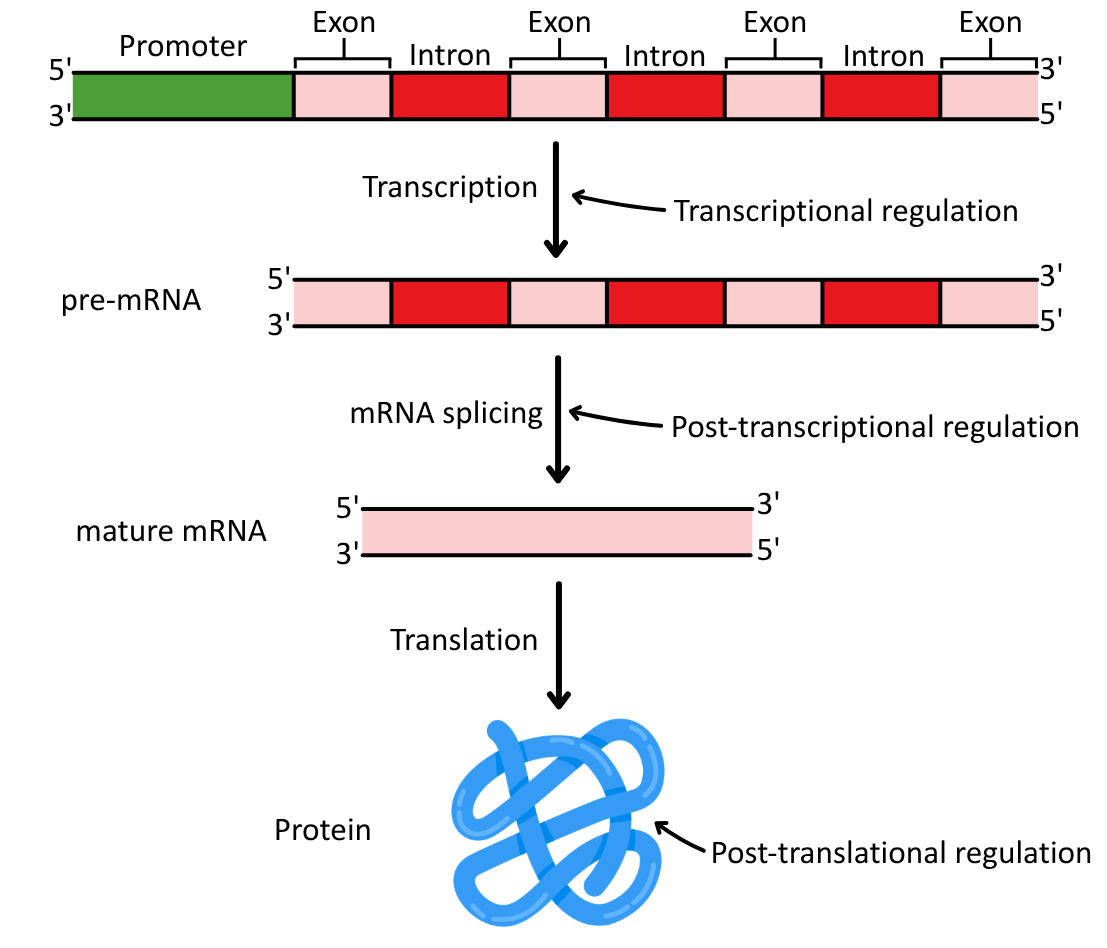
Regulatory mechanisms are categorised as either transcriptional, post-transcriptional, or post-translational:
- Transcriptional regulation is whether a gene is transcribed into mRNA, and how often.
- Post-transcriptional regulation is the editing of the mRNA copy of the gene produced in transcription.
- Post-translational regulation determines whether the protein produced by translation is activated.
The diagram below shows the stages in gene expression at which different regulatory mechanisms act:
Transcriptional regulation
Transcriptional regulation controls whether a gene is transcribed into mRNA, and is controlled by proteins called transcription factors, which turn genes on, off, or influence the rate at which they are transcribed.
Post-transcriptional regulation
Post-transcriptional regulation modifies the mRNA produced in transcription.
Transcription produces a full copy of the gene known as primary mRNA.
Primary mRNA*(and the gene it is a copy of) is made up of sections that can be categorised as either introns or exons:
- Introns are non-coding regions of the gene (and primary mRNA copy) that do not code for the amino acid sequence in the final protein product; however, they may have roles in regulating gene expression.
- Exons are coding regions of the gene (and primary mRNA copy) that do code for the amino acid sequence in the final protein product.
*It is useful to know that primary mRNA is also known as pre-mRNA.
Introns are cut out of the primary mRNA, and the remaining exons are joined together to form mature mRNA (or just ‘mRNA’).
Post-translational regulation
Post-translational regulation controls the activation of proteins produced in translation.
cAMP (cyclic AMP) is an example of post-translational regulation, it is a secondary messenger involved in an enzyme cascade that activates enzymes and proteins.
cAMP is produced from ATP following the binding of a signalling molecule (such as glucagon) to a complementary receptor on the cell surface membrane.