
Free Biomass Transfers OCR A Level Biology revision notes – covering specification point 6.3.1(b).
Biomass
Biomass is the total dry mass of organic material in living organisms within a given area at a particular time.
All biomass in an ecosystem originates from producers, which can capture energy from their environment (e.g. light in photosynthesis), store it as chemical energy, and use it to synthesise organic molecules.
Biomass Transfers Through Trophic Levels
When one organism is eaten by another, its biomass and the energy stored within it are transferred to the consumer, a process called biomass transfer.
Biomass transfer occurs through trophic levels.
The diagram below shows the trophic levels of a food chain:
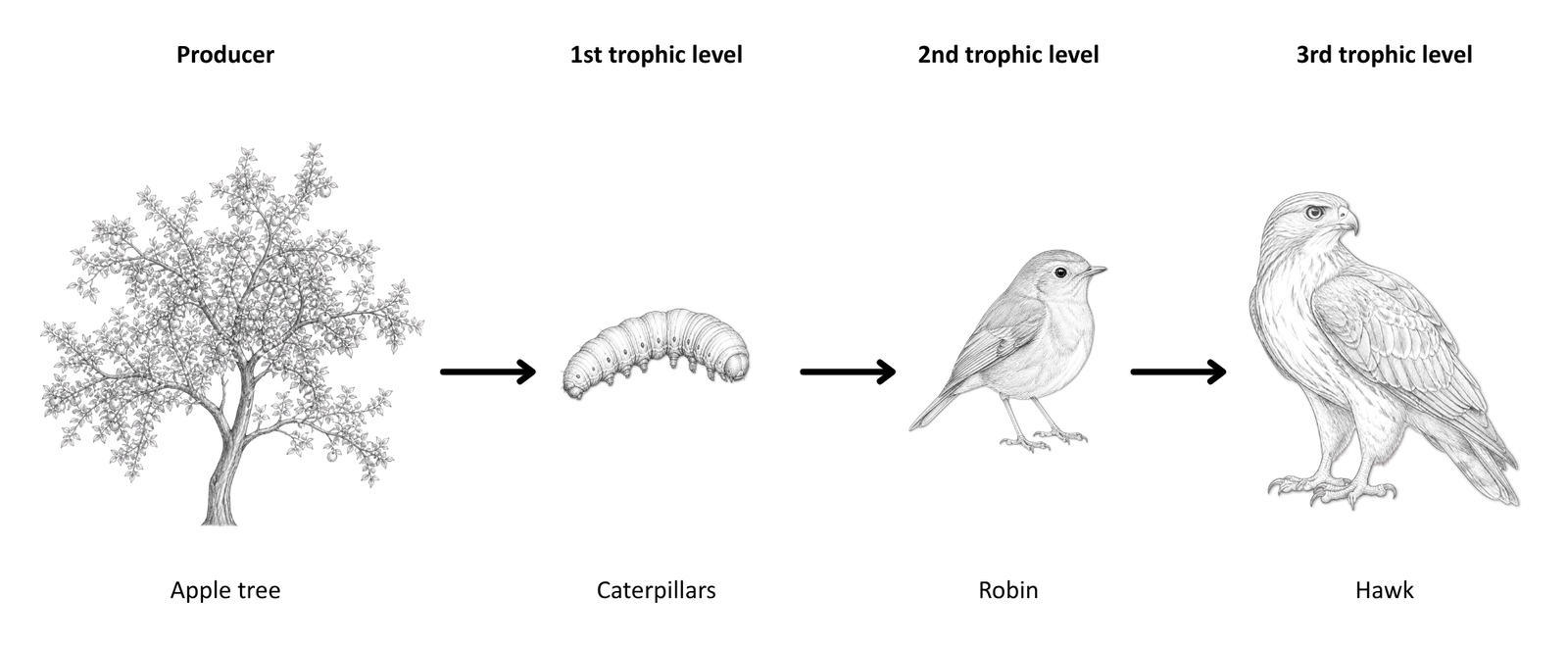
When biomass is transferred from one organism to another along a food chain, a significant proportion of biomass is lost.
Reasons why biomass is lost from one trophic level to the next include:
- Death: Biomass in dead organisms will often be consumed by decomposers.
- Indigestible parts: Some biomass (e.g. bones, hair) cannot be digested.
- Respiration: Some biomass is broken down to release energy during respiration.
Calculating the Efficiency of Biomass Transfer
The efficiency of biomass transfer between trophic levels can be calculated using the following equation:
efficiency = (biomass transferred ÷ biomass intake) × 100
The values used in the efficiency of biomass transfer equation may be masses (e.g. g m⁻²) or quantities of energy (e.g. kJ m⁻²).
It is important to note that you are expected to learn and recall this equation from memory. It will not be provided in the exam.