
Free Immobilised Enzymes OCR A Level Biology revision notes – covering specification point 6.2.1(i).
Immobilised Enzymes
Enzyme immobilisation is a technique which prevents the free movement of enzymes within a reaction mixture containing a substrate.
Enzymes are immobilised by trapping them within, or binding them to, a material that is then packed into a reaction column.
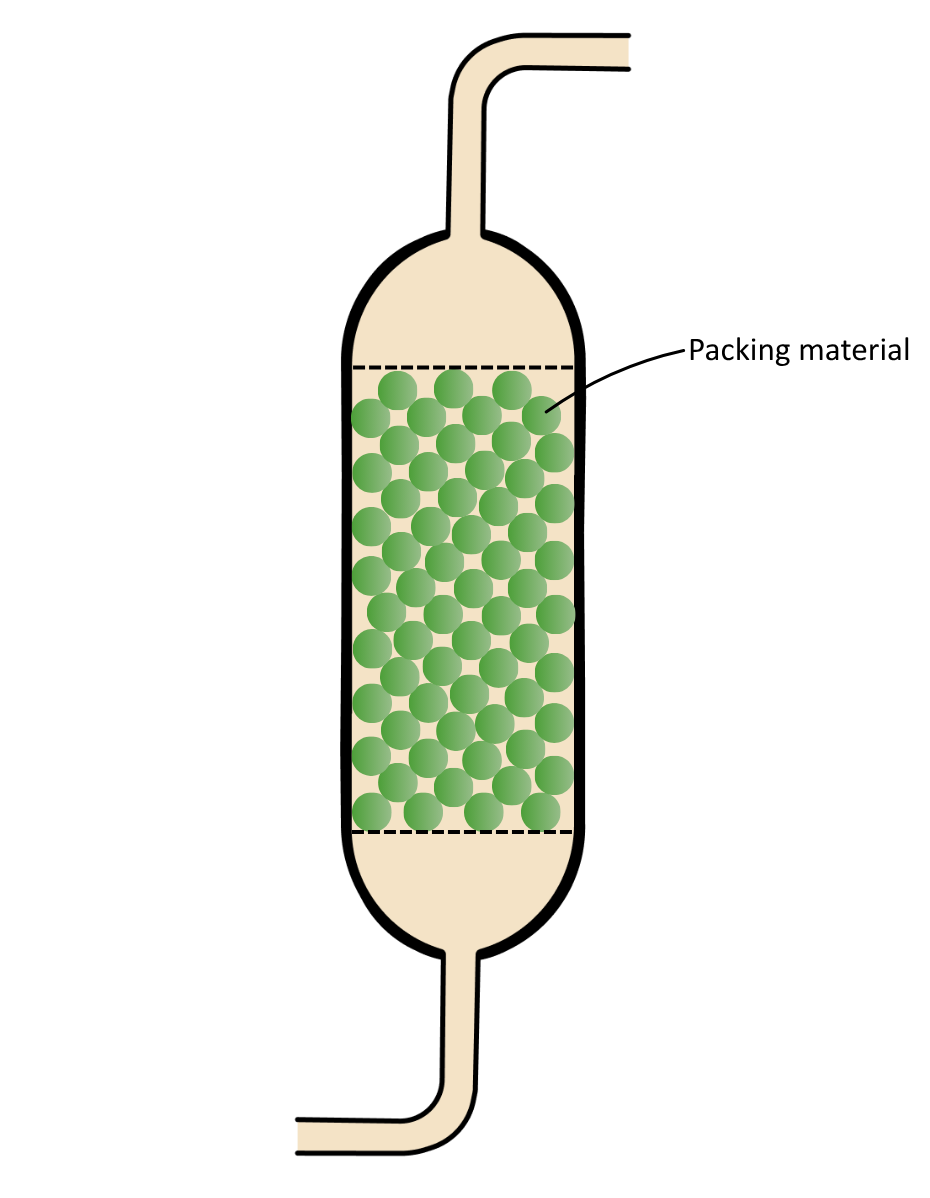
Reaction columns are used in chemical immobilisation to provide a vessel in which the material to which the enzyme is bound can be packed.
The diagram below shows a typical reaction column containing immobilised enzymes:
Methods of Immobilisation
Enzymes can be immobilised either chemically or physically:
- Chemically binding enzymes with chemical bonds to the surface of a solid material.
- Physically trapping enzymes involves allowing the substrate to diffuse through a material that binds the enzymes within a matrix or keeps the enzymes separate by acting as a partially permeable membrane.
Chemical Immobilisation
The two types of chemical immobilisation are adsorption and covalent bonding:
- Adsorption binds enzyme molecules to the surface of an inert supporting material (e.g. clay, glass beads) by weak hydrogen bonds, hydrophobic interactions, or ionic bonds.
- Covalent bonding binds enzyme molecules to a support by strong covalent bonds.
The table below outlines some of the advantages and disadvantages of the different types of chemical immobilisation:
| Method | Advantage(s) | Disadvantage(s) |
|---|---|---|
| Adsorption |
|
The enzyme-surface bonding is weak, so the enzyme may detach and leak into the mixture. |
| Covalent bonding |
|
|
Physical Immobilisation
The two types of physical immobilisation are entrapment and membrane separation:
- Entrapment holds enzymes inside a matrix or gel (e.g. calcium alginate beads) that they cannot leave, but the substrate and product molecules can diffuse in and out of the matrix or gel.
- Membrane separation holds enzymes on one side of a partially permeable membrane, which separates them from the reaction mixture containing the substrate.
It is useful to know that adsorption is more commonly classified as a form of physical immobilisation.
The table below outlines the advantages and disadvantages of the different types of physical immobilisation:
| Method | Advantage(s) | Disadvantage(s) |
|---|---|---|
| Entrapment |
|
|
| Membrane separation |
|
|