
Free Batch and Continuous Fermentation OCR A Level Biology revision notes – covering specification points 6.2.1(gii) and 6.2.1(hii).
Industrial fermentation is the growth of microorganisms at a large scale within bioreactors so that the product yield is maximised.
A bioreactor is a large vessel that maintains the environment of the microorganism being grown at optimal conditions for a desired product.
A fermenter is a type of bioreactor.
The diagram below shows a typical fermenter:
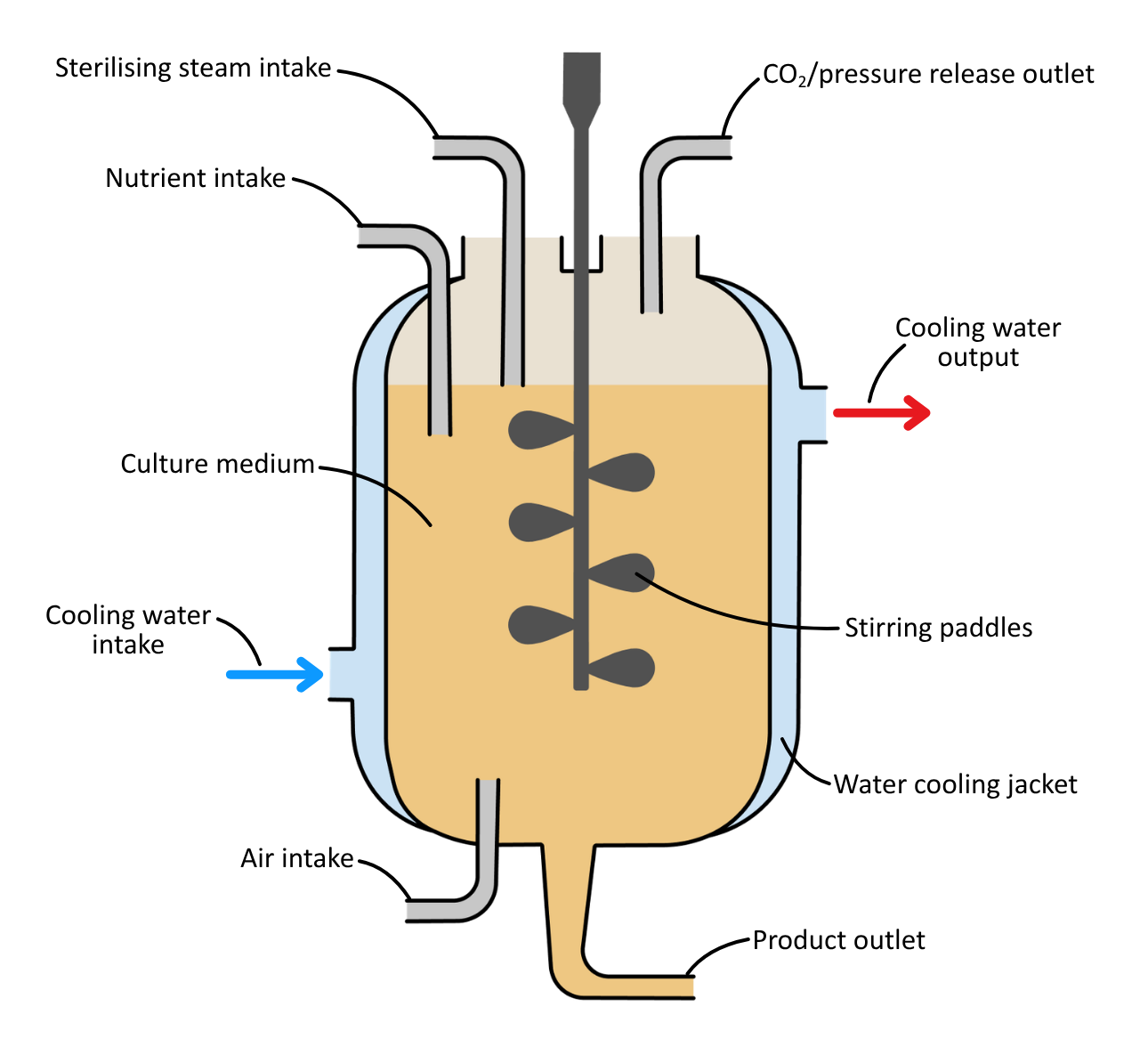
It is useful to know that the microorganisms being grown within a fermenter may not always undergo fermentation as part of the production process, despite what its name indicates.
The table below outlines some of the environmental conditions that a fermenter is designed to control and how it does it:
| Environmental Condition | How it is controlled |
|---|---|
| Nutrients | Inlets allow sufficient nutrients (e.g. carbohydrate, nitrogen) to be added to the tank. |
| Oxygen | Inlets allow sterile air containing oxygen to be bubbled through the culture medium. |
| pH | pH probes monitor the pH, which can be corrected by adding acidic or alkaline substances to maintain an optimal pH. |
| Temperature | A cooling jacket removes the excess heat released by the microorganisms’ metabolism, keeping the temperature at an optimum. |
Continuous and Batch Fermentation
Fermentation can be carried out as either batch fermentation or continuous fermentation:
- Batch fermentation involves growing microorganisms within a fixed volume of culture medium, and then emptying the fermenter to harvest the product.
- Continuous fermentation involves growing microorganisms within a culture medium that continuously has nutrients added and products and wastes removed.
Batch fermentation allows a population to develop through all phases of the growth curve (lag, log, stationary, death), whilst continuous fermentation causes a population to be maintained in the log or stationary phase.
Microorganisms may produce different substances in different phases of the growth curve, due to different environmental conditions affecting their metabolic activity.
Deciding whether to use batch or continuous fermentation is determined by the type of metabolite the desired product is:
- Batch fermentation is used to produce secondary metabolites (e.g. antibiotics) that are only produced during the stationary and/or death phase.
- Continuous fermentation is used to produce primary metabolites (e.g. amino acids, ethanol, enzymes) and/or biomass, by maintaining the population in the log and/or stationary phase.
Investigating Factors Affecting the Growth of Microorganisms
The growth of a microorganism’s population is affected by many different factors, which can be investigated by growing the microorganisms in a broth and measuring the population density over time.
The table below outlines the main factors that affect microbial growth:
| Factor | Effect on growth |
|---|---|
| Nutrient availability |
|
| Oxygen availability |
|
| pH |
|
| Temperature |
|