
Free Electrophoresis OCR A Level Biology revision notes – covering specification point 6.1.3(e).
Electrophoresis is a technique used to separate DNA fragments, RNA, or proteins (typically) by size using an electrical field.
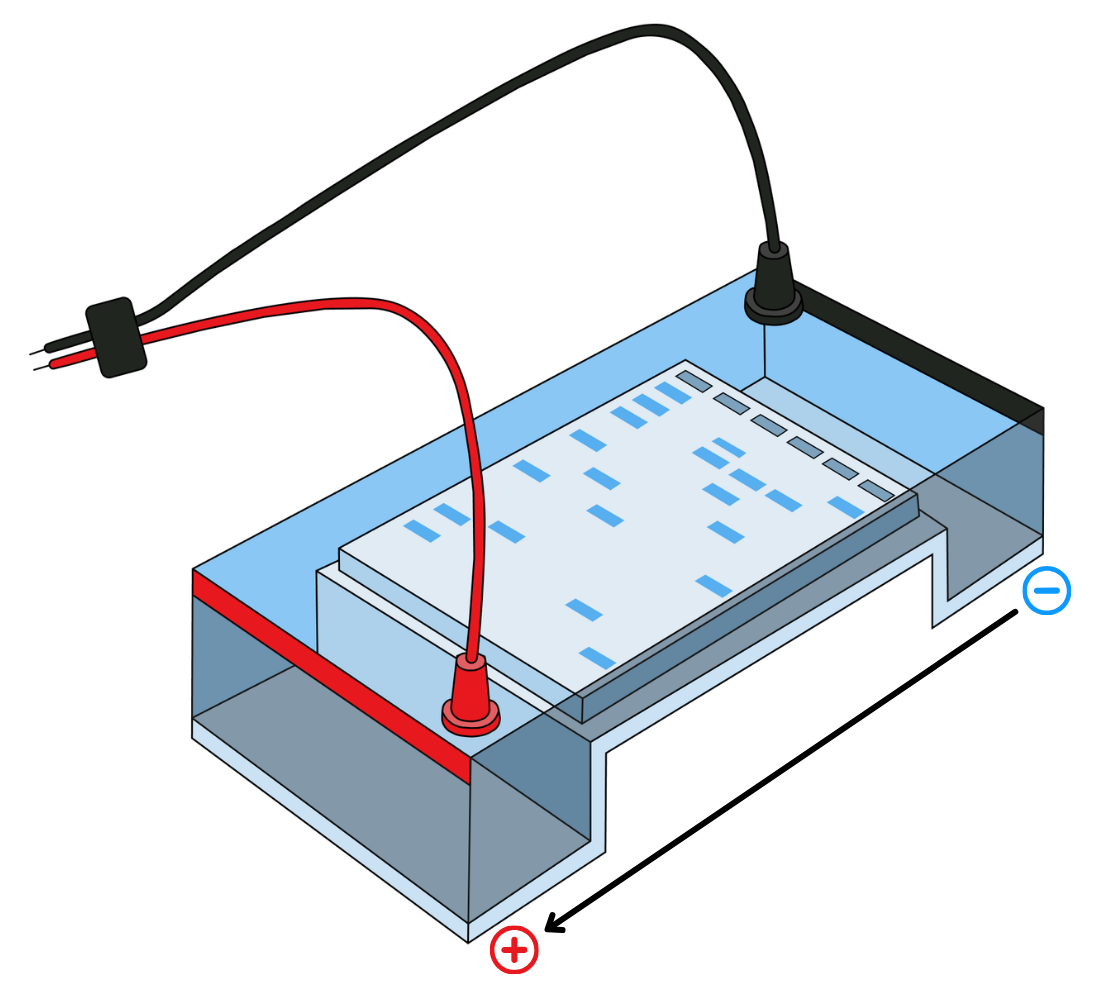
Electrophoresis generates an electric current that causes the negatively charged molecules to move through the matrix (its structure) of an agarose gel towards the anode (positive electrode).
The degree of separation between fragments is determined primarily by their size:
- Smaller fragments experience less resistance moving through the agarose gel matrix, so they move faster, travelling a greater distance during electrophoresis.
- Larger fragments experience more resistance moving through the agarose gel matrix, so they move more slowly, travelling a shorter distance during electrophoresis.
Gel electrophoresis is carried out inside a gel electrophoresis tank.
The diagram below shows a gel electrophoresis tank with the positions of DNA bands made visible towards the end of the run:
The table below outlines examples for using gel electrophoresis on different molecules:
| Molecule separated | Examples |
|---|---|
| DNA fragments |
|
| RNA |
|
| Proteins |
|