
Free Polymerase Chain Reaction OCR A Level Biology revision notes – covering specification points 6.1.3(d).
The Polymerase Chain Reaction (PCR)
Gene sequencing uses many identical copies of a section of DNA in order to determine the order of bases.
PCR (polymerase chain reaction) is a technique that replicates DNA rapidly using the same principles as biological DNA replication.
PCR consists of 3 distinct phases known as denaturation, annealing, and extension:
- Denaturation heats the DNA to ~95 °C* to break the hydrogen bonds between the two strands, producing single-stranded DNA.
- Annealing cools the reaction down to ~68 °C* to allow primers to anneal (bind) to the single-stranded DNA**.
- Extension heats the reaction up to ~72 °C* to allow DNA polymerase to synthesise a complementary strand by adding free activated nucleotides in the 5′ to 3′ direction from the primer.
*Temperatures provided beyond OCR A level Biology are typically ranges, and can vary from the approximate values commonly cited in official OCR exam questions and mark schemes.
**When two strands of nucleic acid join together via hydrogen bonds, it is known as annealing.
The diagram below shows the phases of denaturation, annealing and extension in PCR:
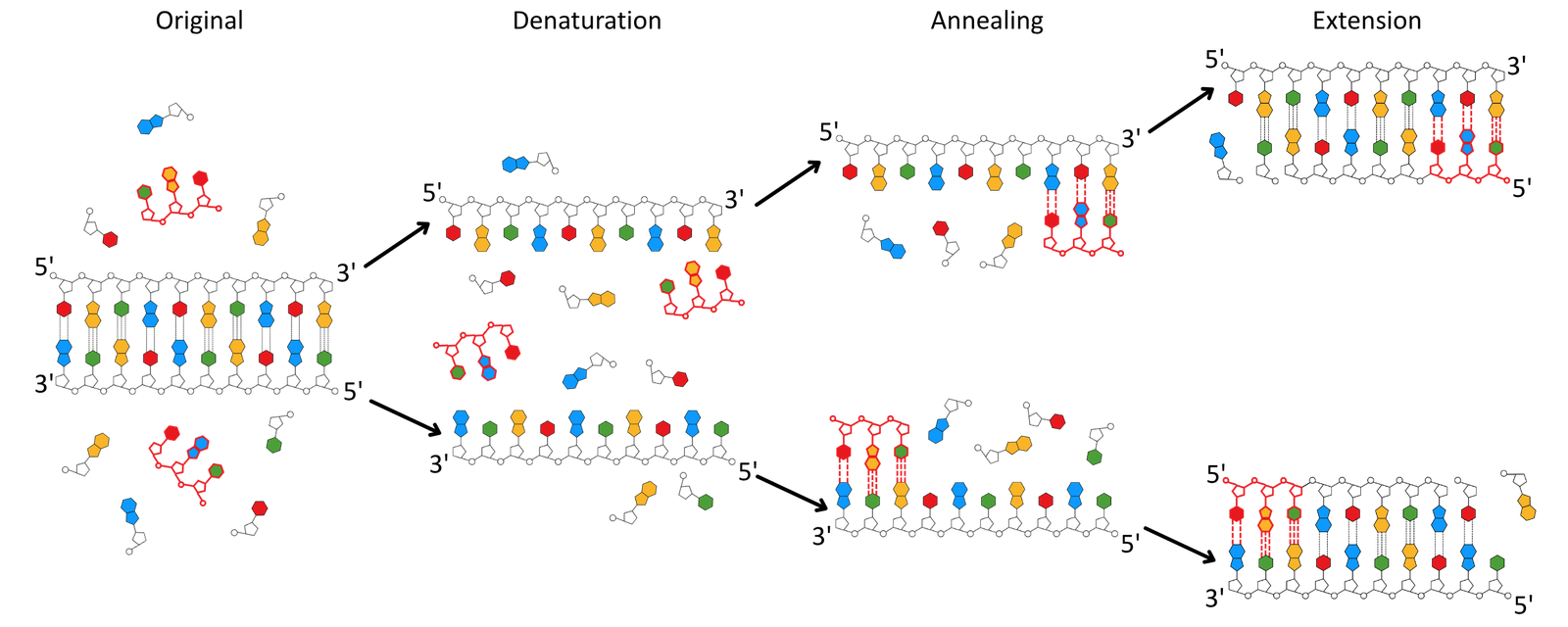
The diagram above shows how PCR doubles the number of DNA strands present at the start of the cycle.