
Free Multiple Alleles OCR A Level Biology revision notes – covering specification point 6.1.2(bi).
Diploid organisms have two homologous chromosomes, which give them two copies* of each gene.
*With the exception of some genes on sex chromosomes.
When a gene locus has three or more alleles, then it is defined as having ‘multiple alleles’.
Worked Example
Coat colour in rabbits is determined by a single gene with four alleles, which produce four distinct coat colours:
- C produces an agouti coat.
- Cch produces a chinchilla coat.
- Ch produces a Himalayan coat (white, with black extremities)
- c produces the albino coat (no pigment)*
*Albinism, which is the absence of pigment, making an organism appear white, must not be confused with a white phenotype from the production of white pigment.
The alleles for coat colour in rabbits have the following dominance hierarchy:
- Agouti (C) is dominant to all other alleles.
- Chinchilla (Cch) is dominant to Himalayan (Ch) and albino (c).
- Himalayan (Ch) is dominant to albino (c).
- Albino (c) is recessive to all other alleles.
A heterozygous chinchilla rabbit (Cchc) and a heterozygous Himalayan rabbit (Chc) are crossed:
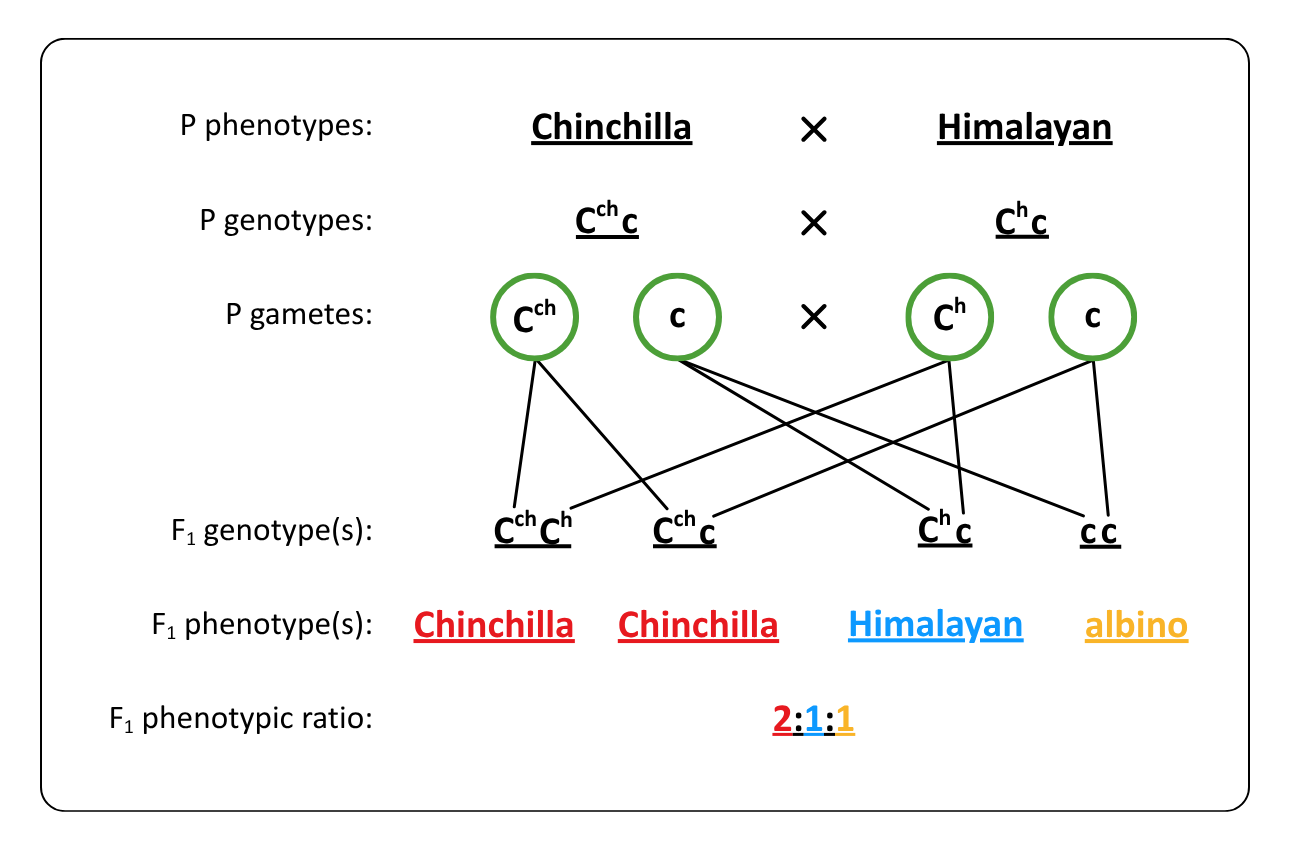
The example dihybrid cross above demonstrates how a new (and third) phenotype emerges in the offspring, because the recessive c allele is masked in both heterozygous parents, but is expressed in some offspring when two recessive alleles combine during fertilisation to form the offspring’s genotype.