
Free Genetic Diagrams and Punnett Squares OCR A Level Biology revision notes – covering specification point 6.1.2(bi).
Genetic Diagrams and Punnett Squares
A genetic diagram is used to predict the genotypes and phenotypes of the offspring of a cross* between two organisms.
*The breeding of two organisms.
The table below provides the definitions of the terms used in genetic diagrams:
| Term | Description |
|---|---|
| Parental phenotype(s) | The observable characteristic(s) of the two parents being crossed. |
| Parental genotype(s) | The combination of alleles each parent carries at the gene locus (or loci). |
| Possible gametes | The different allele combinations* each parent can produce in their gametes through meiosis. |
| F1 genotype(s) | All possible allele combinations* that can result from the fusion of parental gametes at fertilisation. |
| F1 phenotype(s) | The observable characteristic(s) produced by each possible offspring genotype. |
| (F1) Phenotypic ratio** | The proportions in which the different offspring phenotypes are expected to appear. |
*Allele combinations become relevant when the inheritance of two (or more) genes is being predicted.
**At GCSE, percentages were typically given, but ratios are more appropriate at A level.
It is important to note that F1 refers to the first generation produced from crossing the parents, so F2 would refer to the second generation.
The diagram below shows the layout of an example cross between a tall heterozygous pea plant and a short homozygous recessive pea plant:

The diagram above shows how the possible combinations of alleles can be worked out by drawing lines between them.
Monohybrid and Dihybrid Crosses
Two types of crosses are commonly investigated with genetic diagrams (and encountered at A level), which depend on whether the inheritance of one or two characteristics is being observed.
Investigating the inheritance of one characteristic involves a monohybrid cross, whilst two characteristics involve a dihybrid cross:
- Monohybrid crosses involve the inheritance of a single monogenic trait*.
- Dihybrid crosses involve the simultaneous inheritance of two monogenic traits.
*This is the type of cross investigated with (usually) Punnett squares at GCSE, typically with only two alleles involved (one dominant, and one recessive).
Punnett squares are often used in dihybrid crosses to determine and show the possible zygotes that can be formed from gametes.
Worked Example
In pea plants, seed shape and seed colour are determined by unlinked genes at different loci:
- Seed shape can be round (R) or wrinkled (r)
- Seed colour can be yellow (Y) or green (y)
Two pea plants, which produce round and yellow seeds and are heterozygous for both gene loci, are crossed:
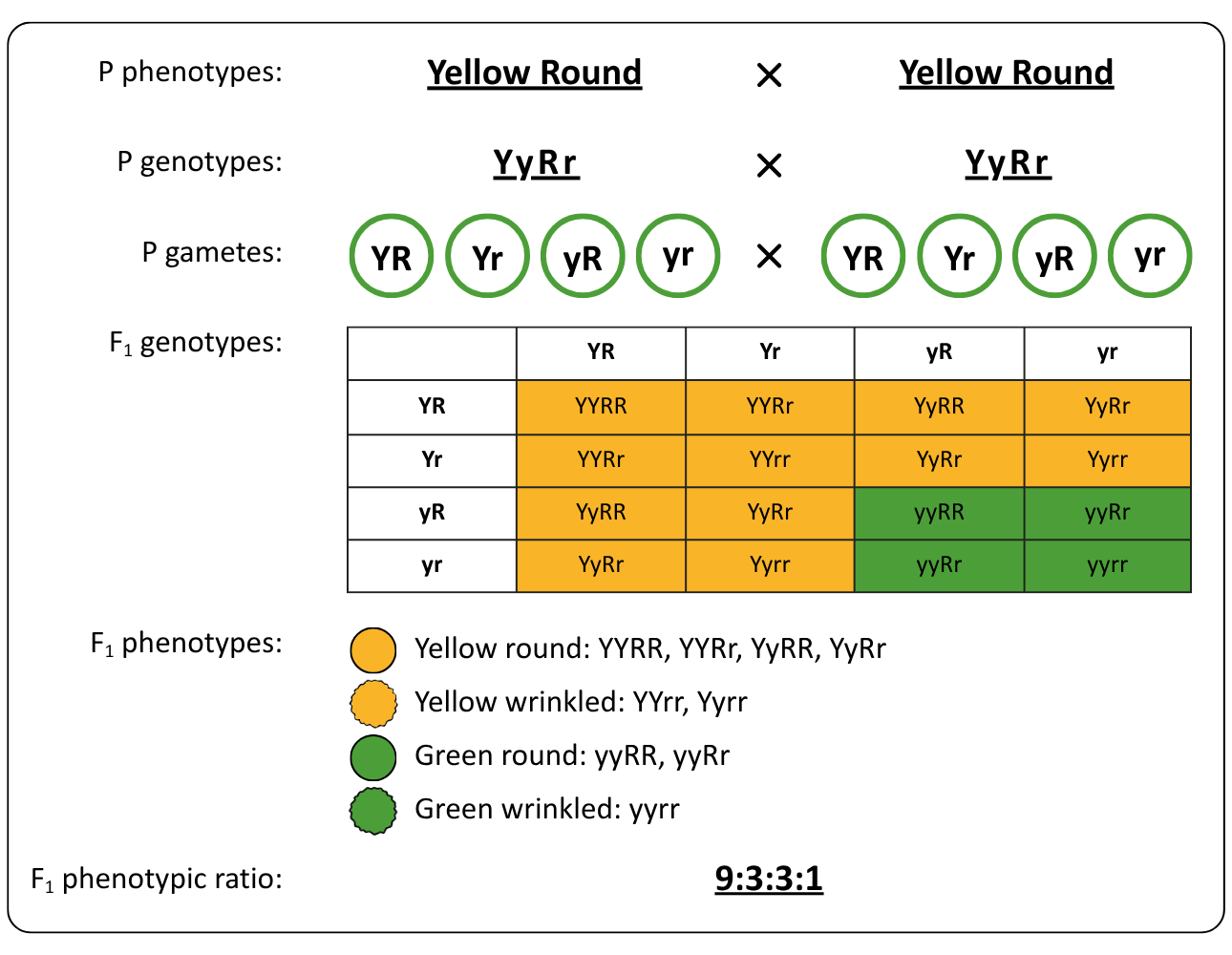
It is important to note that the 9:3:3:1 phenotypic ratio (typically) produced by two individuals who are heterozygous at both gene loci in a dihybrid cross can be used to infer the parental genotypes (as being heterozygous) if they are unknown.