
Free Generating Genetic Variation OCR A Level Biology revision notes – covering specification points 6.1.1(a) and 6.1.2(aii).
Genetic variation is mainly caused by mutation and sexual reproduction.
Mutations generate new alleles and can alter the arrangement of genes on a chromosome.
Sexual reproduction generates new genotypes as a result of meiosis and fertilisation.
The table below outlines different sources of genetic variation and their mechanism:
| Source | Contribution to genetic variation |
|---|---|
| Mutation |
|
| Crossing over | Produces chromosomes with new allele combinations by producing recombinants when non-sister chromatids exchange DNA at the chiasmata. |
| Independent assortment | Produces many chromosome combinations by allowing maternal and paternal chromosomes to be distributed randomly into gametes from homologous pairs as they align randomly at the equator in metaphase I. |
| Random fertilisation | Produces new combinations of chromosomes by allowing any male gamete to fertilise any female gamete. |
Mutation
A mutation is a random change to the genetic material of an organism.
A mutation can be (typically) harmful, (sometimes) harmless, or (rarely) beneficial:
- Harmful mutations alter the structure of a protein in such a way that its function is negatively impacted, interfering with normal cell functioning.
- Harmless mutations don’t affect the structure of a protein, so it functions as normal.
- Beneficial mutations alter the structure of a protein in such a way that its function is improved, positively affecting normal cell functioning.
Gene mutations are either deletions, insertions, or substitutions:
- Insertion: One or more nucleotides are added to the DNA sequence.
- Substitution: One base pair* is replaced with another.
- Deletion: One or more nucleotides are removed from the DNA sequence.
*Sometimes a single nucleotide in the template strand can be replaced, and will not pair correctly with its opposite on the coding strand (which remains unchanged).
Frameshift
Insertions and deletions can cause a frameshift.
A frameshift occurs when the number of bases inserted or deleted is not a multiple of three.
The diagram below shows the effect of frameshift on the DNA sequence, and the polypeptide chain that it codes for:
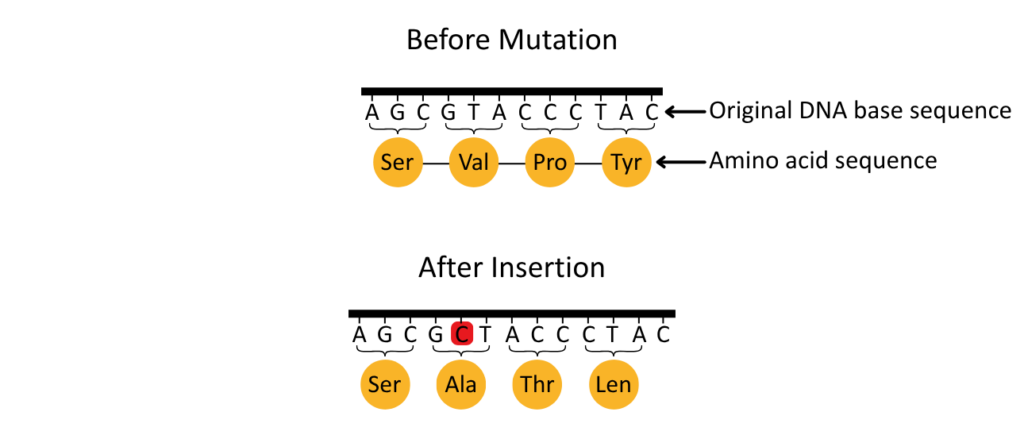
It is important to note that insertions or deletions of three bases (or any multiple of three) do not cause a frameshift, but instead add or remove whole amino acids from the protein.