
Free The Lac Operon OCR A Level Biology revision notes – covering specification point 6.1.1(b).
An operon is a group of genes that are transcribed together by RNA polymerase binding to a single promoter region.
Grouping genes into operons allows a microorganism to switch several related genes on or off together, so that the proteins they code for are only produced when they are actually needed.
The lac Operon
The lac operon is a cluster of 2 genes* in Escherichia coli involved in expressing proteins associated with metabolising lactose.
*It is actually 3 genes, but some components of the lac operon are (typically) omitted for simplicity.
The genes in the lac operon are only expressed when lactose is present.
It is important to note that the lac operon is the required example of an operon given in the OCR A Level Biology specification.
The lac operon is under the control of a regulatory gene called lacI, located upstream of the activator binding site.
The diagram below shows the positions of lacI and the components of a simplified lac operon:
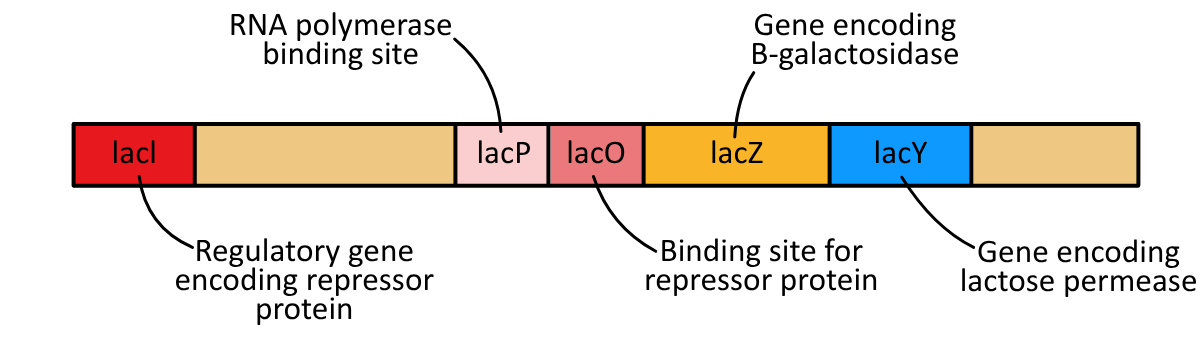
It is useful to know that in educational materials, ‘empty’ sections of DNA are often added between lacI and the components of the operon to emphasise that lacI is not a part of the operon.
LacI encodes a transcription factor (a repressor) that binds to the operator (lacO) and prevents RNA polymerase from binding to the promoter and transcribing lacZ and lacY.
The lac operon can be described as ‘on’ when RNA polymerase can transcribe lacZ and lacY due to the presence of lactose.
Lactose inhibits the repressor molecule, allowing RNA polymerase to bind to the promoter region.