
OCR A Level Biology Command Words
Know exactly what every exam question is asking you to do. Key OCR A Level Biology command words explained – with mark scheme insights and a real exam example for each one.
Key command words
With examples
Online or PDF

What’s included
Download PDF
Free for personal and classroom use. Please don’t redistribute or resell. Always refer to the official OCR specification.
Browse the command words
What it requires from students
Perform a numerical computation to reach a specific answer.
Mark Scheme Insights
Correct answer earns full marks regardless of working. ECF (error carried forward) applies for correct method with the wrong answer.
Best Example
Question
The real size of the line between C and D on Fig. 1.1 is 1.4 × 10⁻⁶ m. Calculate the magnification that was used to produce the image in Fig. 1.1. Give your answer to 2 significant figures.
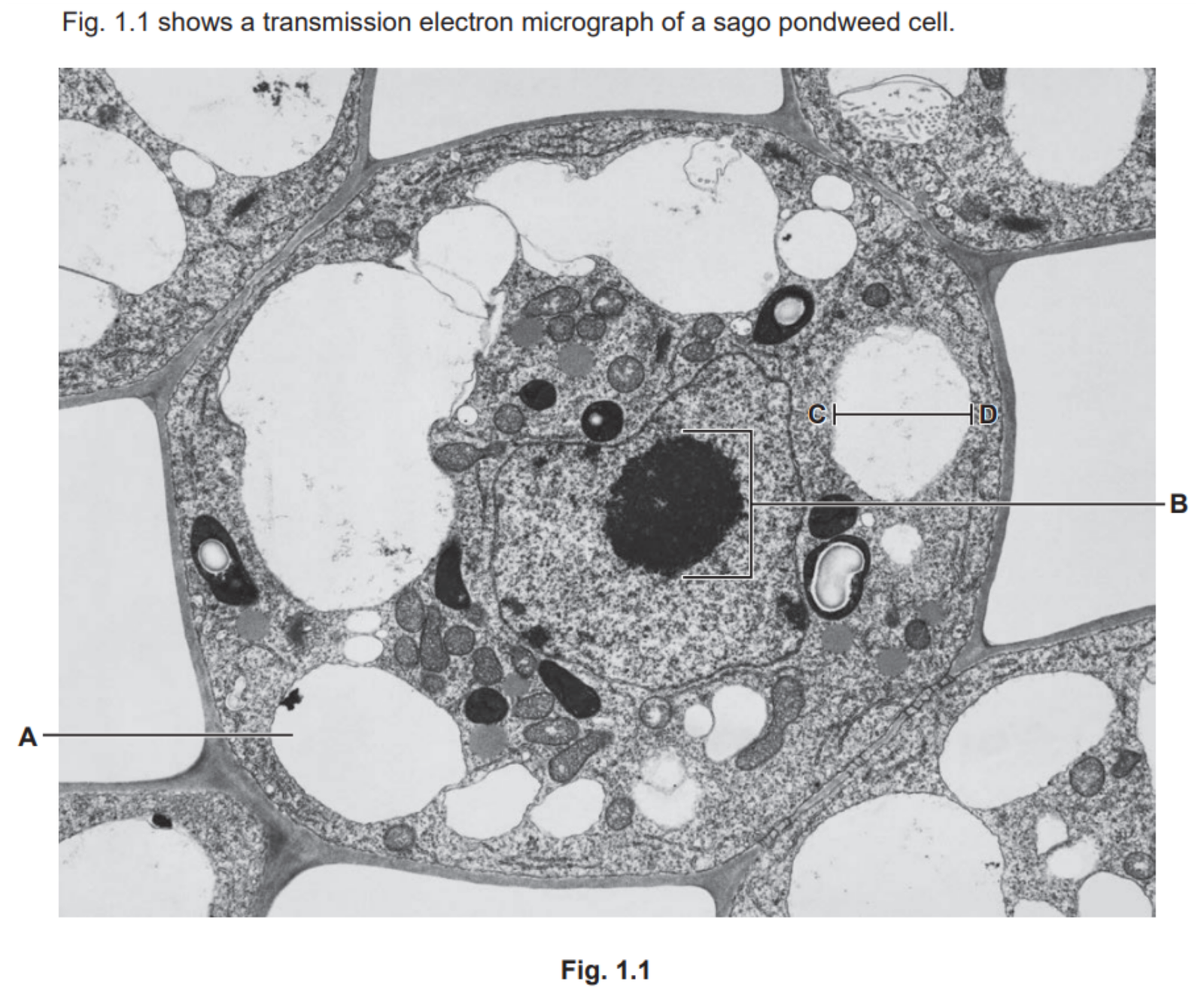
Mark Scheme
(x)14000 / 1.4 x 10⁴ (Note: Dependent on printing scale)
If the answer is incorrect, award one mark for a correct calculation not rounded to 2 s.f. (e.g. 0.02 / 0.0000014 = 14285.71429).
What it requires from students
Identify and state similarities AND differences between two or more items.
Mark Scheme Insights
One-sided responses lose marks. Both items must be referenced for full marks.
Best Example
Question
Mammals and fish both need circulatory systems to transport oxygen to respiring tissues. They have different circulatory systems because they have different oxygen requirements.
Compare and contrast the circulatory systems of mammals and fish.
Mark Scheme
Similarities:
- Both are closed systems / blood in blood vessels
- Both have a heart
- Both carry oxygen using haemoglobin
- Both have arteries / veins / capillaries
Differences:
- Fish has a system that fulfils its needs because fish are cold-blooded with a low metabolic rate and lower oxygen demand; mammal has a system that fulfils its needs because mammals maintain a constant body temperature with a high metabolic rate and higher oxygen demand.
- Fish has a single circulation (blood passes through the heart once per complete circuit); mammal has a double circulation (blood passes through the heart twice per complete circuit).
- Fish has one atrium and one ventricle (2 chambers) and no septum in the heart; mammal has two atria and two ventricles (4 chambers) with a septum separating the sides of the heart.
- Fish has blood that passes through two sets of capillaries before returning to the heart (gill capillaries then body capillaries); mammal has blood that passes through one set of capillaries before returning to the heart in each circuit.
- Fish has lower blood pressure to the organs; mammal has blood that is maintained at higher pressure.
- Fish has no separation of pulmonary and systemic circulation; mammal has two circulations (pulmonary and systemic) with different pressures, allowing high pressure in the systemic circulation.
- Fish has a circulatory system that is less efficient at transporting and supplying oxygen to tissues; mammal has a circulatory system that is more efficient at transporting and supplying oxygen to tissues.
What it requires from students
Fill in the missing information (e.g. in a table, diagram, genetic cross, equation, or sentence).
Best Example
Question
Complete the table to show the stage of mitosis visible in each image.
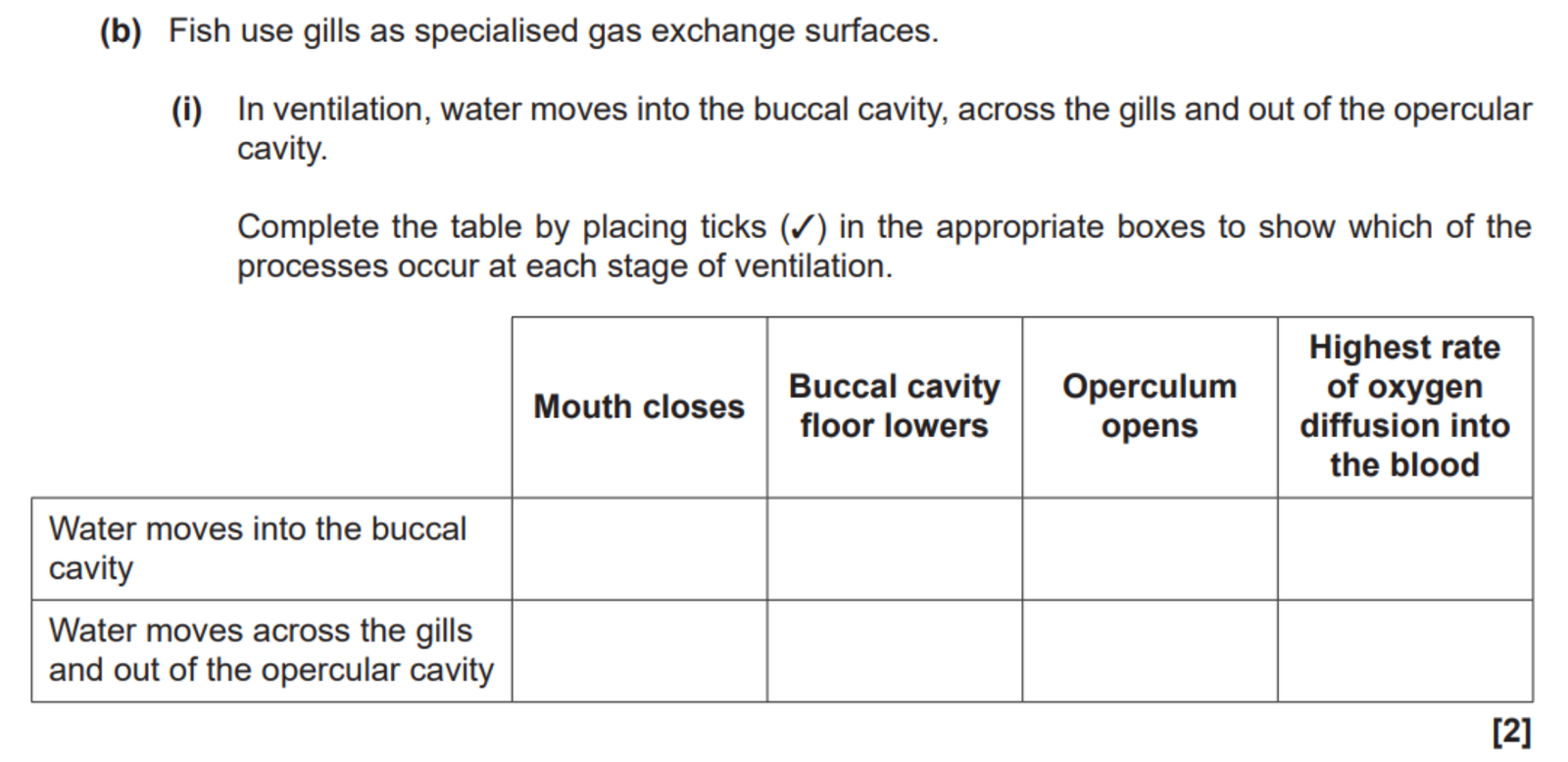
Mark Scheme
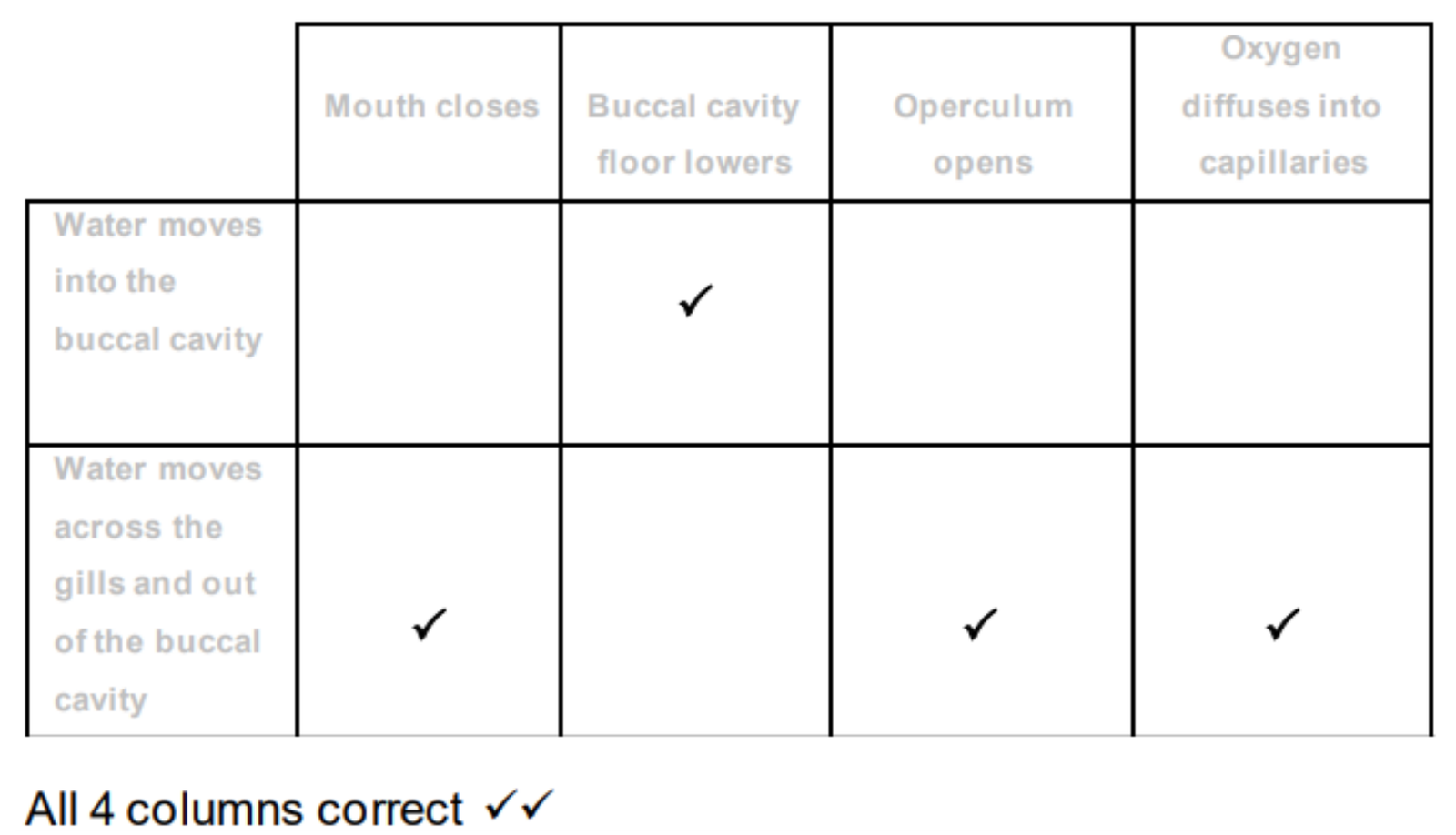
What it requires from students
State the precise biological meaning of a named term. No example or application needed unless asked.
Mark Scheme Insights
Definitions with more than 2 marks target a distinct component of the definition.
Best Example
Question
Define osmosis.
Mark Scheme
2 marks.
- Mark 1: net movement of water across a partially permeable membrane.
- Mark 2: down a water potential gradient.
- IGNORE ‘semi-permeable’ / ‘water concentration’.
What it requires from students
Give the key features, characteristics, or sequence of events that can be observed. No explanation is needed unless asked.
Mark Scheme Insights
Each mark requires a distinct feature or observation.
Best Example
Question
Describe how a student could produce an 8 a.u. solution from a 20 a.u. stock solution.
Mark Scheme
3 marks
- (mix with) distilled water ✓ ALLOW deionized water
- ratio of 3 (water) : 2 (stock solution) ✓ ALLOW any suggested volumes if proportion (3:2) is correct
- IGNORE units IGNORE any procedure with more than one step
What it requires from students
Present arguments and/or evidence for AND against a topic or position. A balanced treatment covering both sides is expected unless specified.
Mark Scheme Insights
Responses that only discuss one side will have their marks capped.
Best Example
Question
Asexual reproduction is also known as cloning. Many organisms can be artificially cloned for commercial purposes. Discuss the arguments for and against artificial cloning in plants and animals.
Mark Scheme
Level 3 (5–6 marks)
Describes arguments for AND against artificial cloning in animals AND plants. There is a well-developed line of reasoning which is clear and logically structured. The information presented is relevant and substantiated.
Generic advantages:
- rapid production of large numbers of individuals
- propagation of individuals with desirable traits
- numbers of rare species can be increased
- production of large numbers of selectively bred or genetically-modified individuals
Animal-specific advantages:
- use of animal example
- key individuals, e.g. beloved pets, can be cloned
Plant-specific advantages:
- propagation of seedless plants
- propagation of plants that are difficult to grow from seed
- quicker than growing from seed
- growth of pathogen-free individuals
- use of plant example
Generic disadvantages:
- lack of genetic variation
- population at greater risk of environmental change
Animal-specific disadvantages:
- process (SCNT) is inefficient / expensive
- high incidence of health issues
- use of animal example
Against cloning in plants:
- if source material is infected with microorganisms offspring will be infected
- complex aseptic procedures
- use of plant example
What it requires from students
Produce a biological drawing, diagram, or graphical annotation as specified. May include a labelled biological drawing, a matching-lines task, or circling/annotating a diagram.
Mark Scheme Insights
Features include:
Correct structure/shape; continuous ruled lines; ruled label lines touching (not crossing) features; correct labels; NO shading; No arrows as label lines.
Best Example
Question
Draw a labelled diagram of cell C [monocyte].
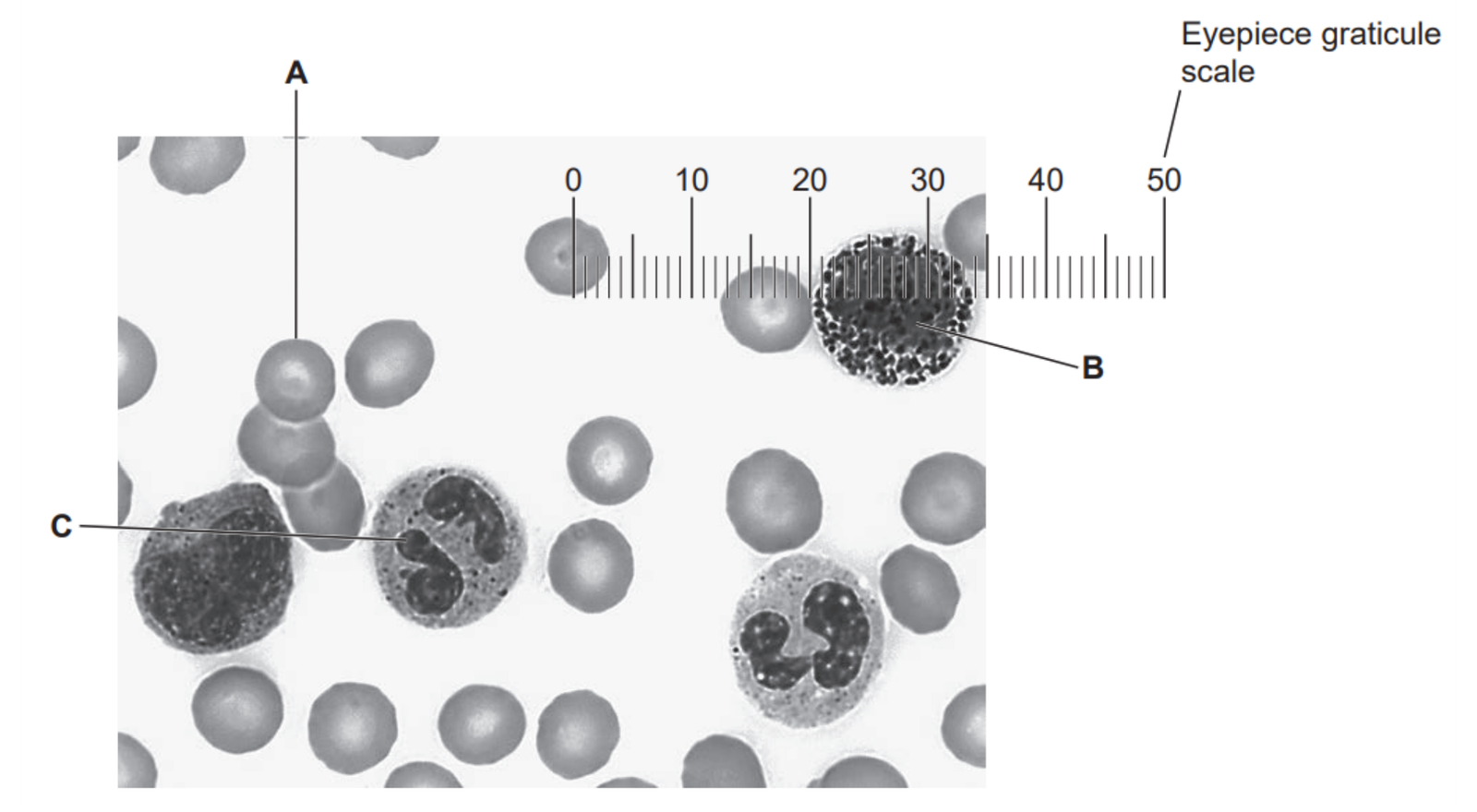
Mark Scheme
4 marks: single cell, bilobed nucleus, continuous lines ≥45 mm, ruled label lines, correct labels.
CREDIT colour annotations. DO NOT CREDIT shading.
What it requires from students
Read or derive an approximate value from a graph, diagram, or data.
Mark Scheme Insights
Any value within the stated tolerance is credited.
Best Example
Question
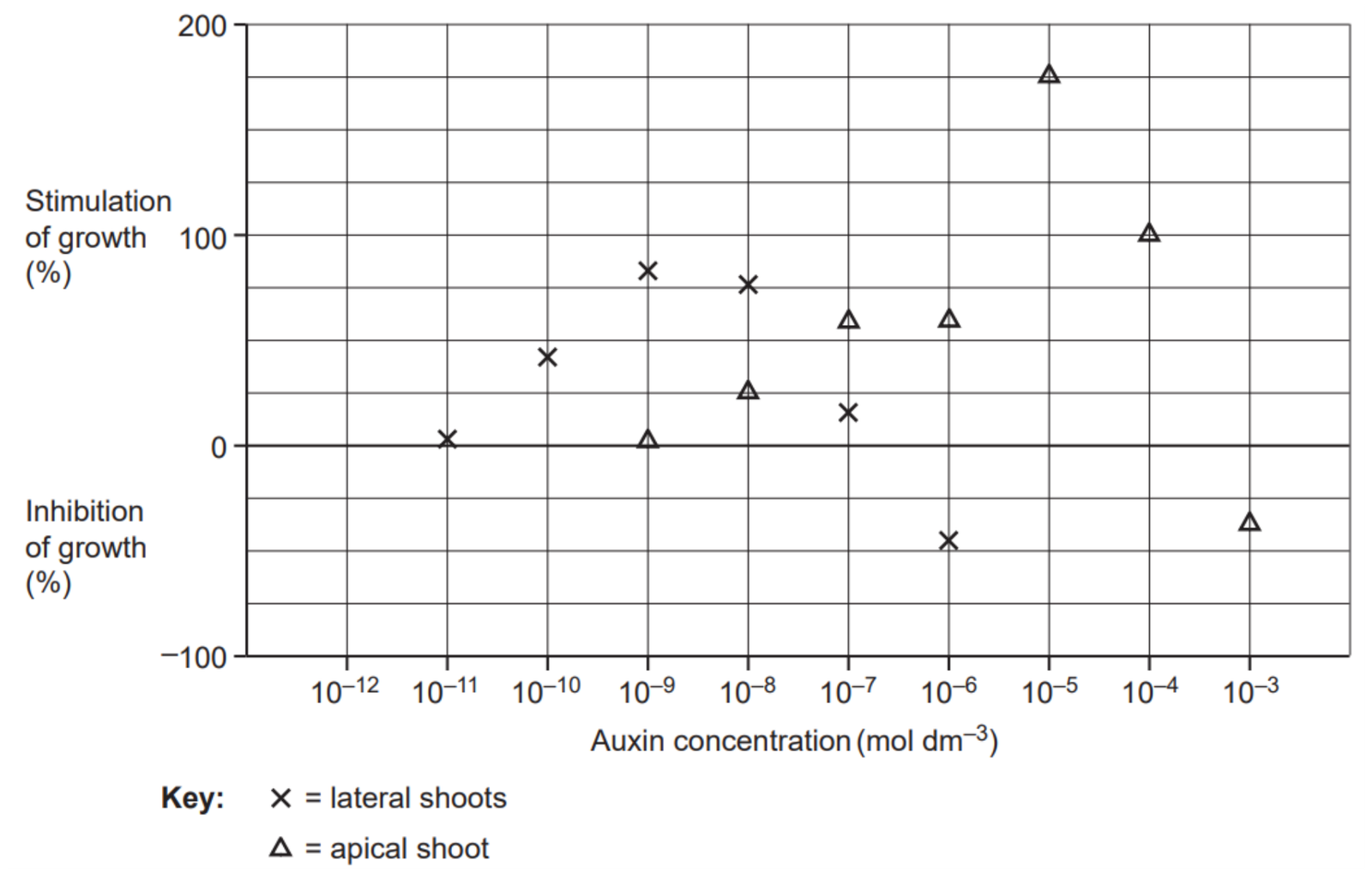
Use the graph to estimate the auxin concentration at which inhibition of lateral shoots is 100%.
Mark Scheme
1 mark. Correct value read from graph at the 100% inhibition crossing point.
What it requires from students
Assess the strengths, limitations, and overall validity of data, a method, a conclusion, or an argument. A judgment is often expected.
Mark Scheme Insights
Responses that only discuss one side will have their marks capped.
Best Example
Question
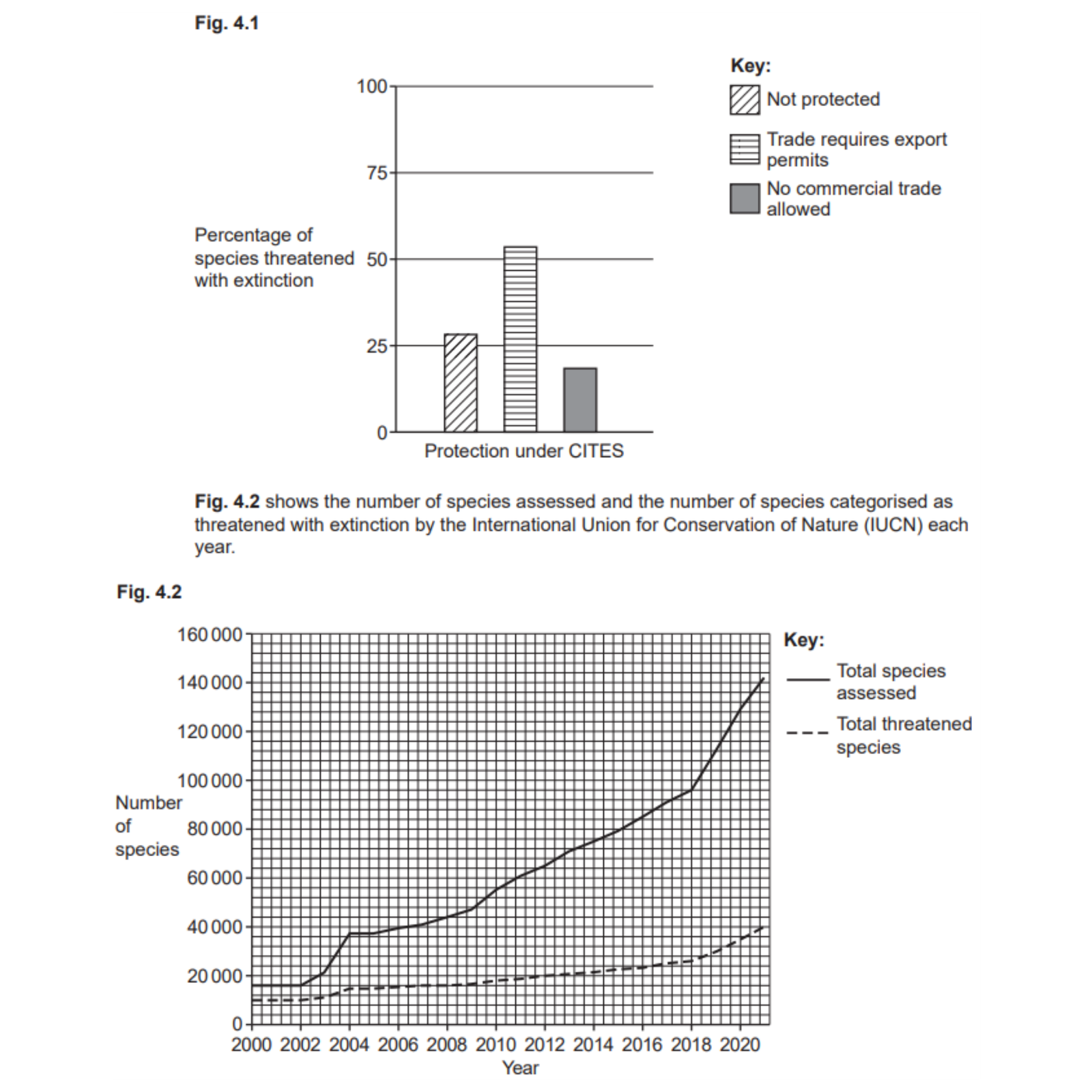
Using the data in Fig 4.1 and Fig 4.2, evaluate how successful CITES has been in achieving its aim.
Mark Scheme
Level 3 (5-6 marks) Detailed evaluation of the negatives and positives in the data from both graphs. There is a well-developed line of reasoning which is clear and logically structured. The information presented is relevant and substantiated.
Indicative scientific points may include (but are not limited to):
Positives (indicators of success)
- The majority of species identified as threatened are protected under CITES (4.1).
- Approximately 20% of threatened species cannot be traded (4.1).
- The number of species being assessed by the IUCN is increasing every year, which means more species can be added to the protected list (4.2).
- The number of species being assessed is rising faster than the number of species identified as threatened (4.2).
Negatives (indicators of lack of success)
- A large number (more than a quarter) of species identified as threatened are not protected under CITES (4.1).
- A large number (more than three-quarters) of the species identified as threatened can still be traded (4.1).
- Trade is only one aspect of protecting threatened species (4.1).
- The number of species assessed is a small fraction of the total number of species that exist, which means most threatened species have not been assessed or protected (4.2).
- The number of threatened species has increased more rapidly in recent years (from 2018) (suggesting conservation has not been successful) (4.2).
- No data on the number of species that have become extinct (4.2).
- The IUCN and CITES alone cannot prevent extinctions (4.1 /4.2).
What it requires from students
Give the biological mechanism or causal reasoning behind a fact, observation, or result.
Mark Scheme Insights
Do not merely re-state the observation; ensure it is linked to the explanation.
Best Example
Question
Explain why cells produced by mitosis in a root tip are genetically identical.
Mark Scheme
2 marks.
- Mark 1: same DNA / chromosomes.
- Mark 2: produced by DNA replication from same parent cell.
What it requires from students
Provide a specific answer, fact, or example. No explanation is needed unless asked.
Best Example
Question
Give one other application of urine analysis in diagnosis. State the substance measured and the corresponding medical condition.
Mark Scheme
1 mark. Correct substance AND corresponding condition both required (e.g. glucose → diabetes mellitus).
What it requires from students
Name or recognise specific features, items, or components from the provided material.
Best Example
Question
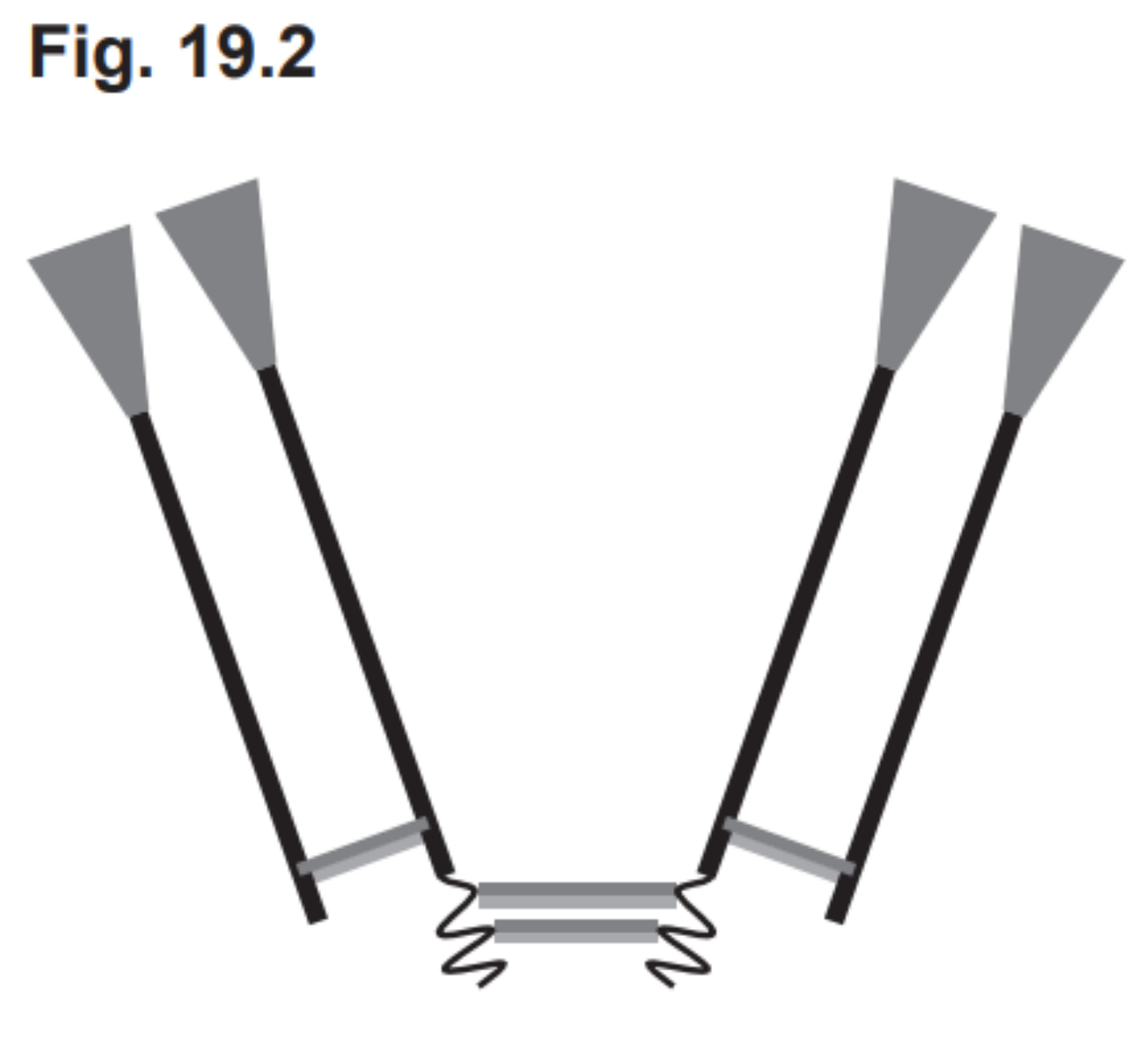
Identify two similarities and one difference in structure between a Fab fragment (Fig. 19.2) and a whole antibody.
Mark Scheme
3 marks.
- Similarity (max 2) two: Variable regions / binding sites ✓ hinge region ✓ disulfide , bond(s) / bridge(s) ✓ four , polypeptides / chains ✓
- Difference: (Fab has) shorter , constant region / heavy chain ✓ IGNORE constant regions (as a similarity). ALLOW no Fc region.
- IGNORE prompt lines, mark first two responses.
- ALLOW ora for antibody.
What it requires from students
Provide a specified number of distinct items without explanation. No explanation is needed unless asked.
Best Example
Question
Important that commercial fishing is done in a sustainable way. Fish farms are one potential solution to declining fish stocks.
(i) List three other strategies that governments could use to increase the sustainability of commercial fishing.
Mark Scheme
3 marks. Only first 3 answers assessed.
- quotas / limiting (mass of) fish caught ✓ ALLOW limit , number / amount , of fish caught IGNORE restrict fishing / limit boats.
- use nets with larger mesh ✓ ALLOW different shaped mesh. IGNORE different sized nets / different mesh size.
- limit fishing to certain times (of year) ✓ ALLOW regulate fishing seasons.
- areas where fishing is banned ✓ ALLOW regulate areas where you can catch fish.
- allow catching of certain (non-endangered) species only ✓ ALLOW regulate which fish can be caught.
- idea of strict enforcement of any one of the above ✓ ALLOW e.g., issuing licences.
What it requires from students
Give the specific biological term, structure, or process.
Mark Scheme Insights
Minor spelling errors are often accepted if unambiguous.
Best Example
Question
Name the technique known as PCR.
Mark Scheme
1 mark. Polymerase chain reaction.
What it requires from students
Give a brief account covering the main points of a biological process, mechanism, or sequence.
Mark Scheme Insights
Less detail than Describe, but all key components must be present. Minor mechanistic detail is not penalised if absent.
Best Example
Question
Outline the importance of photosynthetic pigments in photosynthesis.
Mark Scheme
4 marks.
- (pigments) absorb, light / photons.
- electrons, excited / raised to higher energy level.
- accessory pigments pass energy to reaction centres / primary pigments. ALLOW named accessory pigments e.g. chlorophyll b / xanthophyll / carotenoids.
- primary pigments become oxidised / lose electrons / pass electrons to ETC. ALLOW chlorophyll a for primary pigment.
- for light dependent reaction / photophosphorylation. ALLOW for making , ATP / reduced NADP.
What it requires from students
Place data points onto the provided axes; drawing a line or curve of best fit may be required.
‘Plot as a suitable graph’ requires choosing a graph type, labelling axes, setting a scale, and plotting.
Mark Scheme Insights
Points must be plotted correctly (±½ grid square), and a smooth line of best fit must be used.
Best Example
Question
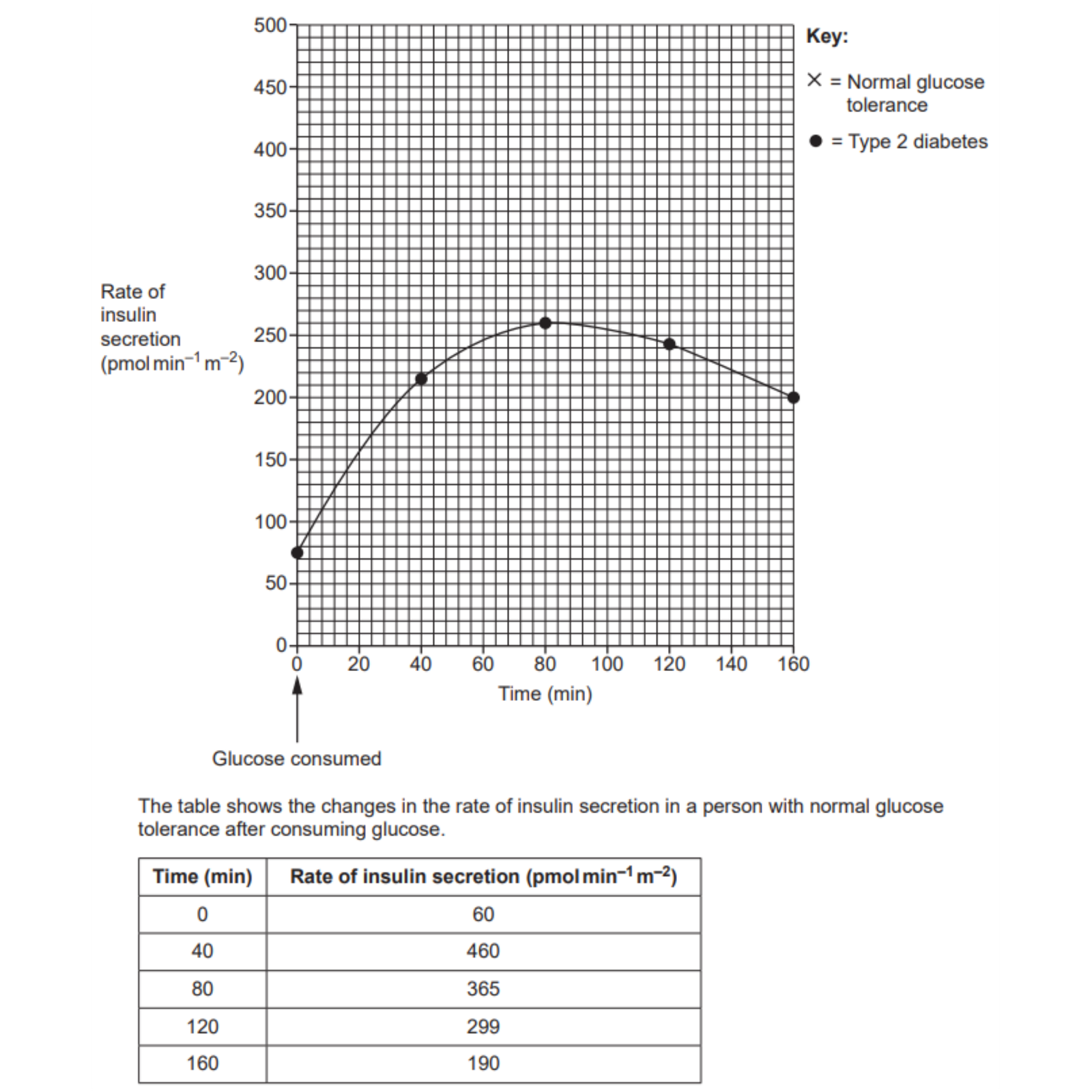
Plot the data from the table on the graph and draw a line of best fit.
Mark Scheme
Mark 1: all 5 points correctly plotted. Mark 2: smooth curve.
- All 5 data points plotted correctly (± half a square).
- (smooth) line of best fit 2 smooth continuous curve starting at point 1 and finishing at point 5 going through all 5 points. ALLOW if goes between points 3 and 4 or misses either point 3 or point. 4 DO NOT ALLOW ruled lines between points.
What it requires from students
State the expected outcome, value, or appearance at a given condition. No explanation is needed unless asked.
Best Example
Question
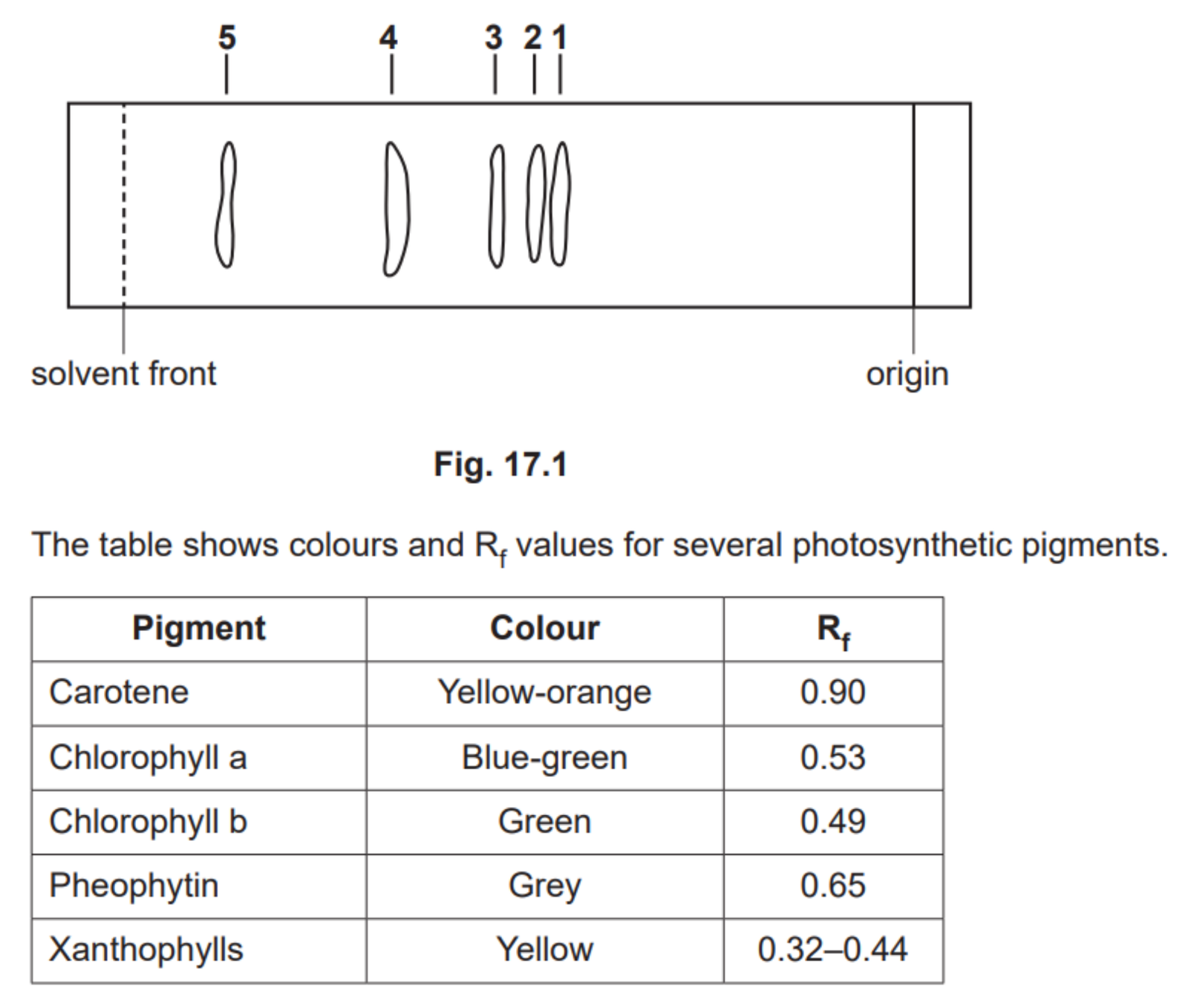
Predict the colour of spot 4.
Mark Scheme
1 mark.
- Grey (pheophytin).
- ALLOW ECF from calculated Rf value in prior question (for ECF looking for a pigment next highest in value than calculated as spot 4 has travelled further from origin than spot 3).
- ECF list: 0.32-0.44 – prediction = green 0.49 – prediction= blue-green 0.65 -prediction = yellow-orange.
What it requires from students
Construct a well-formed data table from the provided data.
Mark Scheme Insights
Features include: ruled lines/border; correct column headings with all variables; units in headings only (not repeated in cells); data to appropriate decimal places.
Best Example
Question
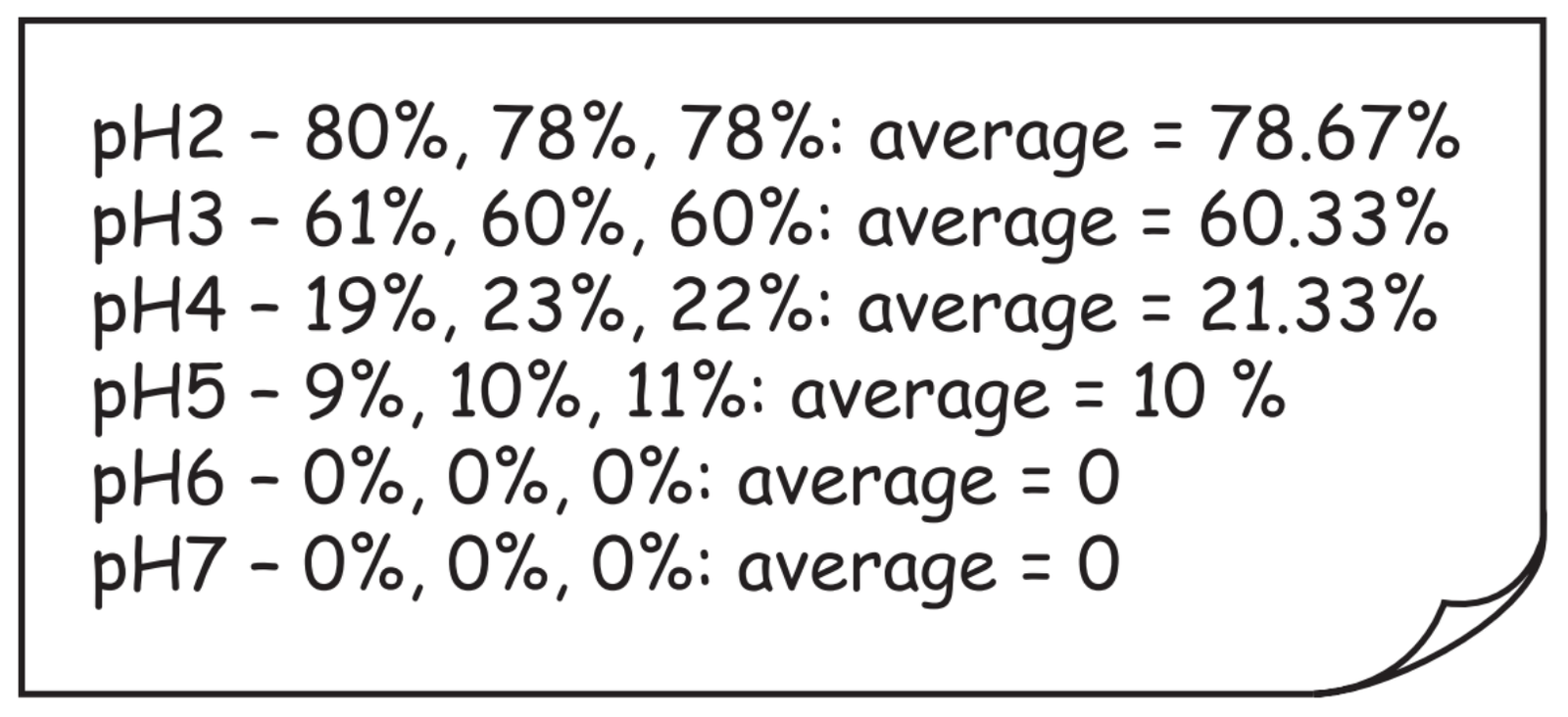
Present the students’ results in an appropriate table.
Mark Scheme
4 marks.
- ruled lines and a border and correct numbers in each column and absorbance and pH and mean in headings.
- pH in left hand column.
- units (%) in headings and not within table.
- means recorded to one decimal place.
What it requires from students
Construct a bar chart from the provided data. Represent always produces a bar chart (unlike plot).
Mark Scheme Insights
Features include: correct bar chart type; labelled axes with linear scale from 0; bars at correct heights; bars within group do not touch; key present.
Best Example
Question
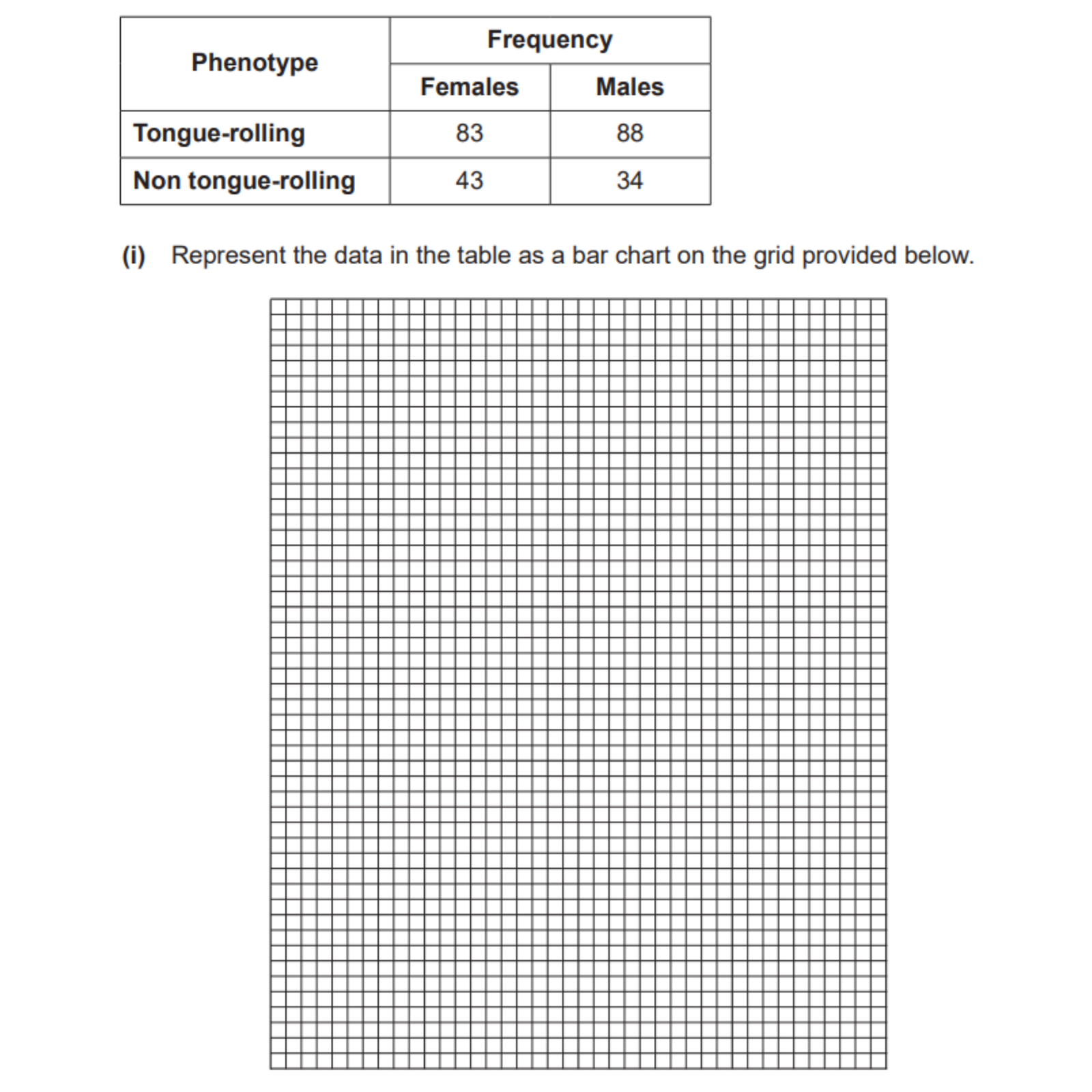
Represent the data in the table as a bar chart.
Mark Scheme
4 marks.
- Mark 1: bar chart (not stacked).
- Mark 2: axes labelled, linear scale from 0.
- Mark 3: bars at correct heights.
- Mark 4: bars within phenotype group do not touch; key present.
- bar chart drawn AND x-axis labelled ‘phenotype’ AND linear y-axis scale labelled ‘frequency’.
- bars correct height and same width.
- bars fill half the available (vertical) space.
- bars labelled / key AND tongue rolling and non-tongue-rolling bars do not touch.
What it requires from students
Draw an approximate representation of the data on a graph using the provided axes.
Mark Scheme Insights
Correct general shape, position relative to existing curve, and trend are assessed. Exact data values are not required unless specified.
Best Example
Question
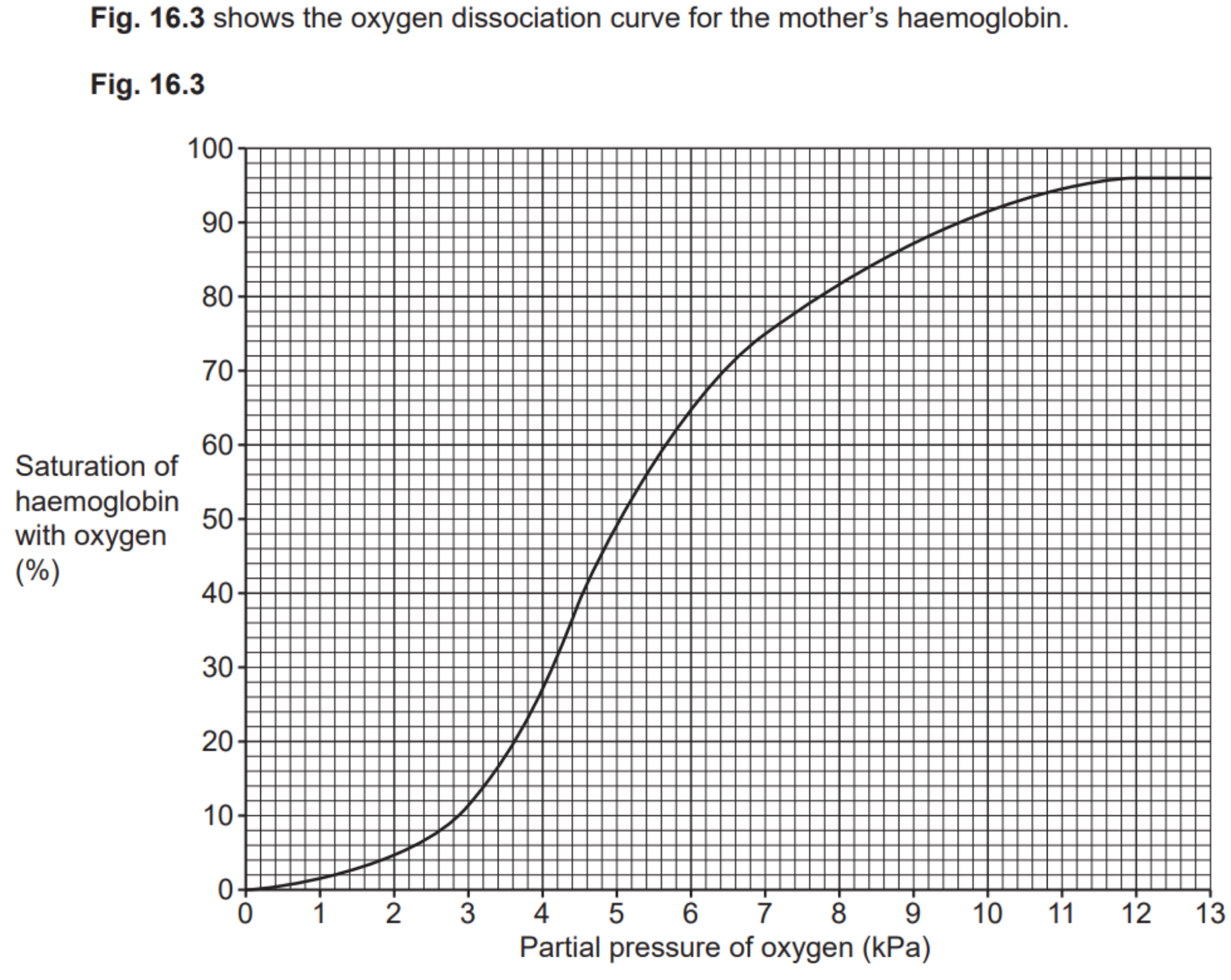
Sketch a curve for foetal haemoglobin on Fig 16.3.
Mark Scheme
1 mark.
- Sigmoid curve sketched to the left of the adult curve.
- Curve must start and finish on same % as maternal and must not exceed 96% at any point.
What it requires from students
Propose a plausible explanation by applying your biological knowledge and providing a reason and/or explanation.
Mark Scheme Insights
Depending on the context, multiple explanations can be correct, and the examiner’s judgement may apply.
Best Example
Question
Suggest why some loci have two peaks but some have only one.
Mark Scheme
2 marks.
- Double peak = heterozygous / different alleles.
- Single peak = homozygous / same allele both copies.
- AVP: correct use of ‘homozygous’/’heterozygous’ even if not linked to peaks.
Put them into practice
Our challenging practice questions are fully aligned to OCR A, so you can test yourself and see what a top response actually looks like.