
Free Investigating the Rate of Respiration OCR A Level Biology revision notes – covering specification points 5.2.1 (iii) and 5.2.1 (l).
Want to go deeper?
Respirometers
A respirometer is a device that can be used to measure oxygen uptake.
Respirometers work by measuring the decrease in volume of a sealed gas chamber containing the air that an organism takes in oxygen from and releases carbon dioxide into.
The decrease in volume is due to the carbon dioxide from respiration being absorbed by a chemical (such as soda lime or potassium hydroxide solution).
The syringe and the U-tube manometer are the two most commonly encountered respirometers used at A level biology.
The diagram below shows examples of both types of respirometer:
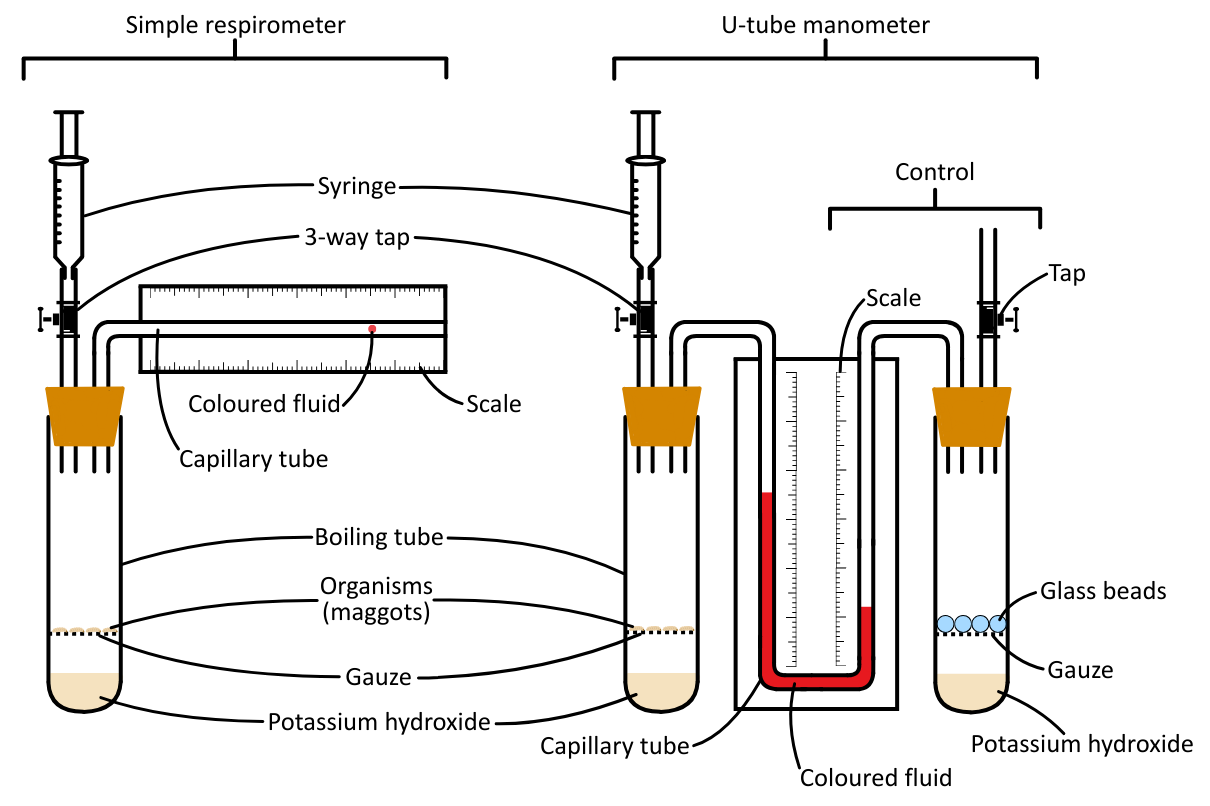
The carbon dioxide absorber is separated from the organisms using a wire mesh or muslin cloth to prevent harm to the organisms.
In both experiments, the distance moved by the coloured fluid along the capillary tubing allows for the volume of carbon dioxide to be calculated using the following equation:
Volume = π × radius² × length (distance travelled)
Practical Investigations into Respiration in Yeast
In OCR A Level Biology you need to be able to use your general understanding of aerobic and anaerobic respiration in yeast to interpret experimental investigations. You are not required to learn or recall any specific experiment.
Respiration in yeast can be investigated under both aerobic and anaerobic conditions:
- Aerobic respiration in yeast occurs when oxygen is available, producing CO₂, water, and a high yield of ATP.
- Anaerobic respiration (ethanol fermentation) occurs in the absence of oxygen, producing CO₂ and ethanol with a low yield of ATP (2 ATP per glucose).
The rate of aerobic respiration can be measured by O₂ consumption, CO₂ production, or redox indicator decolourisation.
The rate of anaerobic respiration can be measured by CO₂ production or ethanol detection.
The table below outlines two examples of practical investigations for investigating respiration in yeast suspensions, and what can be inferred from the observations of each:
| Experiment | Observation | Inference |
|---|---|---|
| Yeast suspension is placed in a respirometer. The effect of temperature or glucose concentration is investigated. | Coloured fluid moves towards the experimental tube. | The rate of fluid movement reflects the rate of O2 consumption, allowing the rate of aerobic respiration in different conditions to be calculated. |
| Yeast suspension with oxygen excluded is placed alongside hydrogencarbonate indicator solution. The effect of temperature, glucose concentration, or substrate type is investigated. | Indicator changes from red towards yellow as the CO2 concentration increases. | Rate of colour change reflects the rate of CO2 production in anaerobic respiration in different conditions. |