
Free Aerobic Respiration OCR A Level Biology revision notes – covering specification points 5.2.2 (c), 5.2.2 (d), 5.2.2 (e), 5.2.2 (f), 5.2.2 (g) and 5.2.2 (h).
Want to go deeper?
Glycolysis
Glycolysis is the first stage of both anaerobic and aerobic respiration (so it does not use oxygen) and occurs in the cytoplasm of all living cells.
Glycolysis is a series of enzyme-controlled reactions that phosphorylate and break down one molecule of glucose (6C) into two molecules of pyruvate (3C), producing a small yield of ATP and reduced NAD that can be used in subsequent stages of respiration.
The diagram below outlines the process of glycolysis:

It is useful to know that glycolysis is simplified at A level, with many intermediate substances and enzymes omitted for simplicity. You are not required to learn them.
The pyruvate and reduced NAD, which are produced in glycolysis, either remain in the cytoplasm to enter anaerobic respiration pathways or enter the mitochondria to be used in aerobic respiration.
The Link Reaction
The link reaction occurs in the matrix of the mitochondrion, utilising pyruvate from glycolysis to produce acetyl-coenzyme A and reduced NAD.
During the link reaction, pyruvate (3C) is decarboxylated into acetyl-CoA (2C), and NAD is reduced into reduced NAD.
The diagram below outlines the process of the link reaction:

It is important to note that coenzyme A acts as a carrier molecule, transferring the acetyl group (2C) from the link reaction to the Krebs cycle.
The Krebs Cycle
The Krebs cycle (also known as the citric acid cycle) occurs in the matrix of the mitochondrion.
The Krebs cycle is a series of cyclical enzyme-controlled reactions that oxidise the acetyl group from acetyl-CoA into carbon dioxide, producing reduced coenzymes (NAD and FAD) and ATP.
The role of the Krebs cycle is to complete the oxidation of glucose by removing hydrogen atoms (which are carried by reduced NAD and reduced FAD) for use in oxidative phosphorylation and to produce ATP through substrate-level phosphorylation.
The Krebs cycle begins when the acetyl group (2C) from acetyl CoA combines with oxaloacetate (4C) to form citrate (6C). This also regenerates CoA for use in the link reaction.
Through a series of oxidation and decarboxylation reactions, citrate is converted back into oxaloacetate, allowing the cycle to continue.
The diagram below outlines the process of the Krebs cycle:

Oxidative Phosphorylation
Oxidative phosphorylation is the final stage of aerobic respiration and occurs on the inner mitochondrial membrane (cristae).
Oxidative phosphorylation generates a large amount of ATP using an electrochemical gradient established by the electron transport chain (ETC) using the reduced coenzymes from glycolysis, the link reaction and the Krebs cycle.
The diagram below shows the processes that occur on the cristae during oxidative phosphorylation:
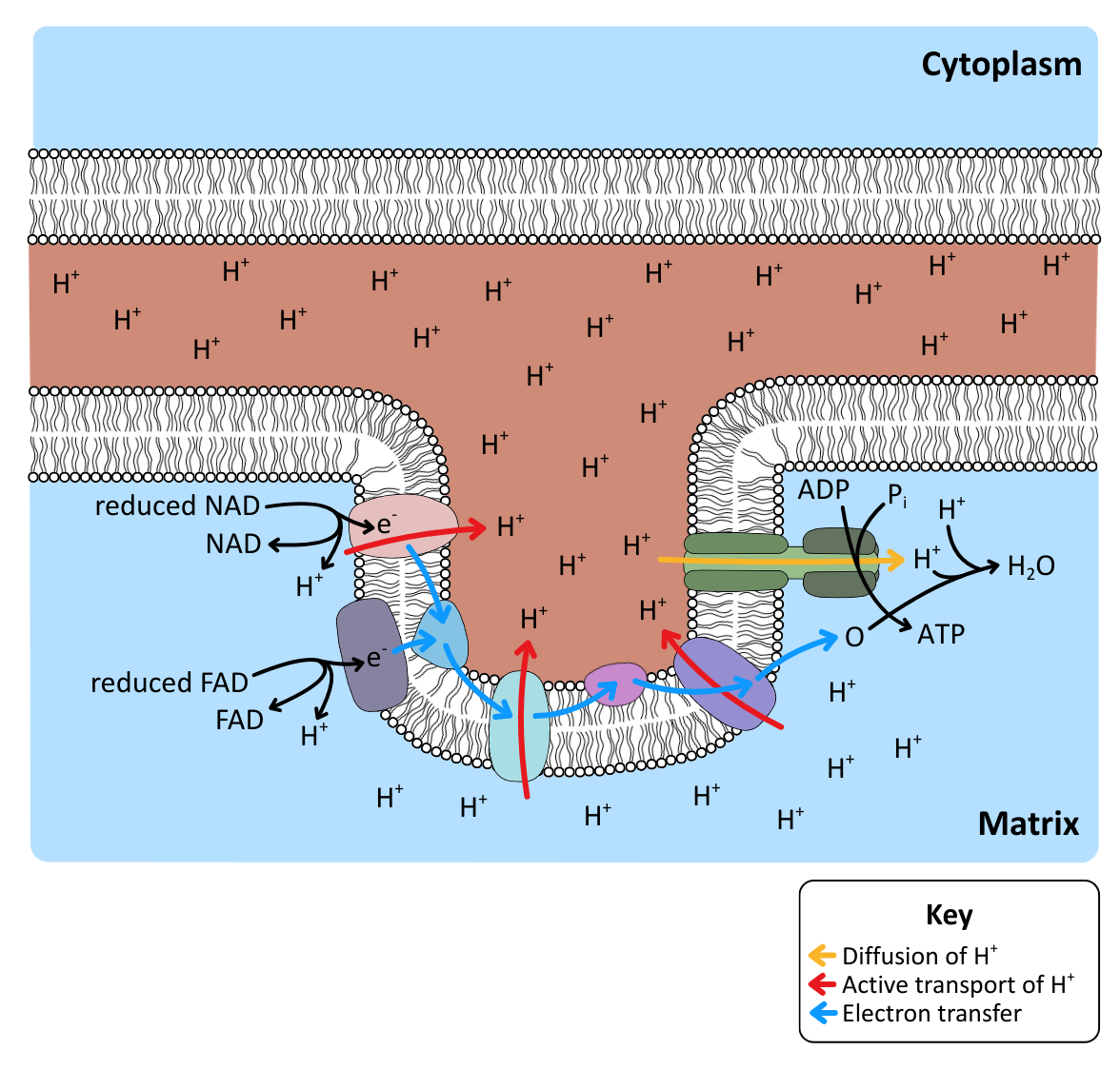
The process can be summarised as:
- Reduced NAD and reduced FAD are both oxidised at the ETC, releasing electrons and H⁺, which regenerates NAD and FAD for the earlier stages of respiration.
- Electrons are transferred along the ETC, releasing energy that is used to actively transport H⁺ from the matrix into the intermembrane space.
- H⁺ accumulate in the intermembrane space, creating an electrochemical gradient.
- H⁺ diffuse down their electrochemical gradient through ATP synthase, which uses the energy to phosphorylate ADP + Pᵢ into ATP, and into the matrix.
- Electrons and H⁺ are accepted by oxygen (the final electron acceptor), forming water.
The overall yield for ATP from aerobic respiration is between 30 – 32 ATP.