
Free Respiration and Mitochondria OCR A Level Biology revision notes – covering specification points 5.2.2 (a) and 5.2.2 (b).
Want to go deeper?
Respiration is the process by which all living organisms transfer energy stored in organic molecules into ATP, enabling the release of energy for biological processes.
ATP (adenosine triphosphate) is the immediate source of energy for biological processes, which can be quickly hydrolysed to release energy where and when it is needed.
Respiration has different pathways depending on the type of organism and whether oxygen is available.
At A level, respiration is studied in animals (particularly mammals), plants, and microorganisms (particularly yeast), in terms of aerobic and anaerobic respiration:
- Aerobic respiration is the same in all eukaryotic organisms using glycolysis, the link reaction, the Krebs cycle, and oxidative phosphorylation.*
- Anaerobic respiration varies between organisms, as different organisms have evolved different pathways in the absence of oxygen.
*It is useful to know that prokaryotes (bacteria) also carry out aerobic respiration, but the process occurs differently because they lack membrane-bound organelles.
Introduction to Aerobic Respiration
Aerobic respiration uses oxygen as a final electron acceptor.
Aerobic Respiration consists of four distinct stages linked together:
- Glycolysis: Glucose is phosphorylated and split into two molecules of pyruvate, producing a small yield of ATP and reduced NAD (NADH).
- The link reaction: Pyruvate is decarboxylated and dehydrogenated and combined with coenzyme A to form acetyl-CoA and reduced NAD.
- The Krebs cycle: Acetyl CoA is oxidised in a series of enzyme-controlled reactions that produce ATP through substrate-level phosphorylation, and reduce coenzymes.
- Oxidative phosphorylation: Reduced coenzymes are oxidised, and the energy released is used to generate a large yield of ATP through chemiosmosis.
Mitochondria Structure and Function
Aerobic respiration occurs in mitochondria.
The diagram below shows the typical structure of a mitochondrion:
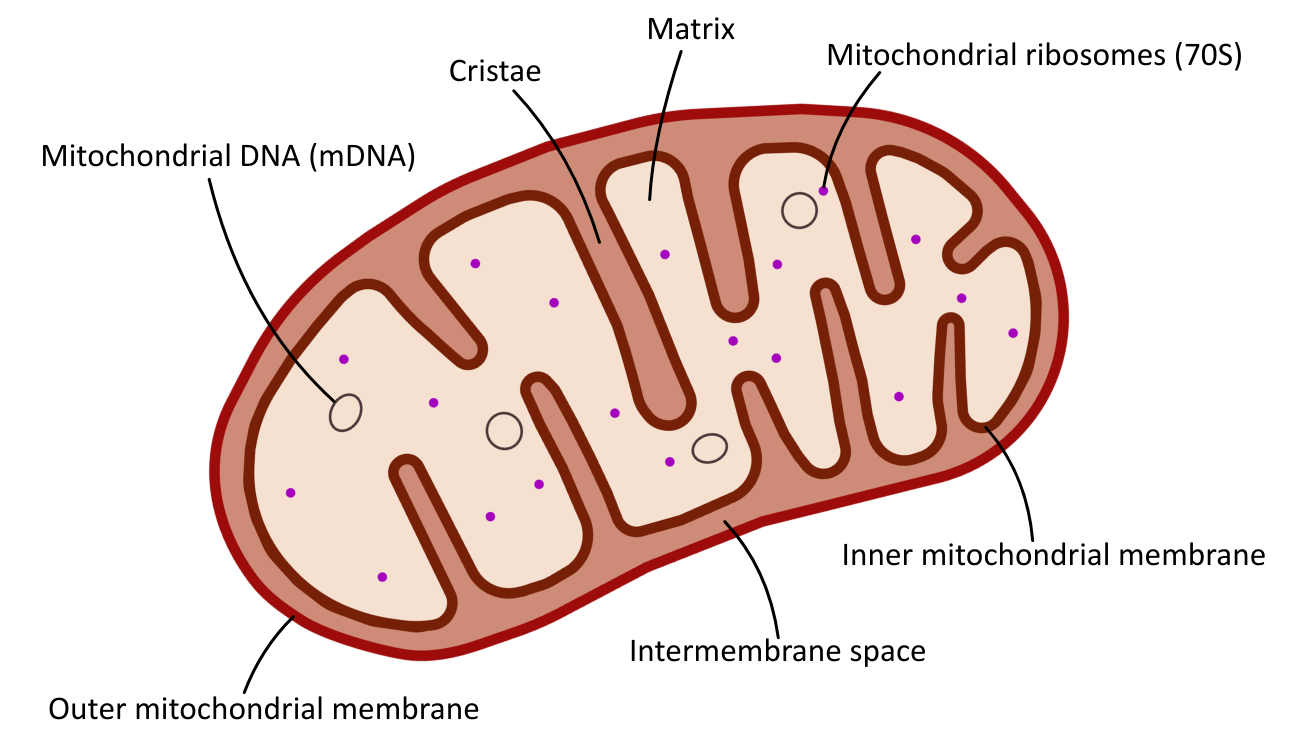
Introduction to Anaerobic Respiration
Anaerobic respiration (also known as fermentation) occurs when oxygen is unavailable as the final electron acceptor for the aerobic respiration pathway, or when additional ATP is needed to supplement ATP production in aerobic respiration.
Anaerobic respiration occurs in the cytoplasm.
There are two main types of anaerobic respiration, lactate fermentation and ethanol fermentation:
- Lactate fermentation: Occurs in mammals and many other animals. Pyruvate is reduced to lactate. This is reversible when oxygen becomes available.
- Ethanol fermentation*: This occurs in yeast and some plants. Pyruvate is decarboxylated to ethanal, which is reduced to ethanol. This is not reversible.
*Also known as alcohol fermentation.