
Free Introduction to Communication Systems in Animals OCR A Level Biology revision notes – covering specification points 5.1.5 (g), 5.1.5 (j) and 5.1.5 (k).
Want to go deeper?
Introduction to Communication Systems in Animals
Animals must continuously respond to changes in both their internal and external environments so they can feed, regulate their internal conditions, avoid danger, and maintain homeostasis.
The two main communication systems in animals are the nervous and endocrine systems:
- The nervous system uses electrical impulses along neurones and neurotransmitters across synapses. This produces extremely fast, targeted and short-lived responses ideal for movement, reflexes and rapid changes in heart rate or ventilation.
- The endocrine system uses hormones released into the bloodstream. Hormonal responses develop more slowly but last longer, supporting processes such as metabolic control, growth, development and long-term stress responses.
Coordinating Responses
The nervous system and endocrine systems often work together, and are (typically) coordinated by the hypothalamus.
The Fight-or-Flight Response
The fight-or-flight response to stress is the required example of coordination by the nervous and endocrine systems in the OCR A level Biology course:
- The hypothalamus stimulates the sympathetic nervous system (SNS), causing pupils to dilate, bronchial tubes to widen, an increased heart rate, and redirection of blood flow to muscles.
- The hypothalamus also signals the pituitary gland to secrete ACTH***, which in turn stimulates the adrenal cortex to secrete corticoid hormones that increase metabolism, blood glucose and blood pressure.
***Adrenocorticotropic hormone.
The SNS also signals the adrenal medulla to release adrenaline and noradrenaline.
The Control of Heart Rate
Heart rate is controlled by both the autonomic nervous system (via the cardiovascular centre in the medulla oblongata) and the endocrine system (via the hypothalamus).
Nervous Control of Heart Rate
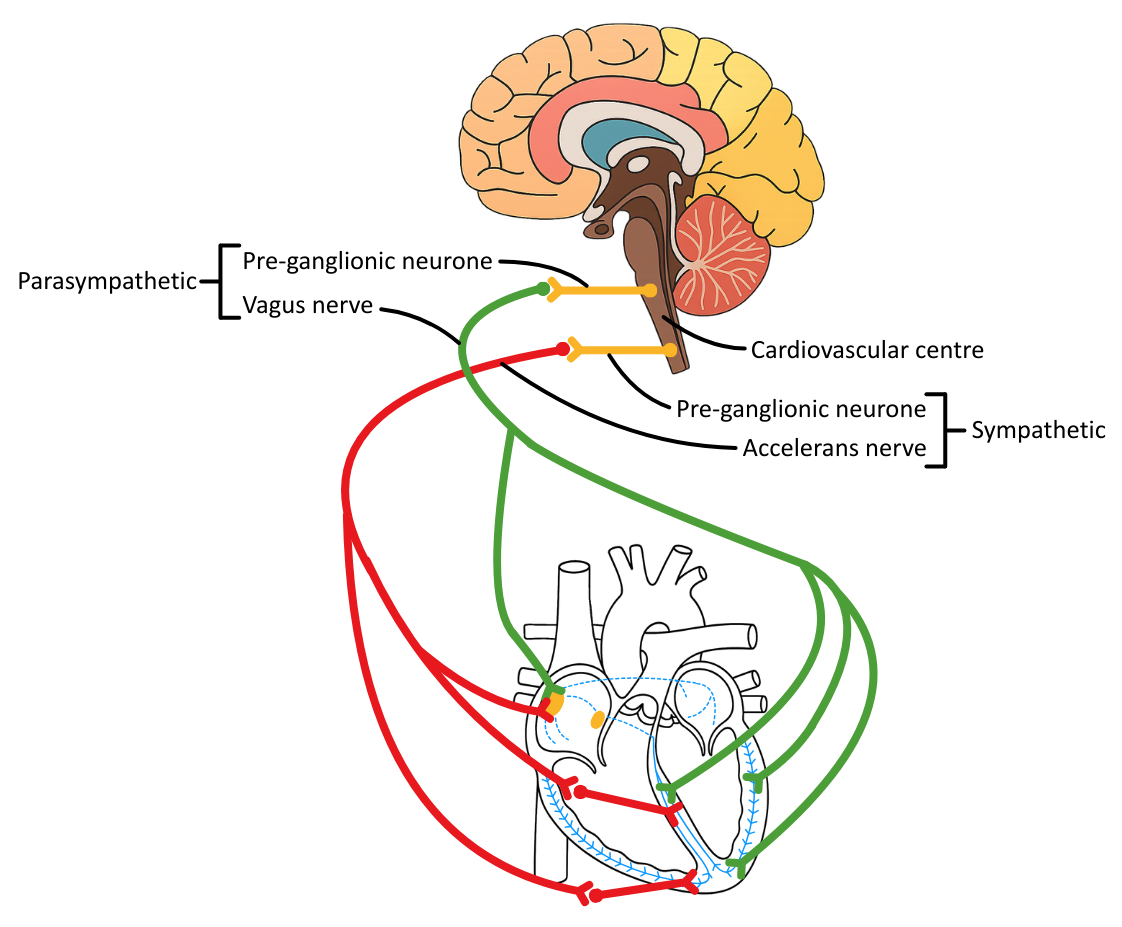
The cardiovascular centre can control the activity of two separate nerves, the accelerans nerve and the vagus nerve:
- The accelerans nerve is a part of the sympathetic division of the nervous system, and releases noradrenaline to increase the SAN’s activity, increasing the heart rate.
- The vagus nerve is a part of the parasympathetic division of the nervous system, and releases acetylcholine to reduce the SAN’s activity, reducing the heart rate.
The diagram below shows how the accelerans and vagus nerve link the cardiovascular centre to the heart:
Hormonal Control of Heart Rate
The hypothalamus can stimulate the adrenal medulla, which responds by releasing adrenaline (a first messenger hormone).
Adrenaline’s mechanism of action can be summarised as:
- Adrenaline binds to its complementary receptor on the cell surface membrane of its target cells in heart tissue, which stimulates adenylyl cyclase.
- Adenylyl cyclase converts ATP into cyclic AMP (cAMP), which acts as the second messenger inside the cell, causing metabolic changes to increase heart rate.