
Free Hormonal Control of Seed Germination OCR A Level Biology revision notes – covering specification points 5.1.5 (b), 5.1.5 (d) and 5.1.5 (e).
Want to go deeper?
Germination typically depends on the ability of an embryo to synthesise and release gibberellin after water uptake, so that seed tissues can release the stored nutrients needed for early growth.
The diagram below shows the typical structure of a cereal grain:
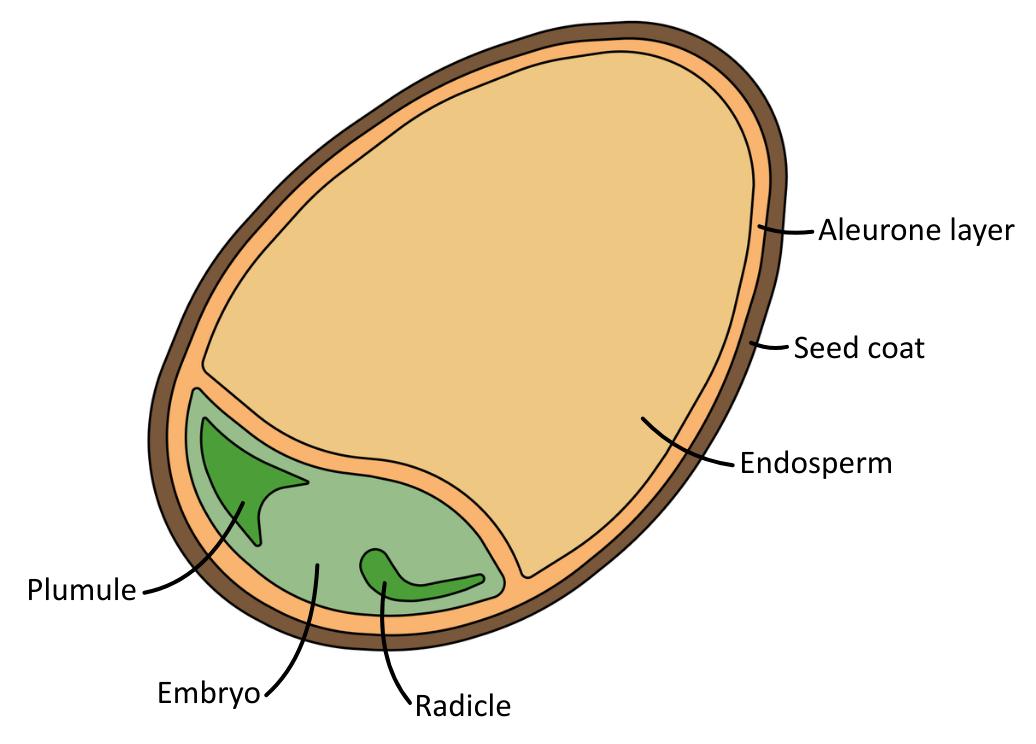
Cereal grains (such as barley and wheat) are characterised by an aleurone layer which surrounds a starchy endosperm.
Gibberellins promote the gene expression of hydrolytic enzymes that release nutrients for the growth of the radicle and shoot during germination.
Gibberellin’s mechanism of stimulation in seed germination can be summarised as:
- Water enters the seed, rehydrating the embryo, which begins synthesising gibberellin (GA).
- GA diffuses from the embryo into the aleurone layer and binds to complementary receptors, triggering an intracellular enzyme cascade.
- Genes are switched on that synthesise digestive enzymes (e.g. amylase), which are secreted into the endosperm.
- Nutrient stores are hydrolysed, such as starch turning into maltose and glucose, for use in respiration and metabolism.
Experimental Evidence that GA Controls Seed Germination
In OCR A Level Biology you need to be able to use your general understanding of the mechanisms of gibberellin to interpret experimental investigations. You are not required to learn or recall any specific experiments.
The table below outlines some examples of experiments or natural observations, relating to the control of germination by gibberellin, and what we can infer from them:
| Experiment/ Observation | Mechanism | Observation | Inference |
|---|---|---|---|
| GA inhibitor applied to seeds | Blocks early GA synthesis steps |
|
Internal GA synthesis is required to initiate germination. |
| GA restores germination in GA-deficient mutant seeds | Genetic defect blocks the GA metabolic pathway. |
|
|