
Free The Adrenal Glands OCR A Level Biology revision notes – covering specification point 5.1.4 (b).
Want to go deeper?
The Adrenal Glands
The adrenal glands are a pair of endocrine glands that sit just above the kidneys.
The diagram below shows the position of the adrenal glands above the kidneys:
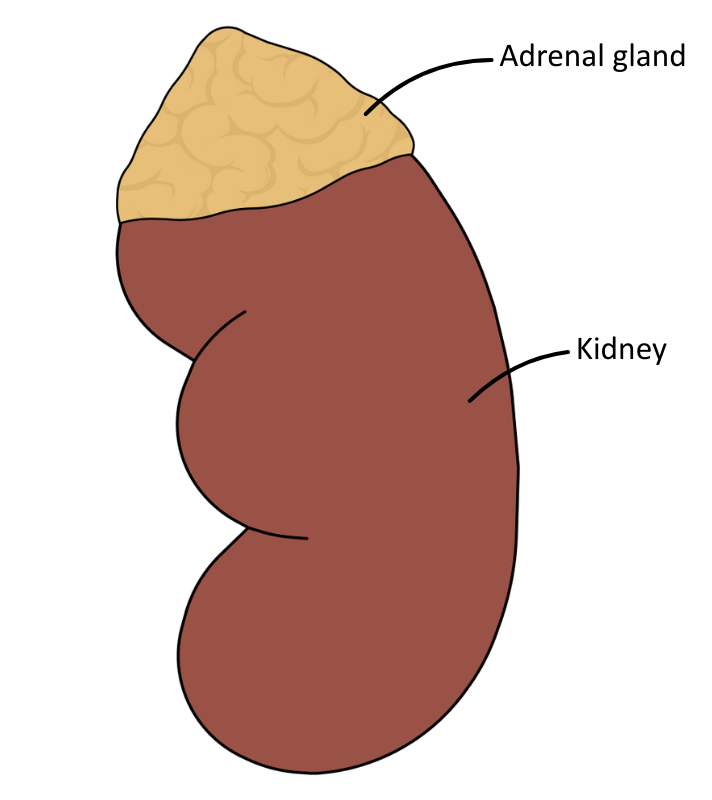
Each gland has a thin outer capsule surrounding an outer (the adrenal cortex) and an inner (the adrenal medulla) region of tissue:
- Adrenal cortex: The outer layer of the adrenal gland that makes steroid hormones.
- Adrenal medulla: The inner layer that releases adrenaline and noradrenaline.
The Adrenal Cortex
The adrenal cortex consists of three regions (called zones), each producing different hormones with their own roles.
The table below outlines each zone of the adrenal gland, its primary hormone(s), and their role(s):
| Zone | Hormones secreted | Role |
|---|---|---|
| Zona glomerulosa (outermost) | Mineralocorticoids (e.g. aldosterone) | Ion/ water balance |
| Zona fasciculata (middle) | Glucocorticoids (e.g. cortisol) | Metabolism/ stress |
| Zona reticularis (innermost) | Androgen precursors (e.g. DHEA, androstenedione) | Sex hormone precursors |
The Adrenal Medulla
The adrenal medulla consists of a single region that secretes adrenaline and noradrenaline into the bloodstream.
It is important to note that the adrenal medulla is the site of synthesis and release of adrenaline, which is the named example of a hormone involved in coordinating responses in the OCR A level Biology specification.
The full overview of adrenaline’s mechanism of action is outlined below:
Adrenaline → binds to receptor → G protein activated → adenylyl cyclase activated → ATP converted to cAMP → cAMP activates PKA →
Enzymes phosphorylated by PKA → Enzymes carry out metabolic responses.
The table below outlines some of adrenaline’s main effects on its target tissues and the response:
| Effect on target tissue(s) | Response |
|---|---|
| Increases heart rate and stroke volume | Raises cardiac output and blood pressure |
| Vasoconstriction | Raises systemic blood pressure |
| Vasodilation in skeletal muscles | Directs blood flow to active tissues |
| Vasoconstriction in the skin and gut | Redirects blood away from non-essential areas |
| Dilates bronchioles | Increases airflow and oxygen delivery |