
Free Sensory Receptors OCR A Level Biology revision notes – covering specification point 5.1.3 (a).
Want to go deeper?
Sensory Receptors
Sensory receptors are specialised cells or sensory nerve endings that detect a change (stimulus) in the internal or external environment.
Receptors are biological transducers.
Transducers convert one form of energy (such as light, pressure, or chemical energy) into an electrochemical signal in the form of a small, local change in potential difference called a generator potential.
If enough generator potentials result in the sensory receptor’s threshold potential being reached, then an action potential will be initiated, leading to an electrical impulse.
The table below outlines the key terms referring to sensory receptors:
| Term | Definition |
|---|---|
| Stimulus | A detectable change in the internal or external environment. |
| Sensory receptor | A specialised cell or sensory nerve ending that detects a stimulus. |
| Transducer | A structure that converts stimulus energy (e.g. light, pressure, chemical, or temperature) into electrochemical energy. |
| Generator potential | A small, local depolarisation of the receptor membrane is caused by ion movement when a stimulus is detected. |
| Threshold potential | The level of depolarisation needed to trigger an action potential. |
The Pacinian Corpuscle
The Pacinian corpuscle is a mechanoreceptor (detects pressure) in the skin and around joints that detects changes in pressure.
Pacinian corpuscles are the given examples of receptors in the OCR A Level Biology course.
The Pacinian corpuscle itself is an oval-shaped structure around the nerve ending; the oval shape is formed from layers of connective tissue, which, when pushed, deform the membrane.
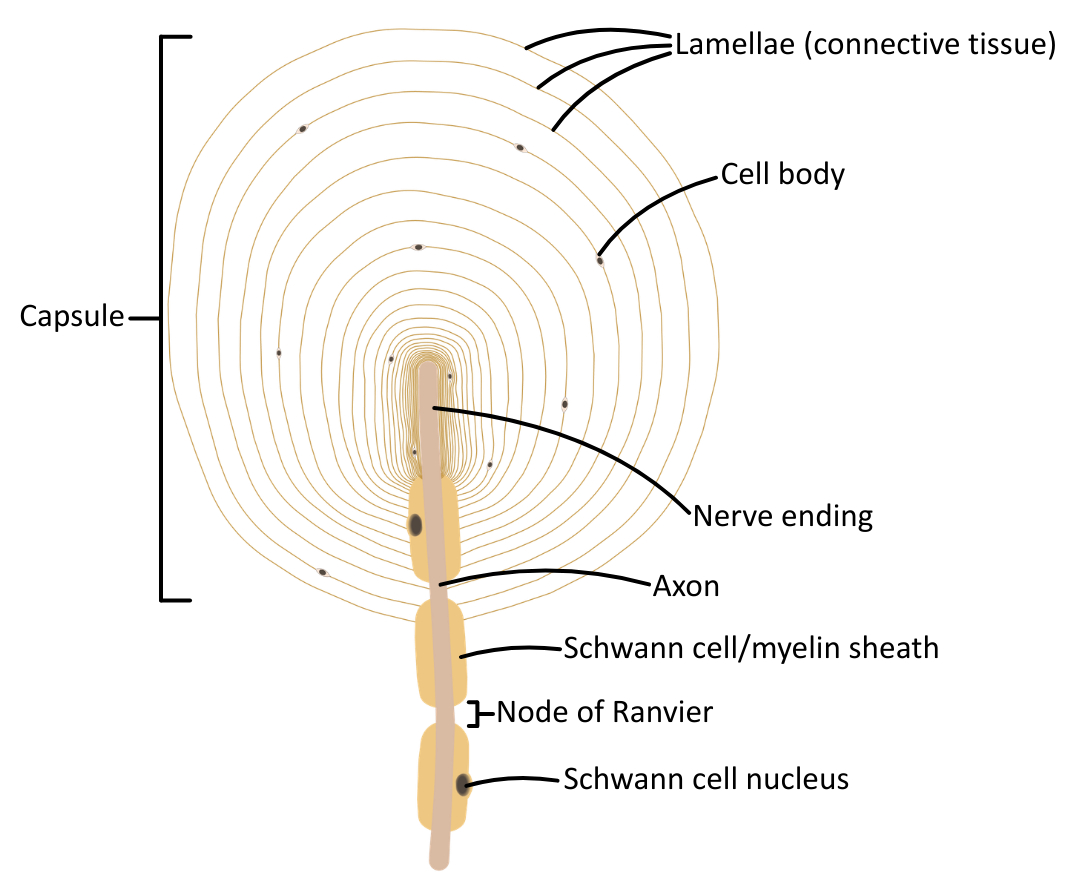
When the axon membrane is deformed, stretch-gated Na⁺ channels open, creating a generator potential.