
Free Kidney Failure OCR A Level Biology revision notes – covering specification point 5.1.2 (e).
Want to go deeper?
Kidney failure is the loss of the kidneys’ ability to filter waste effectively.
The effect of kidney failure on the bloodstream is the loss of effective regulation of water potential, electrolyte balance, and/or pH of the blood, causing serious dysfunction and illness if left untreated.
Causes of kidney failure
It is important to note that in OCR A you do not need to know the causes of kidney failure, only its effects and treatment; however, causes of kidney infection provide opportunities for examiners to test you on your understanding of renal function.
All forms of kidney failure will reduce nephron function by damaging the filtration barrier and/or impairing tubular reabsorption.
The table below outlines some causes of kidney failure and their specific mechanisms and health effects:
| Cause | Mechanism of failure | Health Effect |
|---|---|---|
| Type 2 Diabetes mellitus |
|
|
| Hypertension | Persistently high arterial and glomerular pressure damages the glomerular filtration barrier, so proteins with an Mr larger than 69,000 pass into the urine. | Protein in urine. |
| Infection | Inflammation of renal tissue damages the filtration barrier and tubular epithelium, so proteins with an Mr larger than 69,000 pass into the filtrate, and selective reabsorption is lowered. |
|
*Mr stands for relative molecular mass.
Assessing kidney function: Glomerular filtration rate
Glomerular filtration rate (GFR) is the volume of filtrate entering the nephrons each minute (cm³ min⁻¹).
GFR provides a quantitative estimate of renal function.
The table below outlines the typical glomerular filtration rates discussed in clinical settings:
| GFR (cm3 min-1) | Inferred Kidney Function |
|---|---|
| 90–120 | Expected range (interpret with age and context) |
| < 60 | Suggests chronic kidney disease (CKD) |
| < 15 | Kidney failure: urgent intervention |
It is useful to know that GFR is used in conjunction with clinical observations to make an accurate diagnosis.
Treating kidney failure
Treatments for kidney failure aim to restore the control of solutes and water, or at least temporarily restore them to optimal levels.
The primary treatment options are renal dialysis and/or kidney transplants:
- Renal dialysis replaces the kidney’s filtering role by using partially permeable membranes to exchange excess substances from the blood for those that are lacking.
- Kidney transplants implant a donor kidney to restore (nearly) normal renal function.
Renal Dialysis
Renal dialysis relies on diffusion across a partially permeable membrane.
Dialysis fluid contains the optimal concentrations of the substances that should be found in the blood, so that during dialysis, substances that are in excess will move down their concentration gradients.
Renal dialysis comes in two forms, but haemodialysis is the only one required for OCR A level Biology.
The diagram below shows a simplified diagram for haemodialysis:
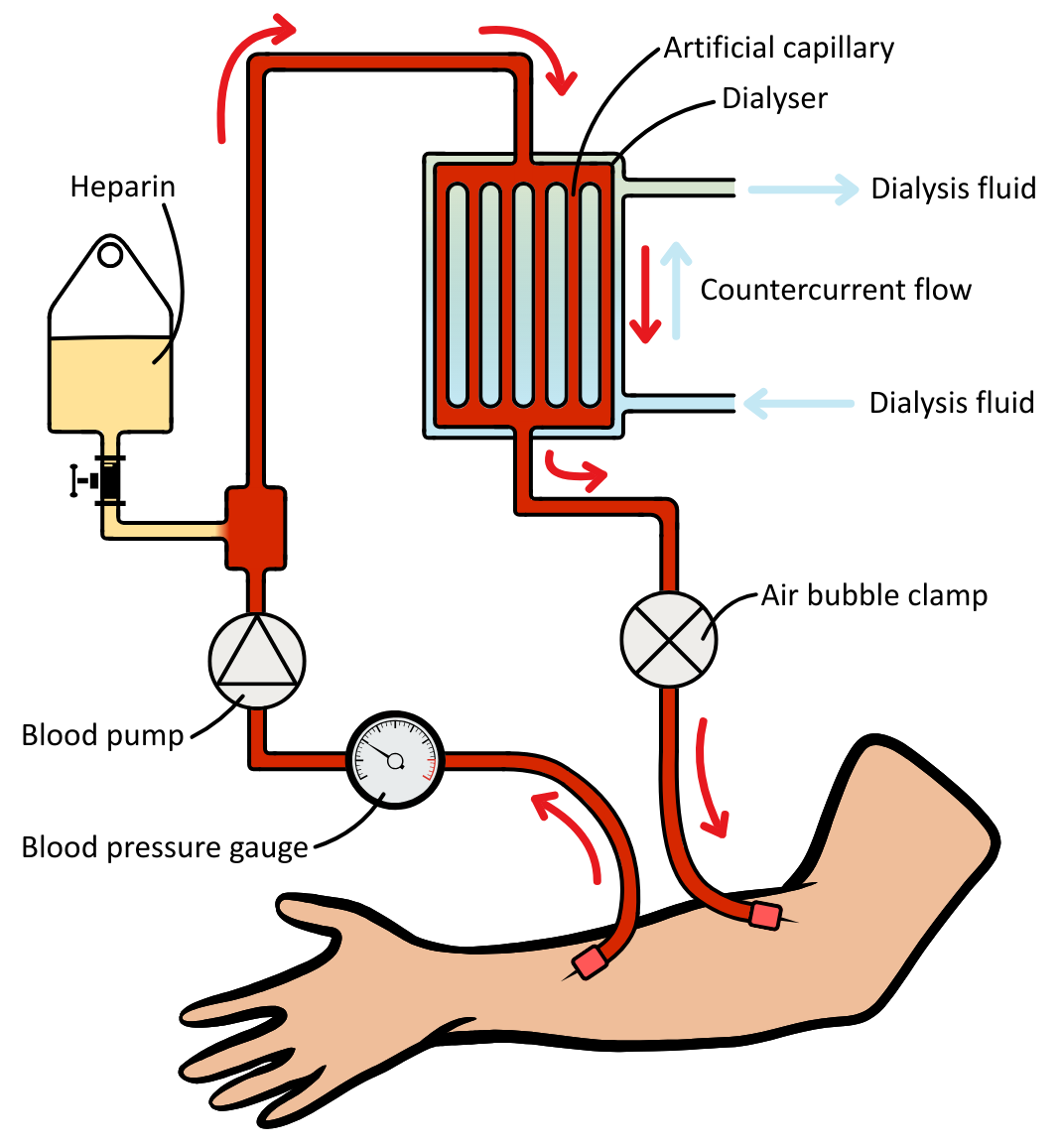
Take note of the countercurrent flow of the dialysis solution and blood.
Kidney transplants
Kidney transplants typically allow patients to feel physically healthy as the concentrations of substances in the blood are steadily maintained, and wastes are effectively excreted.The table below compares the advantages and disadvantages of different kidney failure treatments:
| Treatment | Advantages | Disadvantages |
|---|---|---|
| Haemodialysis |
|
|
| Kidney transplant |
|
|