
Free Osmoregulation: The Collecting Duct and ADH OCR A Level Biology revision notes – covering specification points 5.1.2 (ci) and 5.1.2 (d).
Want to go deeper?
Osmoregulation
Osmoregulation is the homeostatic control of the water potential of the blood and the body fluids to minimise cell shrinking or swelling.
Osmoregulation is under the control of negative feedback processes in the hypothalamus, which controls the reabsorption of water in the collecting duct.
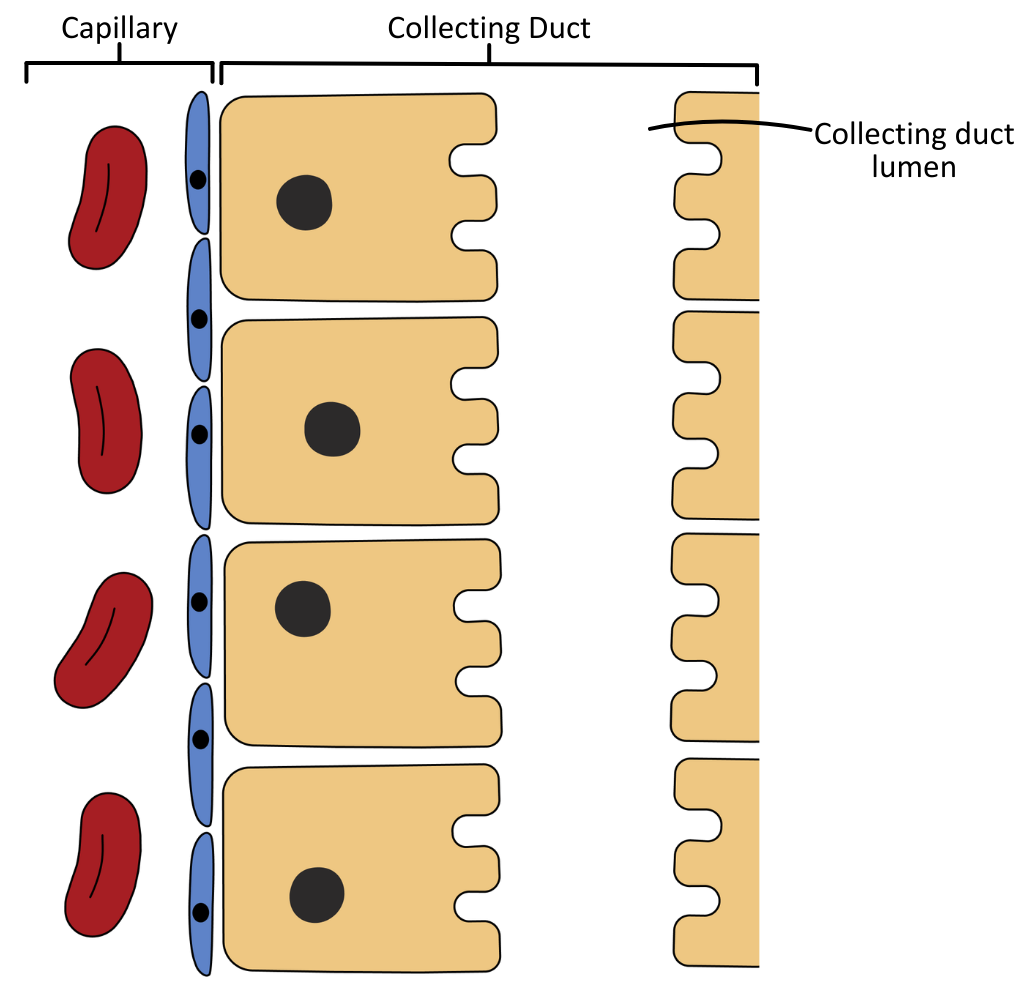
The collecting duct goes down into the medulla towards the renal pelvis, passing through regions of increasingly low water potential, enabling water to move out of the collecting duct and into the blood of the capillaries by moving down its water potential gradient.
To control the reabsorption of water, the epithelial cells can adjust the permeability of their cell surface membranes to water in response to levels of ADH.
The diagram below shows the structures involved in reabsorption of water from the collecting duct:
Control of ADH Secretion
The concentration of ADH in the bloodstream is controlled by negative feedback in the hypothalamus using osmoreceptors and neurosecretory cells working together.
Osmoreceptors are specialised cells in the hypothalamus that monitor the blood’s water potential, shrinking in response to lower blood water potential, and expanding in response to higher blood water potential.
When osmoreceptors shrink (due to a low water potential in the blood), they stimulate the neurosecretory cells, which release ADH into the bloodstream by exocytosis.
ADH travels through the bloodstream before arriving at the kidneys and binding to complementary receptors on the cell surface membrane of the collecting duct’s epithelial cells. This causes the collecting ducts to increase permeability.
When the blood water potential rises (becomes less negative), osmoreceptor cells gain water and swell, inhibiting ADH release, signalling the collecting ducts to reduce permeability.
Mechanism of Water Reabsorption in the Collecting Duct
Aquaporins are present in the cell surface membrane of the collecting duct’s epithelial cells, through which water is reabsorbed by osmosis.
When ADH levels increase (when the water potential of the blood is low):
- ADH binds to complementary receptor proteins on the cell surface membranes of the collecting duct epithelial cells.
- Cell signalling causes vesicles containing aquaporins to move towards and fuse with the cell surface membrane facing the lumen of the collecting duct.
- More aquaporins in the membrane increase the permeability of the collecting duct walls to water.
- Water moves out of the filtrate by osmosis through the aquaporin channels into the medulla, where the water potential is lower.
- Water diffuses into the bloodstream of the capillaries, increasing the blood water potential.
- A smaller volume of concentrated urine is produced.
The increase in blood water potential is detected by osmoreceptors in the hypothalamus, and if it returns to its set point, the release of ADH is reduced.