
Free Homeostasis and Feedback Systems OCR A Level Biology revision notes – covering specification point 5.1.1 (c).
Want to go deeper?
Homeostasis
Homeostasis is the maintenance of a constant internal environment around an optimal set point, despite changes in external or internal conditions.
The table below outlines some of the internal conditions that must be maintained at the organism level:
| Factor | Importance | Typical Set Point (in humans) |
Controlled By |
|---|---|---|---|
| Blood Glucose Concentration | Essential for cellular respiration and osmotic balance. | ~4-6 mmol dm-3 | Pancreas (islets of Langerhans), liver, insulin and glucagon. |
| Blood Water Potential | Maintains osmotic balance between blood plasma and cells. | ~-750 kPa | Hypothalamus (osmoreceptors), posterior pituitary, kidneys. |
| Body Temperature | Affects enzyme and metabolic efficiency. | ~37 °C | Hypothalamus, effectors in skin and muscles. |
Negative Feedback
The mechanism of action for homeostasis is negative feedback.
Negative feedback takes action to reverse changes away from the set point.
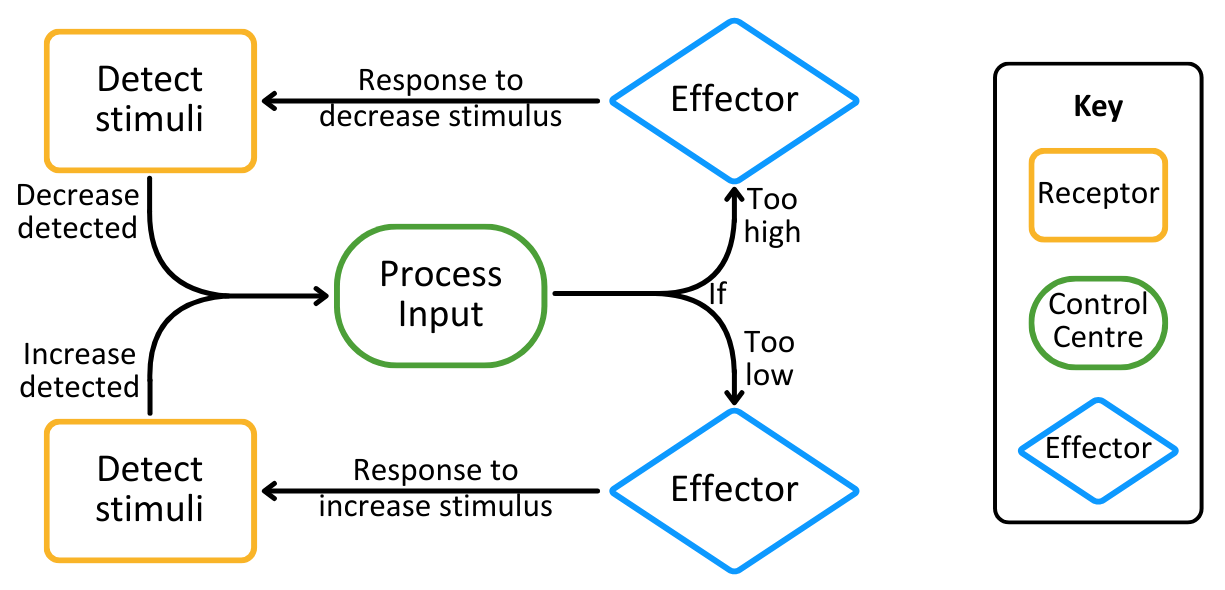
Negative feedback typically follows the following pathway:
Stimulus → Receptor → Control Centre* → Effector → Response
* Also called the coordinator.
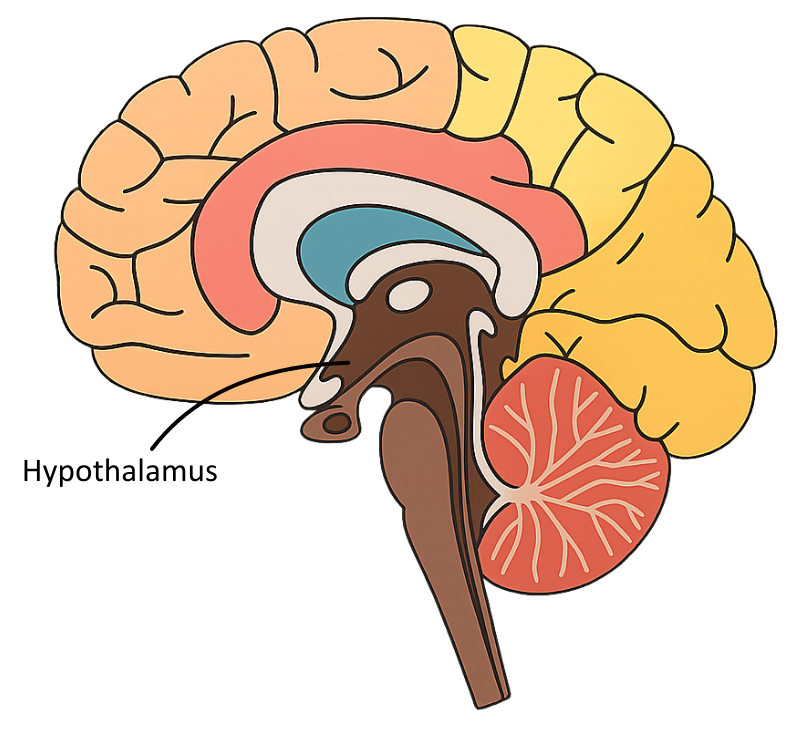
It is useful to know that the control centre for many homeostatic responses in animals is the hypothalamus, a small, central region of the brain.
The diagram below shows the position of the hypothalamus:
The diagram below shows a typical flowchart showing the process of negative feedback:
The table below outlines some examples of receptors involved in homeostatic processes:
| Receptor | Stimulus Detected | Location | Homeostatic Process |
|---|---|---|---|
| Thermoreceptors | Core body/blood temperature | Hypothalamus | Thermoregulation |
| Chemoreceptors | CO2 concentration, pH of blood | Carotid bodies and medulla oblongata | Control of ventilation rate and depth |
| Osmoreceptors | Blood water potential (solute concentration) | Hypothalamus | Osmoregulation |
| Glucose receptors | Blood glucose concentration | Pancreas (islets of Langerhans) | Blood glucose regulation |
All of the examples above measure internal stimuli. Receptors which detect external stimuli are less directly involved in homeostatic mechanisms.
The table below outlines some examples of effectors involved in homeostatic processes:
| Effector | Type | Main Actions | Homeostatic Process |
|---|---|---|---|
| Skeletal muscle | Muscle | Contracts rapidly to generate heat. | Thermoregulation. |
| Cardiac muscle | Muscle | Adjusts rate and force of contraction. | Heart rate regulation via the autonomic nervous system and hormones (e.g. adrenaline). |
| Pancreatic cells | Endocrine gland |
|
Blood glucose regulation. |
| Collecting duct cells | Epithelial tissue | Insert/remove aquaporins to alter water reabsorption rate. | Osmoregulation. |
| Adrenal gland | Endocrine gland | Secretes adrenaline:
|
Fight-or-flight response; short-term stress response. |
Positive Feedback
Positive feedback takes action to amplify any change away from the set point, stopping only when a limiting factor is reached or an external event occurs.
Positive feedback processes are uncommon in biological systems, as they are destabilising; however, they have their uses.
The table below outlines three examples of positive feedback:
| Example | Stimulus | Response | Stopping Point |
|---|---|---|---|
| Labour | Cervical stretch during childbirth. | Hypothalamus signals the posterior pituitary to release oxytocin, causing stronger uterine contractions and more stretching. | More stretch → more oxytocin → stronger contractions until baby is delivered. |
| Blood clotting | Platelet activation at the site of vessel damage. | Platelets release clotting factors, which activate more platelets and trigger an enzyme cascade. | Rapid amplification of clotting until a stable clot forms. |
| Action potential | Initial depolarisation of the membrane. | Voltage-gated Na+ channels in the axon open, Na+ depolarises the membrane further. | More Na+ channels open until full depolarisation is reached. |