
Free Mammalian Gaseous Exchange System OCR A Level Biology revision notes – covering specification points 3.1.1(a), 3.1.1(b), 3.1.1(c) and 3.1.1(f).
Want to go deeper?
Gaseous Exchange
For the effective exchange of oxygen and carbon dioxide, mammals have a highly specialised gaseous exchange system consisting of a series of airways that filter, warm, and moisten air before it reaches the alveoli.
The pathway that air follows during inhalation is:
Nasal cavity → Trachea → Bronchi → Bronchioles → Alveoli
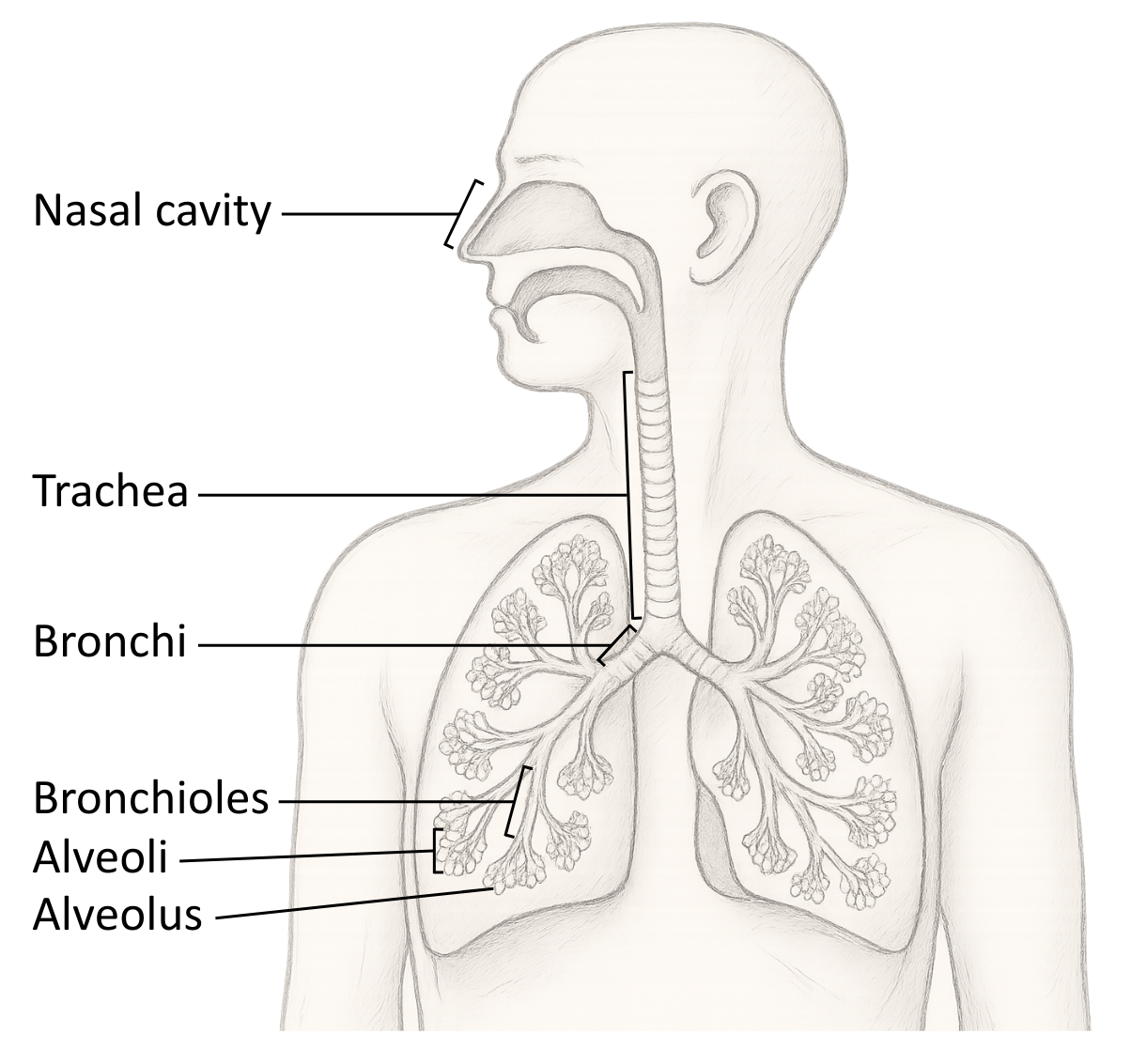
The table below provides an overview of some functions and features of these structures:
| Part | Structure | Function(s) |
|---|---|---|
| Trachea |
– Single-wide tube supported by C-shaped cartilage rings. – Lined with ciliated epithelium and goblet cells. – Contains smooth muscle and elastic fibres. |
– Cartilage prevents the collapse of the airway. – Cilia and mucus trap and remove debris. – Smooth muscle regulates airway diameter. – Elastic fibres recoil after stretching. |
| Bronchi |
– Two tubes branching from the trachea into each lung. – Supported by cartilage plates. – Lined with ciliated epithelium and goblet cells. – Contains smooth muscle and elastic fibres. |
– Cartilage prevents airway collapse. – Cilia and mucus trap and remove debris and microorganisms. – Smooth muscle controls airway diameter. – Elastic fibres provide recoil after stretching. |
| Bronchioles |
– Narrower tubes containing smooth muscle and elastic fibres. – Ciliated epithelium and goblet cells are present in larger bronchioles. |
– Elastic fibres help keep airways open and allow recoil after stretching. – Cilia and mucus trap and remove debris and microorganisms. |
| Alveoli |
– Large surface area with an extensive capillary network. – Short diffusion distance (~0.5 μm). – Microscopic air sacs with squamous epithelium and many elastic fibres. |
– Main site of gas exchange. – Elastic fibres allow recoil to expel air during exhalation. |