
Free Prokaryotic Cell Structure OCR A Level Biology revision notes – covering specification point 2.1.1(k).
Want to go deeper?
Prokaryotic Organisms
Prokaryotic organisms are defined by their lack of membrane-bound organelles, such as a nucleus.
Their DNA, typically in the form of a single circular chromosome, is free-floating in the cytoplasm in a region called the nucleoid.
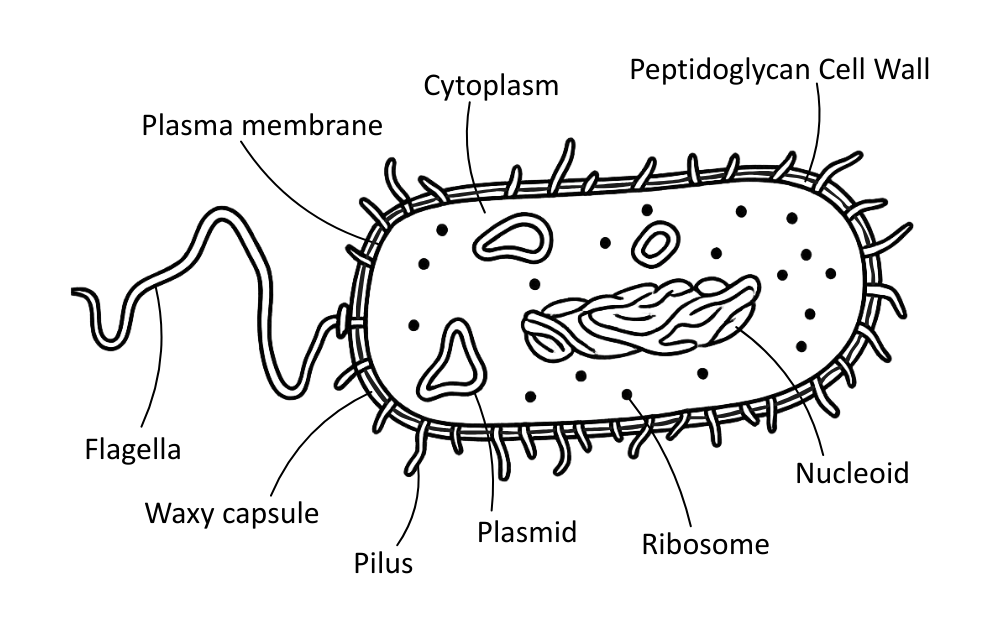
The table below outlines the cell structures that can be found in prokaryotic cells:
| Cell Structure | Structure | Function |
|---|---|---|
| Cell Wall | Made of peptidoglycan in bacteria, it varies in Archaea. |
Provides mechanical support and protection. Prevents lysis when the cell is turgid. |
| Cytoplasm | Gel-like substance with dissolved solutes. | Site of metabolic reactions. |
| Ribosomes (70S) | Made of RNA. | Synthesises proteins from mRNA. |
| Nucleoid | Region of the cytoplasm with a circular chromosome (naked, no histones). |
Contains genes. Controls cell activity via mRNA for protein synthesis. |
| Plasmids | Small circular DNA loops in the cytoplasm. | Carry extra genes that can be shared via conjugation. |
| Flagella | Long whip-like structure. |
Moves the cell. Enables chemotaxis. |
| Pili | Short, needle-like protein projections. |
Attach to surfaces or other cells. Share plasmids by conjugation. |
| Capsule | A thick waxy layer outside the cell wall. | Prevents drying out. |